Paint Protection Basics: How to Protect Your Car’s Paint
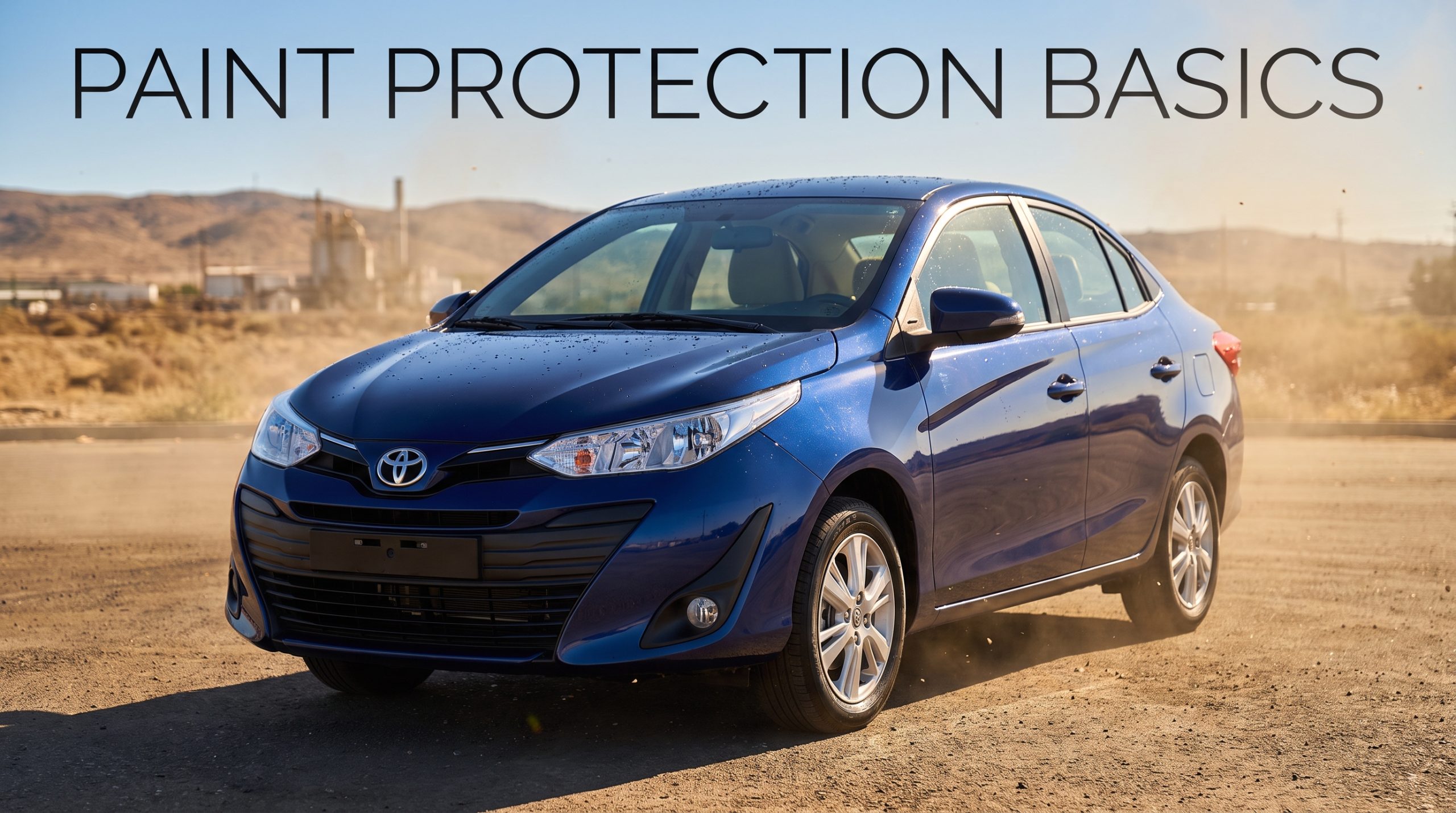
A freshly washed car can look excellent in the morning and already have a layer of dust, fingerprints, water spots, or road grime by the evening.
That is normal.
Your car’s paint is constantly exposed to sunlight, dust, rain, road contamination, insects, bird droppings, and the physical contact involved in washing and drying. Over months and years, poor maintenance can turn a glossy finish into a dull-looking one.
The good news is that protecting your paint doesn’t necessarily mean spending a large amount of money on professional detailing. The foundation is much simpler: wash correctly, minimize unnecessary friction, remove contamination promptly, dry safely, and choose a protection method appropriate for your needs.
In this guide, we’ll explain what paint protection actually means, the major protection methods, common mistakes, and a practical paint-care routine you can follow at home.
What Is Car Paint Protection?
Car paint protection means taking steps to reduce the effect of environmental contamination, UV exposure, washing-related damage, and everyday wear on your vehicle’s painted surfaces.
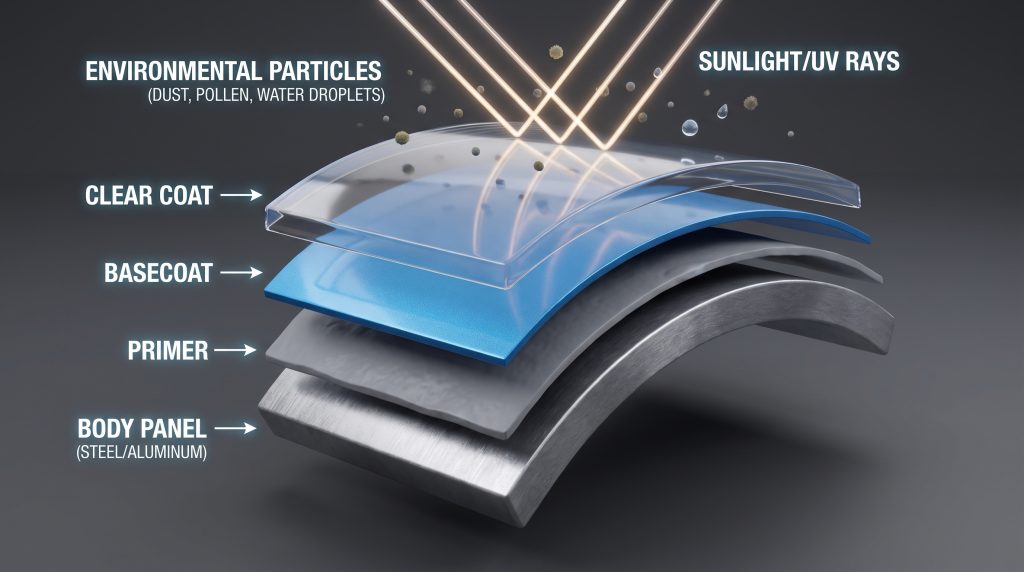
A modern automotive paint system typically consists of multiple layers, including primer, the colored basecoat, and an outer clear coat. That clear coat is the transparent layer that contributes significantly to the surface’s gloss and protects the underlying color layer.
Think of it like the transparent outer skin of your car.
If you repeatedly wash the vehicle incorrectly, wipe abrasive dust across it, leave aggressive contaminants on the surface, or expose it to harsh conditions without proper maintenance, the finish can gradually lose its original appearance.
What Does Paint Protection Actually Do?
Depending on the method, paint protection can help:
- Reduce direct exposure to contaminants
- Make routine cleaning easier
- Maintain gloss and appearance
- Reduce the effects of everyday environmental exposure
- Reduce the chance of washing-related surface marks
- Provide additional physical protection when a film such as PPF is used
However, there is an important distinction:
Paint protection does not make your car completely scratch-proof or damage-proof.
A wax, sealant, ceramic coating, and paint protection film all work differently.
What Can Damage Your Car’s Paint?
Understanding the threats makes it easier to understand why a protection routine matters.
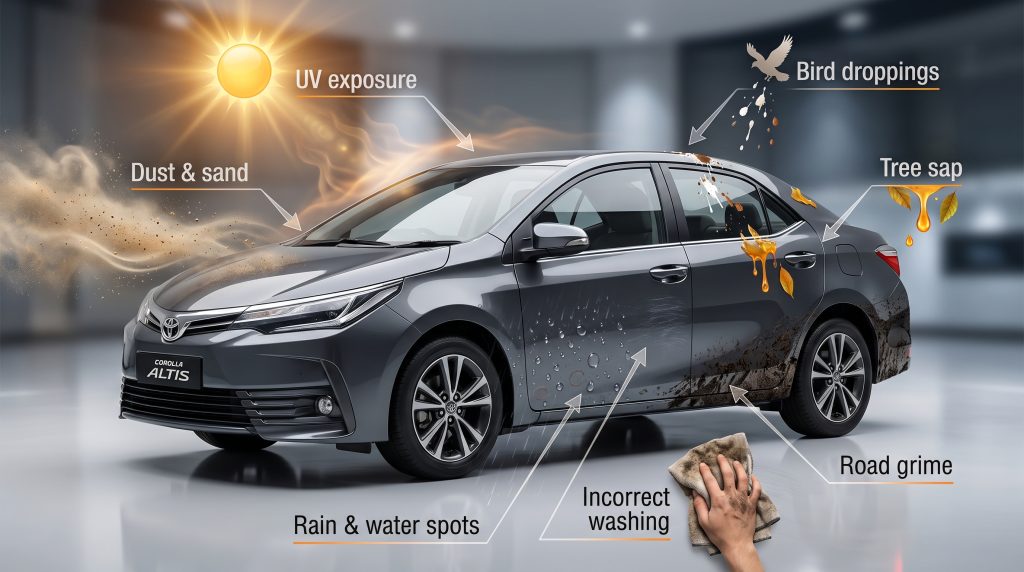
1. Sunlight and UV Exposure
A car parked outside for several hours every day receives repeated exposure to sunlight and ultraviolet radiation.
Over long periods, UV exposure and weathering can contribute to deterioration of automotive finishes. This is one reason outdoor parking can be harder on a vehicle’s appearance than covered or garage parking.
For example, imagine two otherwise identical cars:
- Car A: parked outdoors most days
- Car B: parked under cover most days
Both cars may be washed regularly, but their overall exposure to sunlight and weathering will be different.
Parking in shade or a garage whenever practical is therefore one of the simplest forms of passive paint protection.
For Pakistan-specific conditions, FuelX already has a dedicated guide covering protection from dust and sunlight, so this article focuses on the broader paint-protection framework rather than repeating that article.
2. Dust, Sand, and Road Grime
Dust sitting on your car isn’t automatically the same thing as paint damage.
The bigger issue is friction.
Imagine a thin layer of dusty road grime sitting on your bonnet. If you take a dry cloth and rub across that surface, the particles trapped between the cloth and paint can be dragged across the clear coat.
Repeated over hundreds of cleaning cycles, unnecessary friction can contribute to fine scratches and swirl marks.
This is why a proper pre-rinse is important.
Instead of immediately wiping the surface, first try to remove as much loose contamination as possible.
A simple example
Suppose your car has accumulated a visible layer of dust after several days of driving.
Riskier approach:
Dry cloth → aggressive wiping → dust moves across paint
Better approach:
Rinse → loosen contamination → wash → rinse → dry
The second process reduces unnecessary contact with loose abrasive material.
3. Bird Droppings and Tree Sap
Bird droppings, tree sap, insects, and similar contaminants should not be allowed to sit on painted surfaces unnecessarily.
As contaminants dry, they can become harder to remove, encouraging people to scrub more aggressively.
The better approach is generally to soften and remove the contamination rather than attack it with force.
For example, if you discover a dried bird dropping on the bonnet:
- Don’t immediately scrape it off dry.
- Soften the area with an appropriate cleaning method.
- Gently remove the contamination.
- Rinse or clean the area.
- Dry with a clean microfiber towel.
FuelX’s existing bird-dropping guide also emphasizes careful removal and notes that a quick detailer cannot simply repair clear-coat etching that has already occurred.
4. Rain and Water Spots
Rain doesn’t necessarily clean your car.
Rainwater can pick up airborne contaminants before reaching the vehicle. Once water evaporates, dissolved minerals can remain behind as visible deposits.
You may have seen this yourself:
The car gets wet during rain → water dries → circular or irregular marks remain on the paint.
Those marks are commonly referred to as water spots.
This is one reason drying the vehicle after washing or heavy rain can be useful, particularly where local water contains significant mineral content.
5. Incorrect Washing
Some paint damage isn’t caused by the environment at all.
It happens during cleaning.
Common examples include:
- Wiping a heavily dusty car while dry
- Using a dirty wash mitt
- Using contaminated towels
- Using the same towel for tyres and paint
- Scrubbing aggressively
- Allowing shampoo or dirty water to dry on the surface
- Washing on an extremely hot panel
- Using unsuitable household cleaners
This leads to one of the most important principles of paint protection:
A good product cannot compensate for poor washing technique.
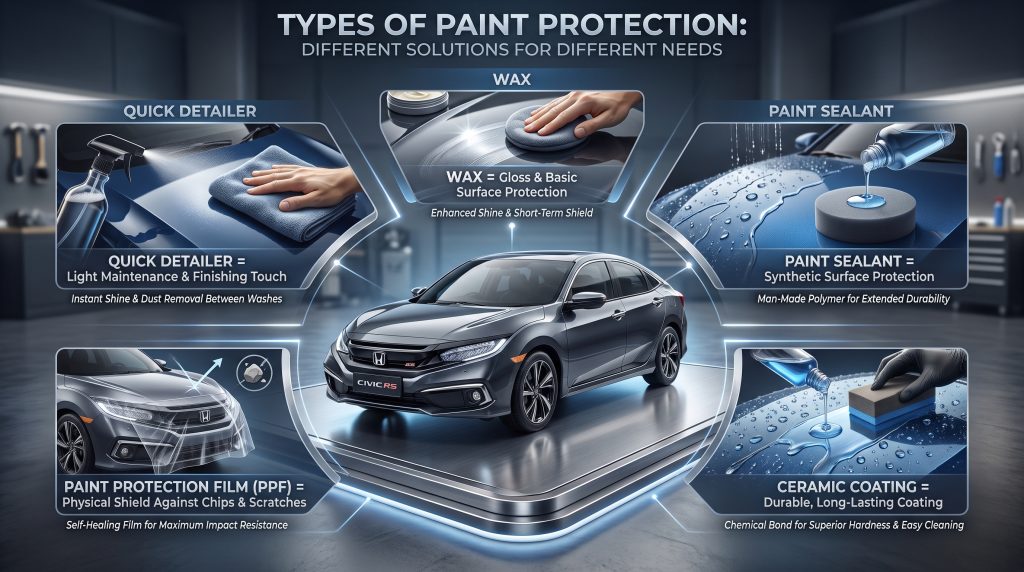
The Main Types of Paint Protection
There isn’t one universal paint-protection solution.
Different methods provide different kinds of protection.
Wax
Car wax is one of the traditional ways to add a protective layer while enhancing the appearance of automotive paint.
Depending on the formulation, wax can provide:
- Gloss enhancement
- Water-beading characteristics
- A temporary protective layer
- A smoother-looking finish
Wax is popular with DIY enthusiasts because the process is relatively straightforward.
However, wax isn’t permanent.
Its performance gradually decreases with washing, weather exposure, and normal use, so it needs to be maintained according to the specific product’s instructions.
Example
If you enjoy detailing your car yourself and don’t mind periodically applying a protection product, wax can be part of a straightforward maintenance routine.
Paint Sealants
Paint sealants are synthetic products designed to provide surface protection.
They are often chosen by car owners looking for protection that lasts longer than a typical traditional wax application.
However, there is no single lifespan that applies to every sealant.
Actual durability depends on:
- Product formulation
- Surface preparation
- Washing frequency
- Weather exposure
- Parking conditions
- Washing chemicals
- Application quality
So be careful with claims such as “one application protects your paint for exactly X months.” The manufacturer’s own specification should be the reference point.
Ceramic Coatings
Ceramic coatings are designed to form a durable protective layer over automotive paint.
Depending on the coating system, benefits can include:
- Water-repellent behavior
- Easier maintenance
- Gloss enhancement
- Longer-lasting surface protection
But ceramic coating is frequently misunderstood.
Ceramic coating does not mean scratch-proof paint.
A coating may improve resistance to certain forms of surface wear, but it cannot guarantee protection against:
- Stone impacts
- Deep scratches
- Accidents
- Severe abrasion
- Poor washing technique
Think of ceramic coating as surface protection, not an invisible force field.
It also doesn’t eliminate maintenance. A coated vehicle still needs proper washing and drying.
Paint Protection Film (PPF)
Paint Protection Film is fundamentally different from wax and coatings.
Instead of applying a liquid or coating to the paint, PPF adds a transparent physical film over the surface.
For example, 3M’s Paint Protection Film is designed to protect automotive surfaces against hazards including stone chips, scratches, road tar, bug damage, stains, and UV-related weathering.
This makes PPF particularly relevant for areas that receive physical impact, such as:
- Front bumper
- Hood
- Side mirrors
- Door edges
- Rocker panels
Some modern PPF products also include self-healing technology for certain minor marks when heat is applied. 3M’s Series 100, for example, lists self-healing properties and a seven-year warranty.
PPF is therefore not simply a more expensive wax.
It solves a different problem.
Quick Detailers
Quick detailers are another commonly misunderstood category.
A quick detailer is primarily a maintenance and finishing product.
It can be useful for:
- Light dust
- Fingerprints
- Smudges
- Minor fresh contamination
- Gloss enhancement
- Quick touch-ups between washes
FuelX Quick Detailer is specifically marketed for light dust, fingerprints and light dirt, while its usage instructions say heavy dirt should be removed before application.
That distinction matters.
Don’t do this:
Muddy car → spray quick detailer → aggressively wipe
Do this:
Heavily dirty car → proper wash → dry → use quick detailer if appropriate
For light dust between washes, however, a quick detailer can be a convenient maintenance step.
Paint Protection Methods Compared
| Protection Method | Main Purpose | Maintenance | Best Suited For |
| Wax | Gloss + basic surface protection | Periodic reapplication | DIY owners |
| Paint Sealant | Synthetic surface protection | Periodic maintenance | Owners wanting longer-lasting protection |
| Ceramic Coating | Durable surface protection | Ongoing maintenance | Enthusiasts wanting a coating system |
| PPF | Physical protection | Film-specific maintenance | Impact-prone areas |
| Quick Detailer | Light cleaning + finishing | Frequent/as needed | Between-wash maintenance |
The important question isn’t:
“Which one is best?”
Instead ask:
“Which type of protection matches the problem I am trying to solve?”
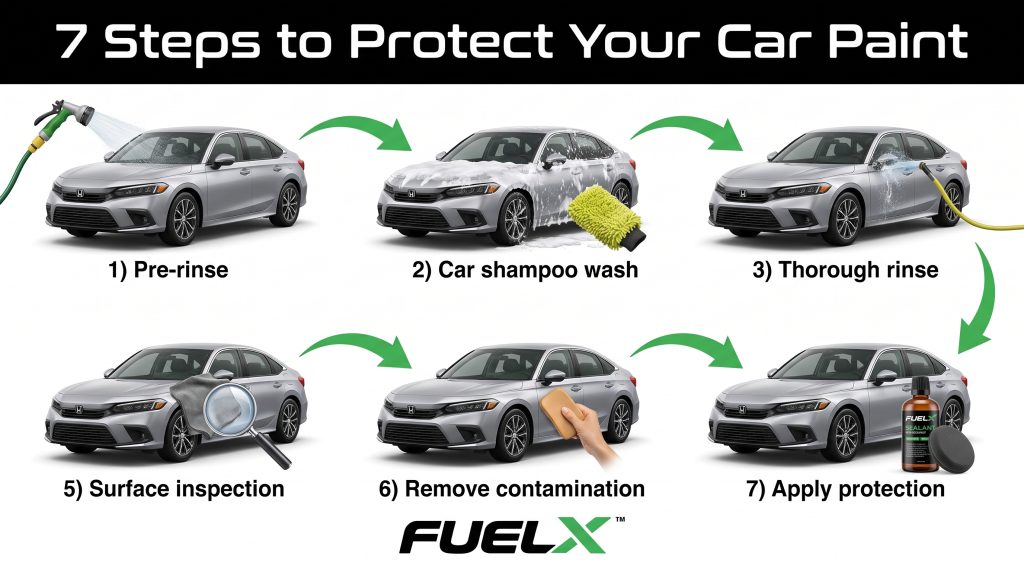
How to Protect Your Car Paint at Home
You can build a good paint-care routine without professional equipment.
The basics are surprisingly simple.
Step 1: Pre-Rinse the Vehicle
Start by removing loose dust, mud, sand, and road grime with clean water.
This reduces the amount of loose contamination that your wash mitt or sponge has to physically move across the paint.
FuelX’s Car Wash Shampoo instructions also begin with a pre-rinse before washing.
Step 2: Use a Dedicated Car Shampoo
Use a shampoo formulated for automotive surfaces.
Avoid assuming that a household cleaning product is suitable for automotive paint simply because it removes dirt effectively.
FuelX Car Wash Shampoo, for example, is marketed as a pH-neutral automotive shampoo and is intended to remove dirt, dust, mud, and road grime while maintaining the vehicle’s finish.
A practical washing sequence
- Pre-rinse the vehicle.
- Prepare the shampoo solution according to the product instructions.
- Use a clean wash mitt or suitable sponge.
- Work from cleaner upper areas toward dirtier lower areas.
- Rinse the wash media regularly.
- Rinse the vehicle thoroughly.
The objective is simple:
Remove contamination while minimizing unnecessary friction.
Step 3: Rinse Thoroughly
Once washing is complete, rinse away the remaining shampoo and loosened contamination.
Don’t allow shampoo residue to dry unnecessarily on the surface.
If you’re washing in strong sunlight, work efficiently and avoid letting individual panels remain wet with product for too long.
Step 4: Dry With a Clean Microfiber Towel
Drying is often treated as an afterthought.
It shouldn’t be.
If water is allowed to evaporate on the surface, minerals can remain behind as spots. And if you use a dirty or rough towel, you’re introducing another source of friction.
Use a clean microfiber towel suitable for automotive surfaces.
FuelX’s own wash instructions recommend drying the vehicle with a clean microfiber cloth after rinsing.
A simple rule:
Don’t use a towel on your paint if you wouldn’t trust it on your own eyeglasses.
If it is visibly dirty, contaminated, or has been used on very dirty surfaces, wash it before using it again on paint.
Step 5: Inspect the Surface
After drying, don’t immediately put another product on the car.
Take a minute to inspect the paint.
Look for:
- Water spots
- Bird droppings
- Tree sap
- Tar
- Remaining road grime
- Scratches
- Swirl marks
- Dull areas
This prevents the common mistake of applying more product when the actual problem requires cleaning or paint correction.
Step 6: Use a Quick Detailer for Light Maintenance
If your car is already relatively clean and only has light dust or fingerprints, a quick detailer can be useful.
FuelX recommends removing heavy dirt first, then lightly applying its Quick Detailer and wiping gently with a clean microfiber cloth before buffing with the dry side.
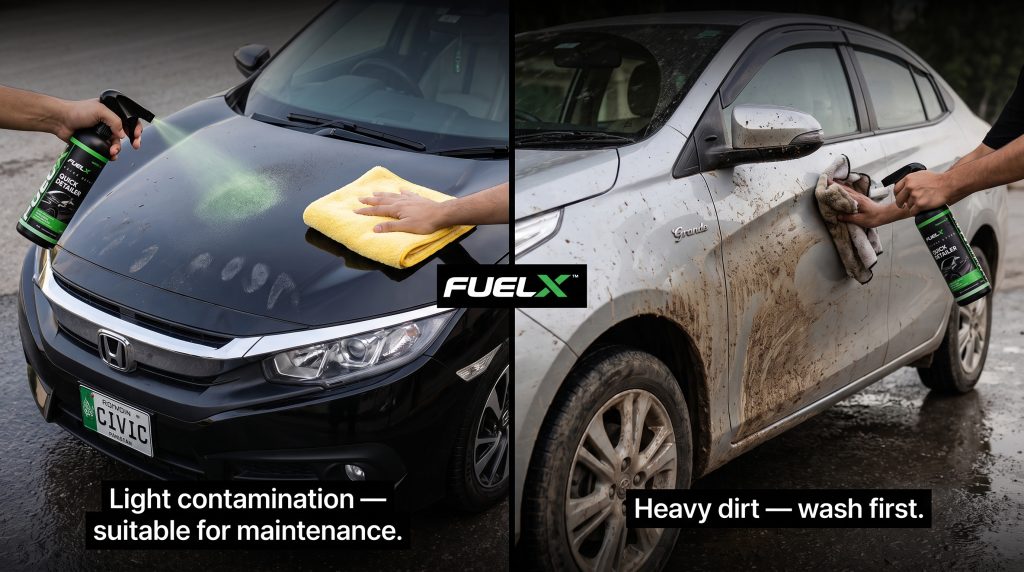
For example:
Morning commute → light dust → quick detailer
can be reasonable.
But:
Rainy/muddy road → thick mud → quick detailer
is not a substitute for a proper wash.
Step 7: Choose Your Long-Term Protection
Once your paint is clean and properly maintained, decide whether you actually need an additional protection system.
You might choose:
- Wax for simple periodic protection
- Sealant for synthetic surface protection
- Ceramic coating for a longer-term coating system
- PPF for physical impact protection
Your decision should depend on your driving, parking, budget, maintenance habits, and expectations.
How Often Should You Protect Your Car’s Paint?
There is no universal “every seven days” or “every 30 days” rule that applies to every protection product.
Your ideal routine depends on:
- How often you drive
- Where you park
- Local weather
- Dust exposure
- Rain
- Road conditions
- Existing protection
- Washing frequency
For example, a car driven daily through dusty urban traffic may need more frequent washing than a weekend car parked indoors.
FuelX currently recommends washing its exterior-care products around 1–2 times per week, with more frequent washing in dusty conditions. Treat that as a practical maintenance guideline rather than a universal rule for every vehicle and environment.
A practical beginner routine
Regularly:
Inspect the car and remove fresh contamination.
When dirty:
Wash rather than repeatedly wiping heavy contamination.
After washing:
Dry thoroughly.
Between washes:
Use a suitable quick detailer for light contamination when appropriate.
Periodically:
Reassess your wax, sealant, coating, or other protection according to the manufacturer’s instructions.
Common Paint Protection Mistakes
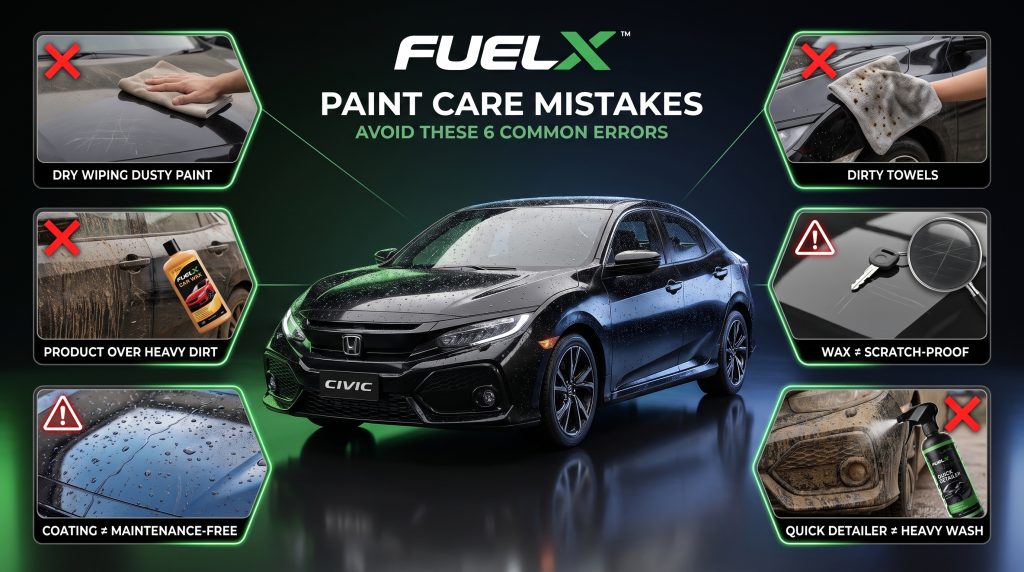
Mistake 1: Wiping Dust From a Dry Car
This is one of the easiest ways to create unnecessary friction.
If the vehicle is visibly dusty, wash it properly instead of aggressively wiping the entire surface dry.
Mistake 2: Using Dirty Microfiber Towels
Microfiber doesn’t automatically mean scratch-free.
A towel covered in dirt and grit can transfer contamination back to your paint.
Keep separate towels for:
- Paint
- Glass
- Tyres
- Interior
- Dirty lower panels
This simple organization can make your detailing routine safer.
Mistake 3: Applying Products to Heavy Dirt
A protection product cannot replace basic cleaning.
If your vehicle has mud and thick road grime, wash it first.
Mistake 4: Thinking Wax Makes Paint Scratch-Proof
Wax adds a protective layer and can improve appearance, but it doesn’t prevent every scratch.
A branch, stone, key, aggressive washing technique, or accident can still damage paint.
Mistake 5: Assuming Ceramic Coating Means No Maintenance
A ceramic coating isn’t an excuse to stop washing the vehicle.
Contaminants still land on the surface.
Regular maintenance remains necessary.
Mistake 6: Using Quick Detailer on Heavy Dirt
FuelX specifically instructs users to remove heavy dirt before using its Quick Detailer.
If you can visibly see mud, thick road grime, or substantial contamination, wash the vehicle first.
Mistake 7: Washing on Extremely Hot Surfaces
When panels are extremely hot, water and cleaning products can evaporate quickly.
Whenever practical, wash in shade or during a cooler part of the day and follow the instructions provided with your chosen products.
Does Paint Protection Prevent Scratches?
Not all protection methods provide the same kind of protection.
Wax or sealant
Primarily provides surface protection and appearance enhancement.
Ceramic coating
Provides a more durable protective surface but does not guarantee scratch prevention.
PPF
Adds an actual physical film over the paint and is specifically designed to protect against certain physical hazards such as stone chips and scratches.
This gives us a useful distinction:
Surface protection and physical impact protection are not the same thing.
If a car regularly travels on roads where stones and road debris strike the front end, PPF addresses a different problem from the one addressed by wax or a quick detailer.
Paint Protection for Cars in Pakistan
Pakistan’s environmental conditions can make consistent exterior maintenance particularly important.
Depending on the city and driving conditions, a vehicle may experience:
- Dust
- Sand
- Strong sunlight
- Traffic pollution
- Rain
- Mud
- Water spots
- Outdoor parking
But the solution isn’t to continuously apply more detailing products.
The foundation remains:
Wash safely → dry properly → remove contamination promptly → protect appropriately → maintain consistently.
FuelX positions its exterior range specifically around everyday cleaning and maintenance, including conditions involving heat and dust.
For a deeper discussion of Pakistan-specific sun and dust exposure, readers can refer to FuelX’s dedicated paint-protection guide.
Which Paint Protection Method Is Right for You?
Instead of looking for one universal answer, match the method to your needs.
If You Want Simple DIY Paint Care
Start with:
- Proper washing
- Automotive shampoo
- Clean microfiber towels
- Safe drying
- Regular maintenance
This is the foundation regardless of whether you eventually choose wax, ceramic coating, or PPF.
If You Want Traditional DIY Protection
Wax or a suitable sealant may fit your routine.
This is particularly practical if you enjoy maintaining your car yourself and don’t mind periodically reapplying protection.
If You Want Long-Term Coating Protection
A ceramic coating may be appropriate if you want a dedicated coating system and are prepared to maintain it correctly.
Don’t choose it simply because you expect it to make the vehicle scratch-proof.
If Physical Impact Protection Is the Priority
PPF is the relevant category.
It creates a physical barrier over the paint and is specifically designed for hazards such as stone chips and road debris.
If You Want Quick Maintenance Between Washes
A quick detailer is useful when the vehicle is already relatively clean and needs a light touch-up.
FuelX Quick Detailer is positioned for light dust, fingerprints, smudges, and quick gloss maintenance.
Where FuelX Products Fit Into a Paint-Care Routine
FuelX’s exterior-care range currently includes Car Wash Shampoo, Quick Detailer, Glass Cleaner, and Tyre Shiner.
These products fit into the everyday maintenance side of paint care rather than replacing specialist treatments such as PPF.
FuelX Car Wash Shampoo
This belongs at the washing stage.
The product is designed to remove dust, dirt, mud, and road grime, and FuelX recommends pre-rinsing, washing from top to bottom, rinsing thoroughly, and drying with a clean microfiber cloth.
FuelX Quick Detailer
This fits into the maintenance stage.
It can be used for light dust, fingerprints, smudges, and quick appearance touch-ups when the vehicle isn’t heavily dirty.
FuelX Exterior Shine Kit
For owners who want multiple exterior-care products together, the Exterior Shine Kit combines the washing and finishing stages, including Car Wash Shampoo, Quick Detailer, and Tyre Shiner. FuelX’s instructions follow the sequence of pre-rinse → wash → rinse → dry → Quick Detailer.
This makes it useful as a routine-oriented exterior-care package, rather than simply another individual detailing product.
The FuelX Box
For owners wanting a broader home car-care setup, The FuelX Box includes:
- Car Wash Shampoo
- Glass Cleaner
- Quick Detailer
- Tyre Shiner
- Multi-Purpose Cleaner
It therefore covers both exterior and interior maintenance.
Again, these products should be viewed as tools for routine car care. They are not substitutes for PPF or a professionally applied ceramic coating.
A Simple Paint Protection Routine for Beginners
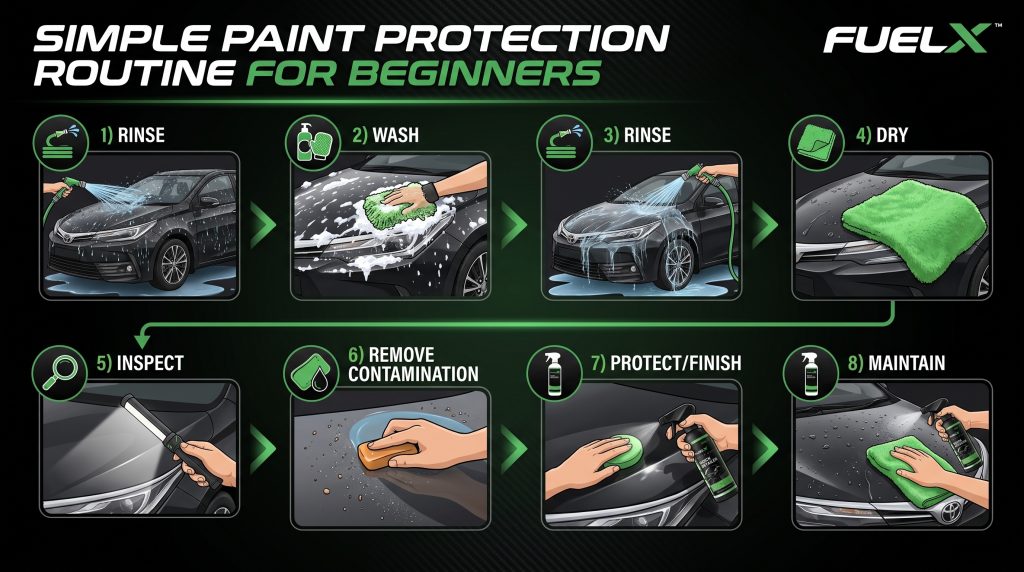
If you’re new to detailing, don’t start by buying ten different products.
Start with a repeatable process.
1. Rinse
Remove loose dust, sand, mud, and road grime.
↓
2. Wash
Use a dedicated automotive shampoo.
↓
3. Rinse
Remove shampoo and loosened contamination.
↓
4. Dry
Use a clean microfiber towel.
↓
5. Inspect
Look for water spots, bird droppings, sap, scratches, and remaining contamination.
↓
6. Remove Contamination
Use an appropriate method instead of aggressive rubbing.
↓
7. Protect or Finish
Use wax, sealant, ceramic coating, PPF, or a suitable maintenance product depending on your objective.
↓
8. Maintain
Keep the vehicle clean and address new contamination before it becomes difficult to remove.
This process may sound basic, but consistency matters more than having a garage full of products.
Final Thoughts
Paint protection isn’t one magic product.
It is a system of good habits and appropriate protection.
Start with the fundamentals: rinse away loose contamination, wash with a suitable automotive shampoo, avoid unnecessary friction, rinse thoroughly, and dry using a clean microfiber towel.
Then deal with contamination such as bird droppings, tree sap, and water spots promptly.
Once those fundamentals are in place, choose the protection method that matches your needs.
For straightforward DIY care, regular washing and maintenance may be enough. Wax or sealants can provide periodic surface protection. Ceramic coatings offer a more durable coating approach, while PPF provides a physical film designed to protect vulnerable painted areas from impacts such as stone chips.
For everyday maintenance, FuelX’s exterior-care range provides products for the practical stages of washing, light detailing, and exterior finishing.
The most important lesson is simple:
Protecting your car’s paint isn’t about using the most products. It’s about using the right method consistently.
A clean car isn’t necessarily a protected car—but a car that is washed correctly, dried safely, maintained regularly, and protected according to its environment has a much better chance of keeping its finish looking good for years.
FAQ’s
What is the easiest way to protect car paint?
Start with correct washing and drying.
Use automotive shampoo, clean microfiber towels, avoid aggressive dry wiping, and remove bird droppings and other contaminants promptly.
Does car wax protect paint?
Yes. Wax can provide a temporary protective layer and improve gloss, but it isn’t permanent and does not make the paint scratch-proof.
Is ceramic coating better than wax?
They are different types of protection.
Wax is generally a simpler, periodic DIY protection method, while ceramic coatings are designed to provide a more durable coating.
The right choice depends on your maintenance expectations, budget, vehicle use, and the specific products being considered.
Does ceramic coating prevent scratches?
No.
Ceramic coatings can provide additional surface protection, but they cannot guarantee protection against every scratch, stone impact, accident, or improper washing technique.
Is PPF worth considering for a car?
PPF is specifically designed to provide a physical barrier against hazards such as stone chips, scratches, road debris, and certain environmental contaminants.
It is therefore particularly relevant when physical impact protection is a priority.
Can a quick detailer protect car paint?
A quick detailer can help maintain the surface and improve gloss, and some formulations provide light protective characteristics.
Its main purpose, however, is convenient maintenance between washes.
Can I use quick detailer instead of washing my car?
Not when the car is heavily dirty.
FuelX specifically instructs users to remove heavy dirt before using its Quick Detailer.
If the vehicle has mud or substantial road grime, wash it properly.
How often should I protect my car paint?
There isn’t one universal schedule.
Washing frequency depends on how often you drive, where you park, weather, dust exposure, and the condition of the vehicle.
For protection products such as wax, sealants, or coatings, follow the manufacturer’s application and maintenance instructions.
Does sunlight damage car paint?
Long-term UV and weather exposure can contribute to deterioration of automotive finishes.
Reducing unnecessary exposure through shade or covered parking and maintaining the paint properly can help preserve its appearance.
Does dust scratch car paint?
Dust sitting on the surface isn’t itself the same thing as a scratch.
The concern is dragging abrasive contamination across the paint.
This is why dry wiping a heavily dusty car can be a poor practice.
About FuelX Research & Detailing Lab
FuelX engineers high-performance automotive cooling solutions and specialized car detailing products engineered for Pakistan's demanding driving conditions. All guides and tips are validated by our technical team to ensure engine longevity and lasting vehicle protection.
Keep Your Engine Cool & Your Ride Shining
Shop FuelX certified Long Life Coolants, high-gloss tyre shine, safe car wash shampoo, and lint-free microfiber accessories.