Wash Method Showdown: One-Bucket vs Two-Bucket vs Foam Cannon
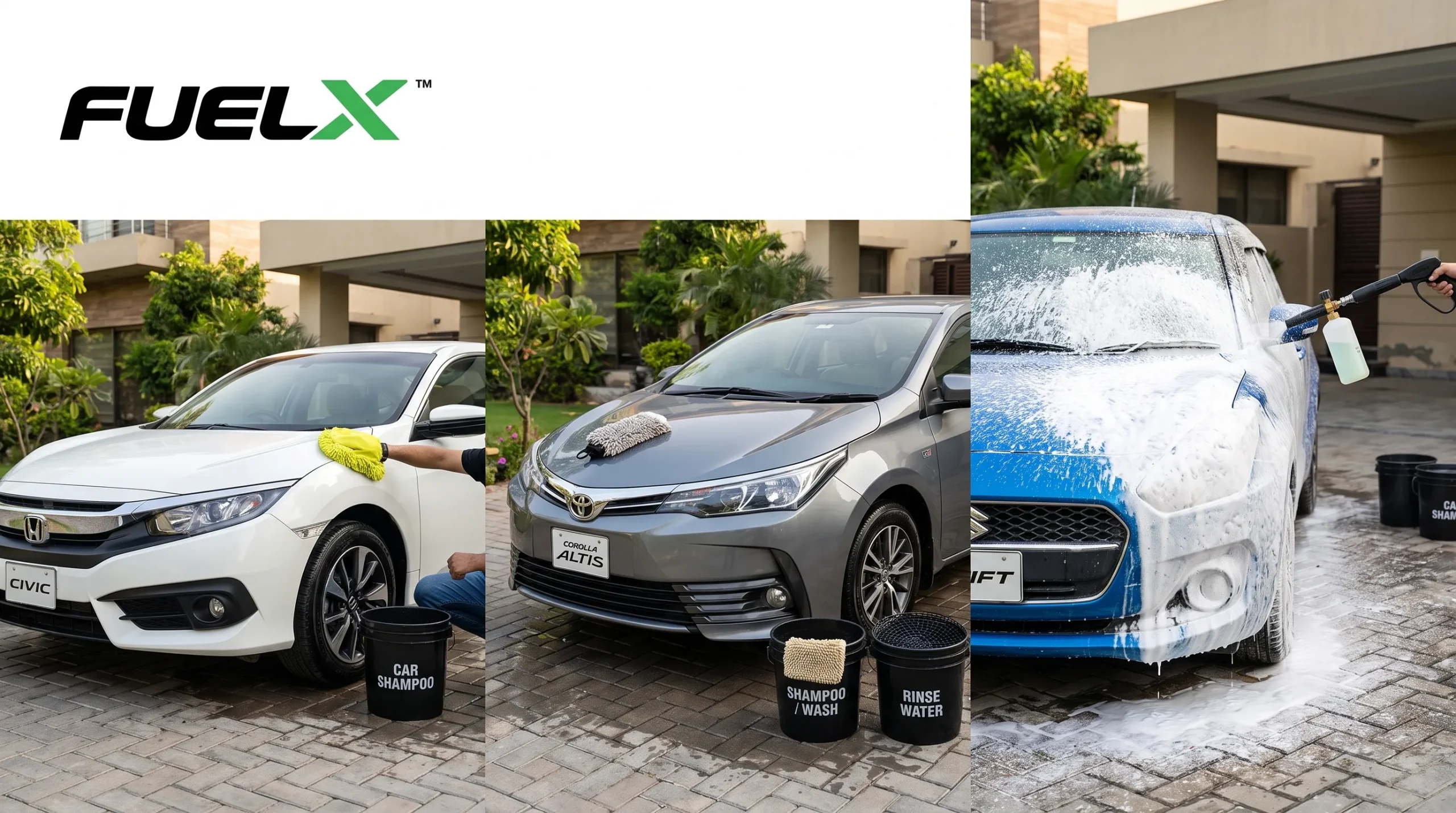
Washing a car looks simple: add shampoo, grab a mitt, rinse the car and dry it.
But the method you use can make a meaningful difference to how much dirt is dragged across the paint.
Every time you make contact with a dirty vehicle, you are dealing with dust, sand, road film, mud and other contaminants. If those particles become trapped in your wash mitt and are repeatedly rubbed against the paint, they can contribute to fine scratches and swirl marks over time.
This matters even more in Pakistan, where cars can face heavy dust, road grime, intense summer heat and muddy conditions during the monsoon.
So which method should you use?
- One bucket?
- Two buckets?
- Foam cannon plus two buckets?
The answer depends on how dirty your car gets, how often you wash it, how much equipment you have and how much control you want over contamination.
Let’s put the three methods head-to-head.
Why Your Car Wash Method Matters
Your car’s clear coat is designed to protect the paint underneath, but it isn’t immune to abrasion.
A vehicle that has been driven for several days may have a mixture of:
- Fine road dust
- Sand and grit
- Mud
- Brake dust
- Pollution
- Insects
- Bird droppings
- Oily road film
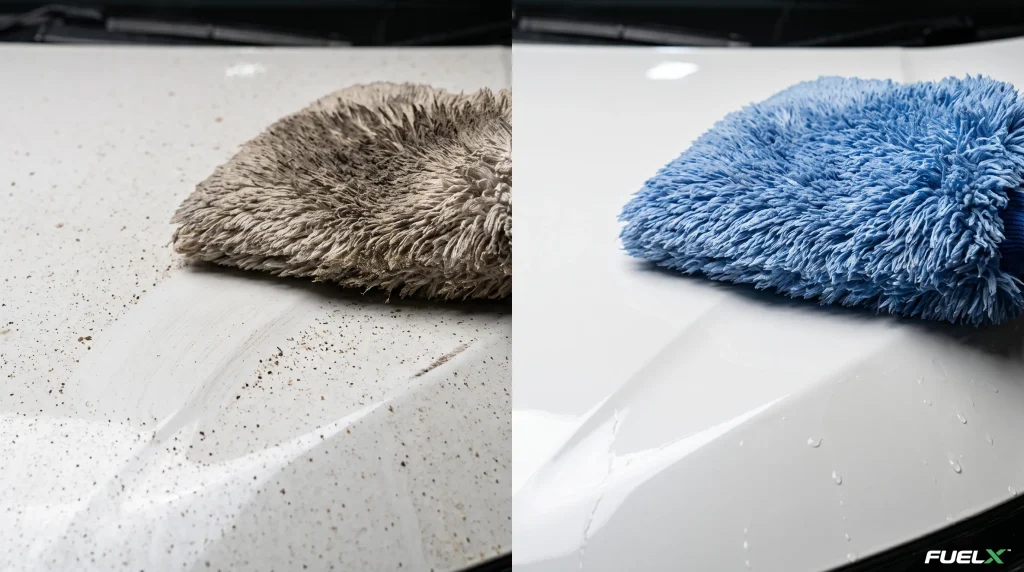
Imagine wiping a dusty table with a damp cloth. If you first remove the loose dust, the cloth glides over a cleaner surface. If you immediately scrub the dry dust into the table, you increase friction.
Car washing works on a similar principle.
The objective isn’t simply to make the car wet and covered in foam. The objective is to remove loose contamination before you create unnecessary contact with the paint.
The two-bucket method helps by separating the shampoo solution from the water used to rinse the dirty mitt, while a foam pre-wash can loosen some contamination before the mitt touches the vehicle.
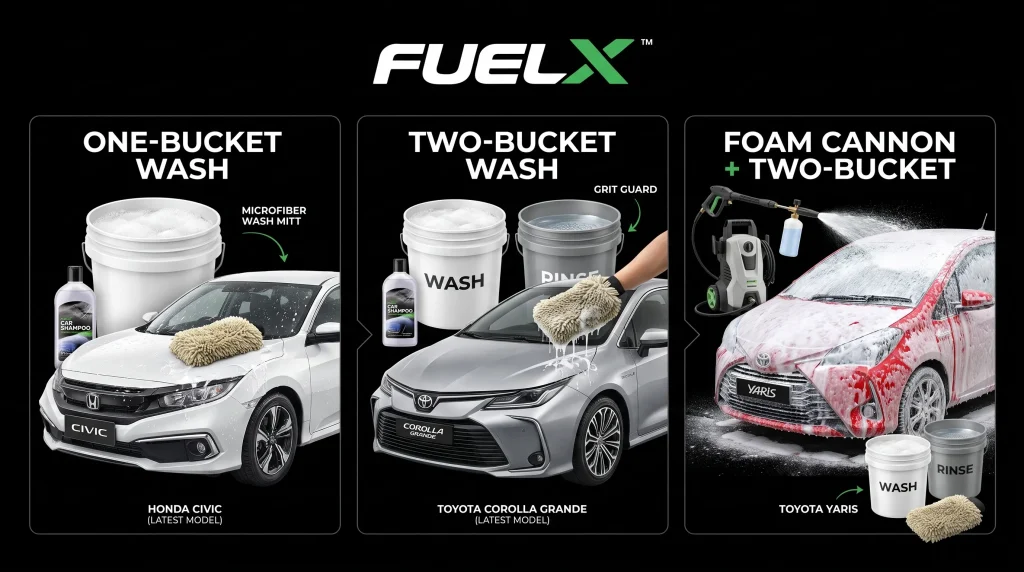
The Three Wash Methods at a Glance
| Method | Typical Setup | Contamination Control | Equipment Cost | Best Use |
| One-bucket | 1 bucket + shampoo + mitt | Basic | Low | Lightly dusty cars |
| Two-bucket | 2 buckets + shampoo + mitt | Better | Low–Moderate | Regular home washing |
| Foam + two-bucket | Pressure washer + foam cannon + 2 buckets | More comprehensive | Moderate–High | Heavy dirt & enthusiasts |
There isn’t a universal winner for every car owner.
A person who drives a clean car mainly around the city has different needs from someone returning from a muddy road trip.
Method 1: The One-Bucket Wash
The one-bucket wash is the simplest setup.
You use:
- One bucket
- Car shampoo
- Water
- Wash mitt
- Drying towel
The shampoo is mixed in the bucket, the mitt is loaded with the solution, and the vehicle is washed section by section.
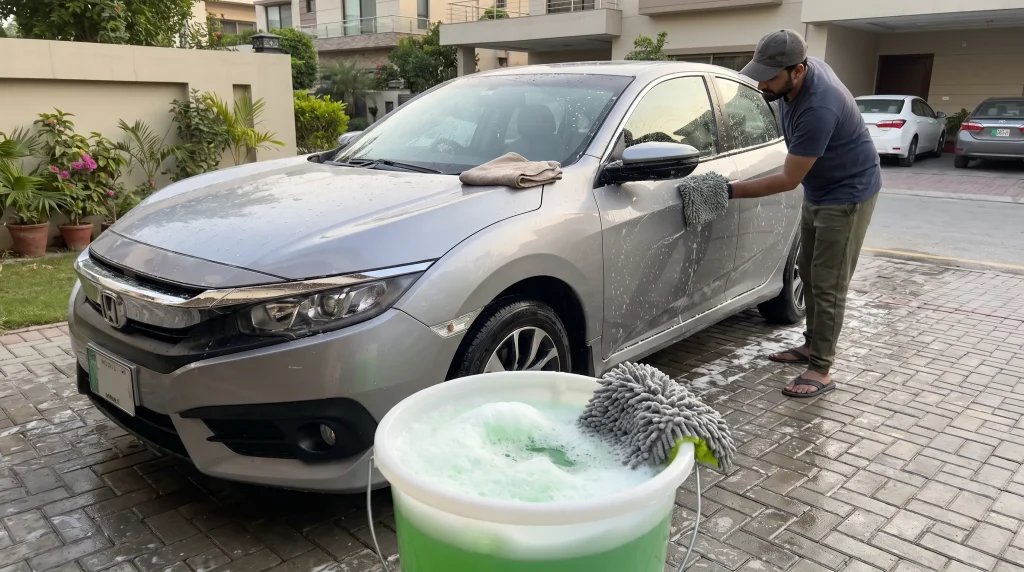
How It Works
A basic one-bucket process looks like this:
- Pre-rinse the vehicle.
- Fill the bucket with water and car shampoo.
- Soak the wash mitt.
- Wash one section.
- Return the mitt to the same bucket.
- Reload it with shampoo.
- Continue around the car.
- Rinse the vehicle.
- Dry it with a clean microfiber towel.
The weakness is contamination.
As you wash, the mitt collects dirt from the vehicle. When that same mitt goes back into the shampoo bucket, some of that contamination enters the wash solution.
That doesn’t mean every one-bucket wash will damage your paint. It means you have less separation between clean shampoo and dirty rinse water.
Advantages
- Cheapest setup
- Very simple
- Requires little equipment
- Convenient for lightly dusty vehicles
- Easy for beginners
Disadvantages
- Dirt can accumulate in the wash solution
- Less contamination control
- The mitt needs frequent cleaning
- Less suitable for heavily contaminated vehicles
When Does It Make Sense?
A one-bucket wash can be practical when the vehicle has relatively light contamination and has been properly pre-rinsed.
For example, if your car was parked overnight and only picked up a light layer of dust, the contamination level is very different from a car that has spent several days driving through construction zones or muddy roads.
Method 2: The Two-Bucket Wash
The two-bucket method adds one simple but important change:
One bucket is for shampoo.
One bucket is for rinsing.
The idea is to prevent as much dirt as possible from returning to the clean shampoo solution.
Your washing cycle becomes:
Wash → Rinse Mitt → Reload Shampoo → Wash
After cleaning one panel or section, rinse the mitt in the clean-water bucket before returning it to the shampoo bucket.
This is the core reason the two-bucket method is popular among DIY detailers.
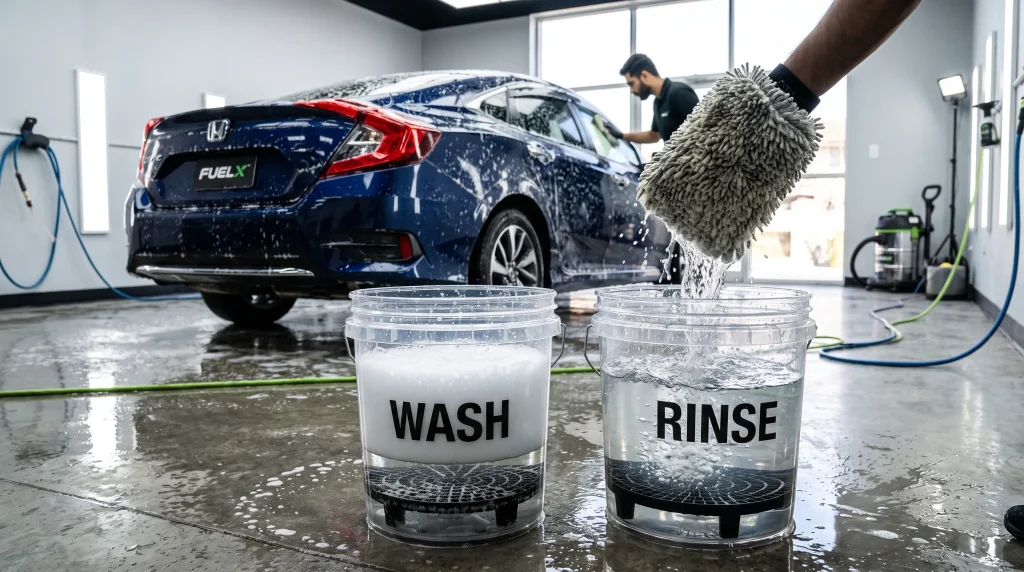
How the Two-Bucket Method Works
A practical setup might use two buckets of around 15–20 litres each.
For example:
Bucket 1: 15–20 L water + correctly diluted car shampoo
Bucket 2: 15–20 L clean rinse water
You don’t necessarily need to fill both buckets completely. The exact volume depends on the bucket size, vehicle and product instructions.
The process is:
- Rinse the vehicle.
- Prepare the shampoo bucket.
- Prepare the rinse bucket.
- Load the mitt with shampoo.
- Wash one section.
- Rinse the mitt in the rinse bucket.
- Agitate the mitt gently to release dirt.
- Reload with shampoo.
- Continue to the next section.
A grit guard can also be placed at the bottom of a bucket to help keep loosened contamination separated from the mitt.
A Realistic Water Example
More buckets don’t automatically mean dramatically more water.
One 2026 test comparing one-bucket and two-bucket washing used a 20-litre bucket setup on a normally dusty sedan. The test recorded approximately 63 litres per wash for the one-bucket method and 69 litres for the two-bucket method under that particular setup.
That’s a difference of roughly 6 litres per wash.
If someone washed the car twice a month, that would be around:
6 L × 24 washes = 144 L extra per year
But this should be treated as an illustrative test result, not a universal water-consumption figure. Hose flow, rinsing habits, bucket size, pressure washer use and washing technique can change the total substantially.
The bigger lesson is that using two buckets doesn’t automatically mean wasting large amounts of water.
Advantages
- Better separation of clean and dirty water
- More controlled contact washing
- Doesn’t require a pressure washer
- Relatively inexpensive
- Practical for regular home washing
Disadvantages
- Requires an additional bucket
- Slightly more setup
- Still involves physical contact with the paint
- Heavy contamination may require a stronger pre-wash
Who Should Use It?
For many home car owners, the two-bucket method is a practical middle ground.
You don’t need a professional detailing setup, but you gain better contamination control than a basic single-bucket process.
Method 3: Foam Cannon + Two-Bucket Wash
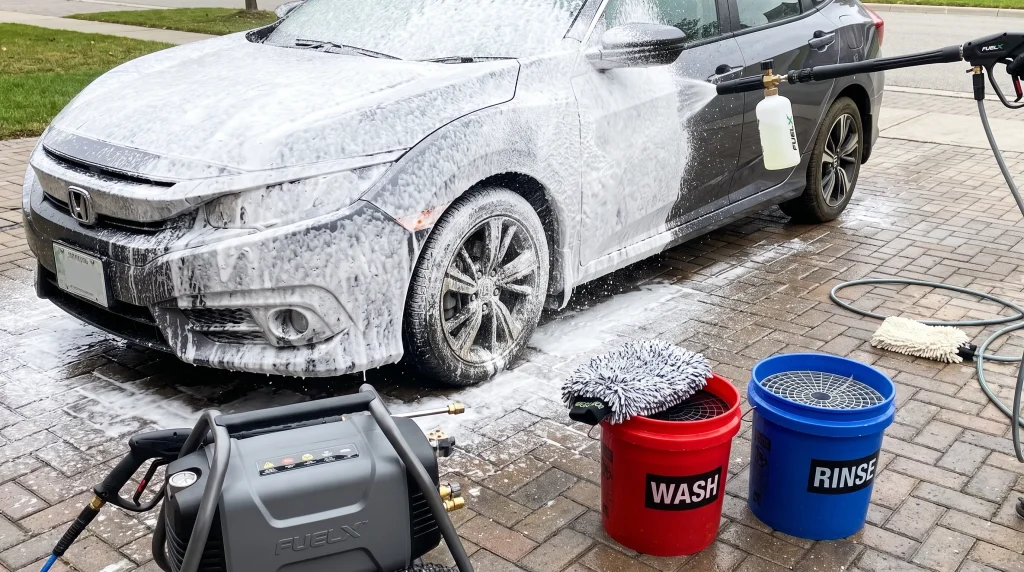
Now we move to the more advanced setup.
A foam cannon is normally connected to a pressure washer and used to apply a layer of cleaning solution before the contact wash.
The basic idea is:
Rinse → Foam → Dwell → Rinse → Contact Wash
The foam helps loosen and lift some surface contamination before the wash mitt touches the paint.
But there is an important misconception:
A foam cannon does not automatically replace hand washing.
A foam pre-wash is generally a preparation step. Bonded contamination and remaining road film can still require a contact wash. Current detailing guidance also treats foam cannon use as a pre-wash rather than a universal replacement for contact washing.
How It Works
A typical workflow is:
- Rinse loose dirt.
- Apply foam.
- Allow appropriate dwell time.
- Rinse the foam away.
- Prepare the two-bucket system.
- Wash using a clean microfiber mitt.
- Rinse the mitt regularly.
- Perform the final rinse.
- Dry with a clean microfiber towel.
How Long Should Foam Dwell?
There isn’t one magic number for every product.
In practical conditions, a few minutes is commonly used, but the more important rule is:
Never allow the foam to dry on the paint.
In hot Pakistani weather, especially on a sunny panel, foam can dry much faster than expected. Working in shade and rinsing before the product dries is therefore particularly important.
Advantages
- Adds a dedicated pre-wash stage
- Can loosen surface grime before contact washing
- Useful for heavily contaminated vehicles
- Fits well into a detailed washing routine
- Reduces the amount of loose dirt present before the mitt stage
Disadvantages
- Requires additional equipment
- Higher initial investment
- Requires more setup and cleanup
- Foam thickness does not automatically equal better cleaning
- Still may require a contact wash
One-Bucket vs Two-Bucket vs Foam Cannon: Head-to-Head
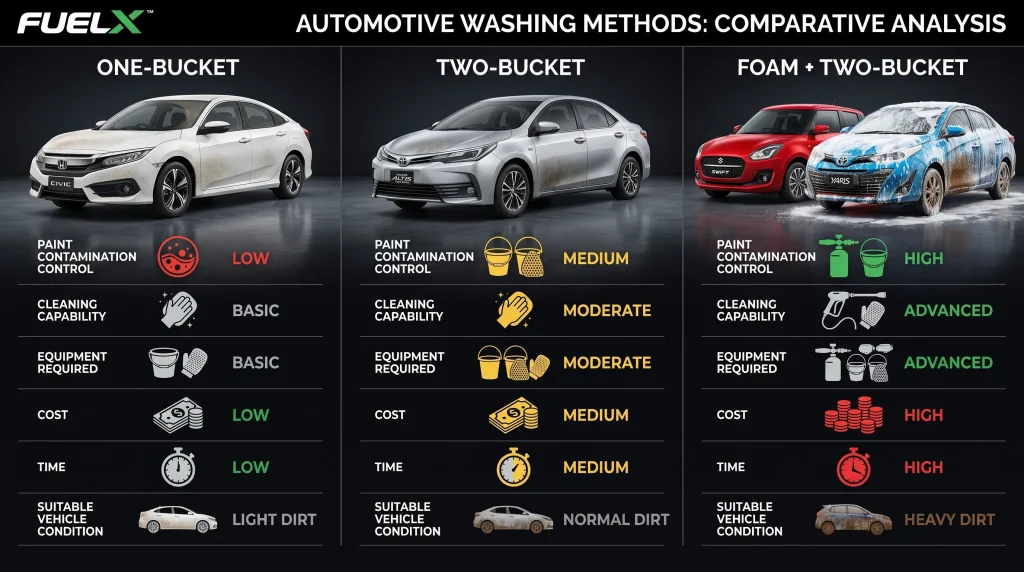
1. Paint Safety
The important factor isn’t how impressive the foam looks.
It’s how much abrasive contamination is present when your wash mitt makes contact with the paint.
A two-bucket system gives you a dedicated place to rinse the mitt.
A foam pre-wash adds another opportunity to loosen and rinse away contamination before contact.
However, no method can guarantee completely scratch-free washing.
Your technique still matters.
2. Cleaning Ability
Different levels of dirt call for different approaches.
Light Dust
A careful one-bucket or two-bucket wash may be sufficient after a proper rinse.
Normal Weekly Grime
A two-bucket wash provides a practical balance between cleaning and contamination control.
Heavy Road Film
Foam pre-wash followed by a two-bucket contact wash can be more appropriate.
Mud
A thorough rinse and pre-wash become particularly important because you don’t want to immediately drag thick mud across the paint with a mitt.
3. Equipment Requirements
One-Bucket Setup
You need:
- 1 bucket
- Car shampoo
- Wash mitt
- Water
- Drying towel
Two-Bucket Setup
You need:
- 2 buckets
- Car shampoo
- Wash mitt
- Water
- Drying towel
Optional:
- Grit guards
Foam Cannon Setup
You need:
- Pressure washer
- Foam cannon
- Suitable car shampoo
- 2 buckets
- Wash mitt
- Drying towel
The jump from two buckets to a foam cannon is therefore more significant than simply buying another bucket.
4. Cost
The one-bucket system has the lowest initial cost.
A two-bucket setup mainly adds the cost of another suitable bucket and possibly grit guards.
A foam cannon setup can cost considerably more because you need a compatible pressure washer and foam cannon.
For someone washing one family car every week, the advanced setup may not be necessary.
For someone who enjoys DIY detailing or regularly deals with heavy contamination, the extra equipment may be worthwhile.
5. Time
The one-bucket system has the simplest preparation.
The two-bucket system takes a little longer to set up, but the washing process itself is still straightforward.
The foam-cannon workflow takes longer because you’re adding:
Pre-rinse → Foam → Dwell → Rinse
before the contact wash.
That additional step isn’t necessarily wasted time. Its purpose is to reduce contamination before contact.
What About Pakistani Conditions?
The method you choose becomes more important when you consider local driving conditions.
A Pakistani daily driver may encounter:
- Road dust
- Construction dust
- Fine sand
- Traffic pollution
- Mud during rain
- Bird droppings
- Hard-water deposits
- High summer temperatures
The heat creates another problem: water and shampoo can dry quickly on the surface.
Hard water can also leave mineral deposits behind after evaporation. These deposits are commonly associated with dissolved minerals such as calcium and magnesium.
That means a car washed correctly can still develop visible water spots if rinse water is allowed to dry on a hot surface.
During Hot Weather
Try to:
- Wash in shade
- Work panel by panel
- Keep the surface wet
- Avoid letting shampoo dry
- Dry the car soon after the final rinse
During Monsoon
Mud and road film can become more significant.
Give the car a thorough rinse before introducing a wash mitt.
If the vehicle is visibly muddy, don’t start scrubbing immediately. The first job is to remove as much loose contamination as possible.
Which Wash Method Should You Choose?
Instead of asking, “Which method is the best?”, ask:
“Which method is appropriate for my car today?”
Choose One Bucket If:
- The car has light dust.
- You want the simplest setup.
- You have limited equipment.
- You can thoroughly pre-rinse the vehicle.
- You’re willing to clean the mitt frequently.
Choose Two Buckets If:
- You wash your car regularly.
- You want better contamination control.
- You don’t own a pressure washer.
- You want a practical home setup.
- You want to keep equipment and costs reasonable.
Choose Foam Cannon + Two Buckets If:
- The car frequently gets heavily contaminated.
- You enjoy DIY detailing.
- You already own a pressure washer.
- You want a dedicated pre-wash stage.
- You’re comfortable with additional equipment and setup.
The Practical Wash Workflow for Most Car Owners
If you’re unsure where to start, focus on technique before equipment.
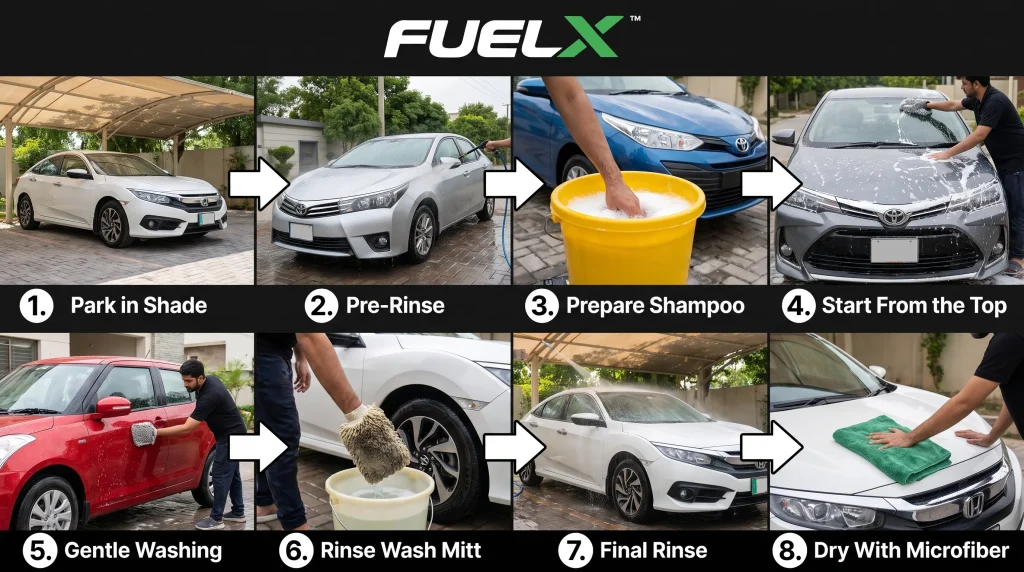
Step 1: Park in Shade
A shaded surface gives you more working time and reduces the chance of shampoo and rinse water drying prematurely.
Step 2: Pre-Rinse
Use plenty of water to remove loose dust and grit.
Don’t immediately attack a heavily dusty panel with a wash mitt.
Step 3: Prepare Your Shampoo
Use a dedicated automotive shampoo and follow its dilution instructions.
Avoid assuming that more shampoo automatically means better cleaning.
Step 4: Start From the Top
Begin with the roof, glass and upper panels.
Move progressively toward the lower panels, which normally carry more road contamination.
Step 5: Use Gentle Passes
You don’t need to aggressively scrub the paint.
Let lubrication and the wash media do the work.
Step 6: Rinse the Mitt
With the two-bucket method, rinse the mitt after each section before returning it to the shampoo bucket.
Step 7: Leave the Dirtiest Areas for Later
Lower doors, rocker panels, rear bumpers and areas behind the wheels usually collect more contamination.
Don’t spread that contamination onto cleaner areas.
Step 8: Final Rinse
Rinse the entire vehicle thoroughly.
Step 9: Dry Promptly
Use a clean, suitable microfiber drying towel.
Avoid allowing mineral-rich water to evaporate naturally on a hot panel.
Step 10: Inspect the Finish
Once dry, look for:
- Water spots
- Remaining dirt
- Streaks
- Missed areas
- Bird-dropping residue
A clean wash is about more than simply making the vehicle look wet and shiny.
5 Mistakes That Can Ruin Any Wash Method
Even a pressure washer and foam cannon can’t compensate for poor technique.
1. Washing a Very Dusty Car Without Pre-Rinsing
This increases the amount of contamination your wash mitt has to deal with.
2. Using Household Detergent
Car shampoos are formulated specifically for automotive surfaces. Don’t assume dishwashing or laundry detergent is an appropriate substitute.
3. Using the Same Dirty Towel Everywhere
Keep wash and drying towels clean and separate them from towels used on wheels or heavily contaminated areas.
4. Scrubbing Too Hard
Pressure isn’t a substitute for proper cleaning chemistry and lubrication.
5. Letting Water or Shampoo Dry on the Paint
This is especially important during hot weather.
A rinse that dries on the surface can leave mineral deposits behind, while dried shampoo can leave residue.
What Equipment Do You Actually Need?
You don’t need to turn your garage into a professional detailing studio.
Basic Car Wash Setup
For a simple maintenance wash:
- Car shampoo
- Bucket
- Microfiber wash mitt
- Microfiber drying towel
- Water source
Better Home Setup
For more controlled washing:
- Two buckets
- Car shampoo
- Microfiber wash mitt
- Separate wheel-cleaning tools
- Microfiber drying towel
- Optional grit guards
Advanced Detailing Setup
For enthusiasts:
- Pressure washer
- Foam cannon
- Two buckets
- Grit guards
- Car shampoo
- Microfiber wash mitt
- Dedicated wheel tools
- Quality drying towels
The key principle is:
Buy equipment because it solves a real problem—not because it looks professional.
A person with a simple two-bucket setup and good technique can achieve better results than someone with an expensive pressure washer who uses a dirty mitt and scrubs aggressively.
Final Thoughts
The one-bucket method is about simplicity.
The two-bucket method provides better separation between clean shampoo and dirty rinse water while remaining practical for home users.
The foam cannon + two-bucket method adds a dedicated pre-wash stage that can help loosen contamination before contact washing.
None of these methods is magic.
The biggest improvement comes from understanding what you’re trying to prevent:
less dirt on the paint → less abrasive contamination under the mitt → less unnecessary friction.
For many Pakistani car owners, a well-executed two-bucket wash is a sensible everyday approach. If your vehicle regularly comes home heavily contaminated and you already have—or are willing to buy—a pressure washer, adding a foam pre-wash can make the overall process more comprehensive.
And if your car is only lightly dusty, you don’t necessarily need a garage full of detailing equipment.
Good technique comes first. Equipment comes second.
FAQ’s
Is a foam cannon better than the two-bucket method?
They serve different purposes. A foam cannon is primarily a pre-wash tool, while the two-bucket method is a contact-washing system. They can actually be used together rather than treated as direct alternatives.
Can I wash my car with one bucket?
Yes. A one-bucket wash can work for lightly contaminated vehicles, particularly when you pre-rinse thoroughly and keep your wash media clean. A two-bucket setup simply provides better separation between rinse water and shampoo solution.
Does a foam cannon replace hand washing?
Usually, no. Foam can loosen and remove some surface contamination, but remaining road film and bonded contamination may still require contact washing.
Is the two-bucket method scratch-proof?
No. No washing method can guarantee scratch-free paint. The two-bucket method is designed to improve contamination control, but wash media, pressure, technique, pre-rinsing and drying all matter.
Do I need a pressure washer to wash my car properly?
No. A pressure washer can be useful, particularly for pre-rinsing and foam application, but you can perform a proper home wash with buckets, suitable shampoo, clean wash media and good technique.
Can foam remove all dirt without touching the car?
Not reliably. Foam can loosen and lift some contamination, but it doesn’t guarantee complete removal of bonded grime. For a thorough maintenance wash, a contact-wash stage is often still required.
What is the safest way to wash a dusty car?
Start with a thorough rinse to remove loose contamination. Then use a suitable automotive shampoo, clean wash media and controlled contact washing. Avoid aggressively rubbing a dry or heavily dusty surface.
How often should I wash my car in Pakistan?
There isn’t one perfect interval. A lightly used, garage-kept car may need less frequent washing than a daily driver exposed to dust and traffic.
As a practical starting point, many daily-driven vehicles can be washed around every 1–2 weeks, with additional cleaning when exposed to heavy mud, bird droppings or other contamination.
The condition of the vehicle should determine the schedule—not an arbitrary calendar date.
Can hard water affect the result of a car wash?
Yes. When water evaporates, dissolved minerals can remain on the surface and form visible deposits. This is particularly noticeable when water dries on a hot vehicle.
Is more foam always better?
No. Thick foam may look impressive, but foam thickness alone doesn’t determine cleaning performance. The shampoo formulation, dilution, dwell time, rinsing and overall technique all matter. Most importantly, don’t allow foam to dry on the paint.
Should I wash wheels with the same mitt I use on the paint?
It’s better to keep wheel-cleaning tools separate. Wheels can carry brake dust and other heavy contamination that you don’t want to transfer to painted body panels.
About FuelX Research & Detailing Lab
FuelX engineers high-performance automotive cooling solutions and specialized car detailing products engineered for Pakistan's demanding driving conditions. All guides and tips are validated by our technical team to ensure engine longevity and lasting vehicle protection.
Keep Your Engine Cool & Your Ride Shining
Shop FuelX certified Long Life Coolants, high-gloss tyre shine, safe car wash shampoo, and lint-free microfiber accessories.