Eco-Friendly Waterless Wash: How to Clean Your Car Using Less Water
Washing a car can use far more water than most people realize.
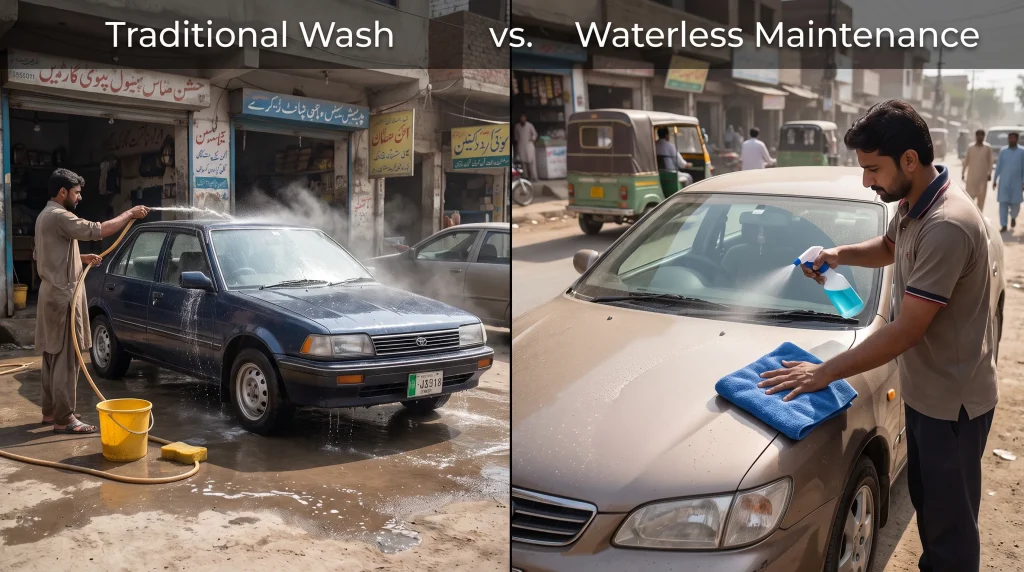
Depending on the washing method, equipment and vehicle type, a single conventional wash can consume tens or even hundreds of litres of freshwater. Research from Pakistan has reported figures ranging from around 255 litres per vehicle in surveyed Karachi service stations to approximately 450 litres per vehicle at surveyed car-wash stations in Peshawar.
That makes water-efficient car care worth considering, particularly in places where water availability is already under pressure.
One option is a waterless car wash.
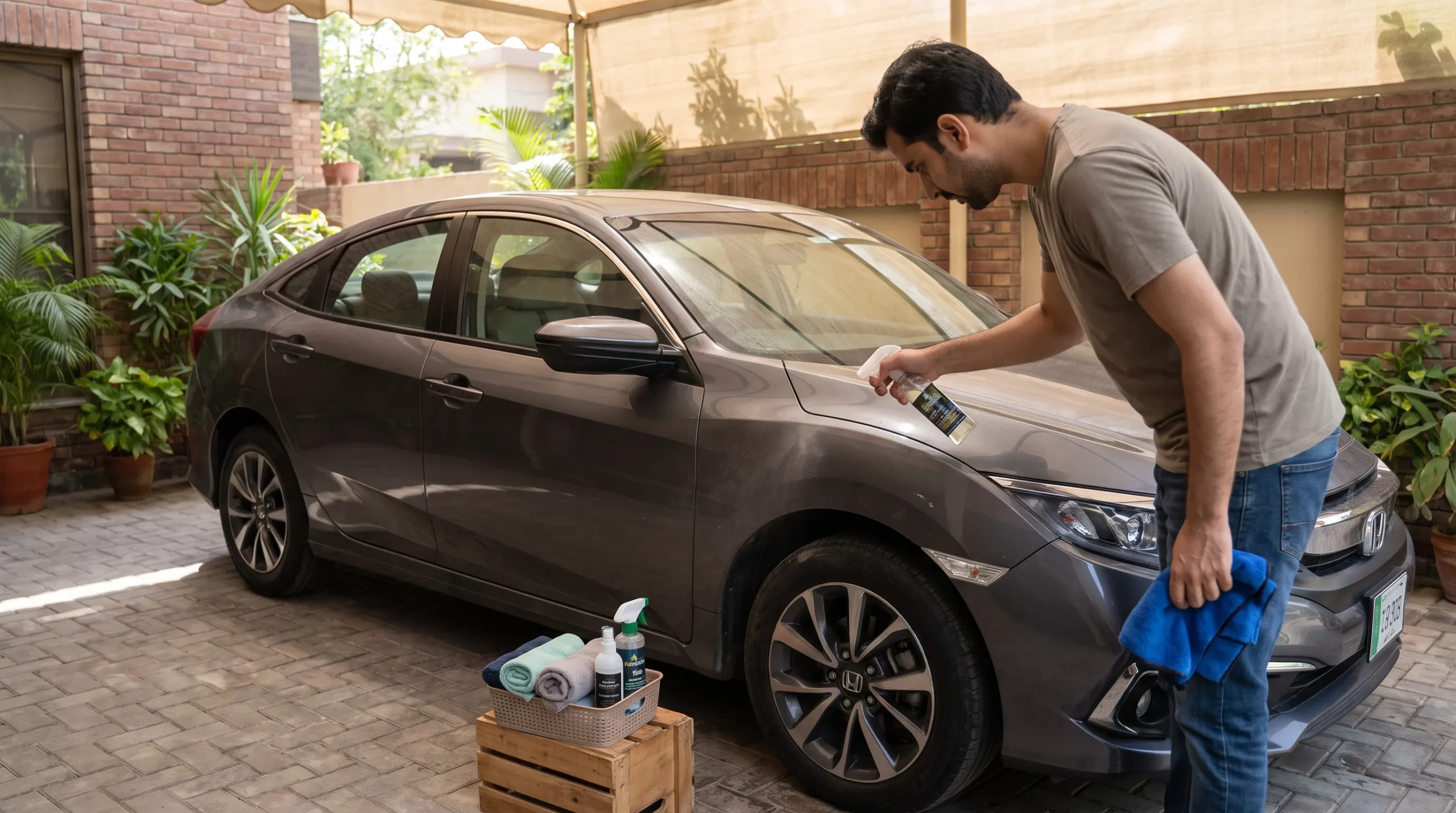
Instead of using a hose and rinse water, a waterless wash uses a specially formulated cleaning solution and microfiber towels to remove light dust, fingerprints and minor surface contamination.
But there’s an important limitation:
A waterless wash is not designed to replace every conventional car wash.
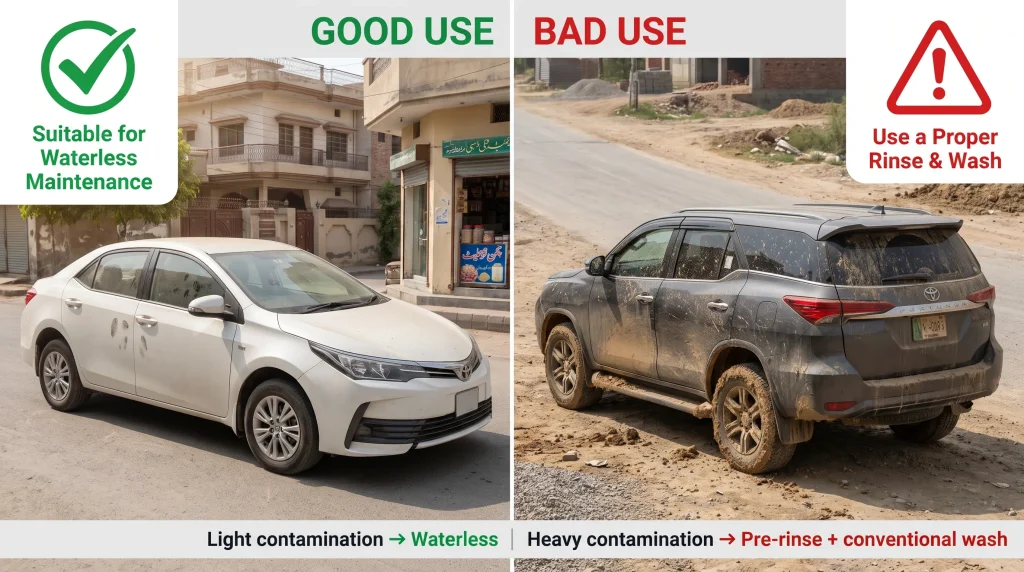
If your car is covered in mud, sand, heavy road grime or thick contamination, wiping the surface can drag abrasive particles across the paint. In that situation, a proper rinse and wash is the safer approach. Current detailing guidance and recent hands-on testing similarly describe waterless products as maintenance solutions for lightly contaminated vehicles rather than replacements for heavy-duty washing.
So, how does waterless washing work, when should you use it, and can it genuinely help reduce water consumption?
Let’s take a practical look.
What Is a Waterless Car Wash?
A waterless car wash is a spray-and-wipe cleaning method that removes light contamination without a traditional hose-and-rinse process.
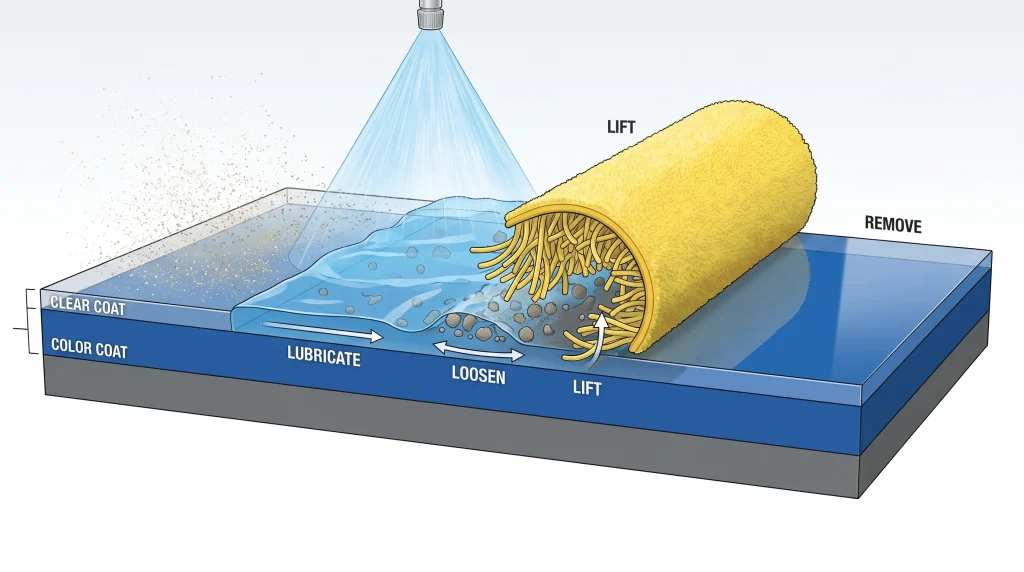
Instead of flooding the vehicle with water, you apply a suitable cleaning solution to one section at a time. The solution provides lubrication and helps loosen or encapsulate light contamination. You then carefully lift the residue using a clean microfiber towel.
The basic process is:
Spray → Loosen → Gently Wipe → Rotate to a Clean Towel Face → Buff
The lubrication step is especially important.
Imagine there is a thin layer of dust on your car’s paint. If you take a dry towel and rub that dusty surface, the particles can move across the paint. A properly designed waterless-wash solution adds lubrication, making the cleaning process less dependent on friction.
However, lubrication cannot make heavy contamination disappear.
A product may help lift light dust safely, but it cannot magically turn sand, dried mud or thick road grime into harmless particles.
Waterless Does Not Mean Dry Wiping
This is one of the most important distinctions to understand.
Waterless washing does not mean taking a dry microfiber towel and wiping dust from the car.
Instead, the surface should receive an appropriate cleaning solution first.
The purpose is to loosen and lubricate the contamination before the towel makes contact with the paint.
That’s why proper technique matters as much as the product.
Waterless Wash vs Rinseless Wash vs Traditional Wash
These three methods are often confused, but they serve different purposes.
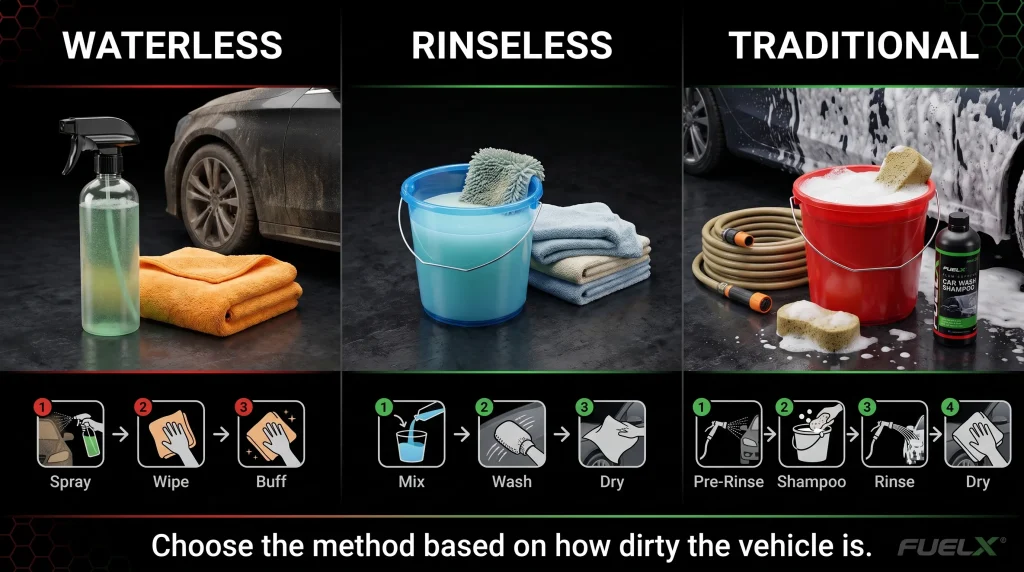
Waterless Wash
A waterless wash normally uses a ready-to-use spray solution.
Basic process:
Spray → Wipe → Buff
It is primarily intended for light contamination.
Rinseless Wash
A rinseless wash generally uses a concentrated product diluted in a bucket of water. You clean the vehicle panel by panel but don’t perform a traditional running-water rinse afterward.
Basic process:
Mix → Wash → Dry
Because the solution is used with a wash medium and bucket, rinseless washing can handle more contamination than a typical spray-and-wipe waterless method.
Traditional Wash
A traditional wash normally follows something like:
Pre-rinse → Shampoo → Agitate → Rinse → Dry
This remains the better choice for heavily contaminated vehicles.
Quick Comparison
| Feature | Waterless Wash | Rinseless Wash | Traditional Wash |
| Running hose | No | No | Usually |
| Bucket | No | Yes | Usually |
| Water requirement | Very low | Low | Higher |
| Light dust | Suitable | Suitable | Suitable |
| Moderate dirt | Limited | More suitable | Suitable |
| Heavy mud | Not recommended | Generally unsuitable | Suitable |
| Setup | Very simple | Moderate | More involved |
| Main benefit | Convenience | Water-efficient cleaning | Deep cleaning |
The important lesson is simple:
Choose the method based on how dirty the vehicle is—not simply on which method sounds more environmentally friendly.
How Does a Waterless Wash Work?
A good waterless wash depends on three basic principles.
1. Lubricating the Surface
The cleaning solution creates a lubricated layer between the towel, dirt and paint.
This helps reduce the amount of friction required during cleaning.
Recent testing of waterless products also identified lubrication as one of the most important characteristics when evaluating how confidently a product can lift light contamination from paint.
2. Loosening Light Contamination
The solution helps loosen surface particles such as:
- light dust
- pollen
- fingerprints
- fresh smudges
- light road film
This makes them easier to lift.
3. Moving Contamination Into the Towel
The microfiber towel should collect the contamination rather than simply push it around the panel.
This is why you should continuously expose a clean towel face.
If a towel has already collected dirt, continuing to use the same contaminated surface increases the amount of debris being moved across the paint.
Is Waterless Car Washing Safe for Your Paint?
It can be, provided the vehicle has only light contamination and the technique is correct.
The biggest factor isn’t simply whether you use water.
It’s the amount and type of contamination on the surface.
Waterless washing may be suitable for:
- Light dust
- Fingerprints
- Fresh smudges
- Pollen
- Light surface contamination
- Recently washed vehicles
- Quick maintenance between full washes
Waterless washing is not suitable for:
- Thick mud
- Heavy sand
- Dried road grime
- Heavy monsoon dirt
- Muddy lower panels
- Thick road film
- Very dirty wheels and tyres
The reason is straightforward.
A dirty car contains particles that can be abrasive. If you wipe those particles repeatedly across the paint, you increase the possibility of creating fine scratches or swirl marks.
Recent detailing guidance makes the same distinction: waterless products are intended for light contamination, while heavy grit, mud and road grime should be removed through a more appropriate washing process.
The Simple Rule
If the vehicle is visibly gritty or heavily dirty, don’t try to wipe the dirt away simply to avoid using water.
Use a proper pre-rinse or conventional wash.
How to Do an Eco-Friendly Waterless Car Wash
If the vehicle has only light contamination, follow a careful process.
Step 1: Park in the Shade
Start by parking the vehicle somewhere shaded.
A hot body panel can cause a cleaning solution to dry quickly, which makes spreading and buffing more difficult.
Ideally, the paint should be cool to the touch.
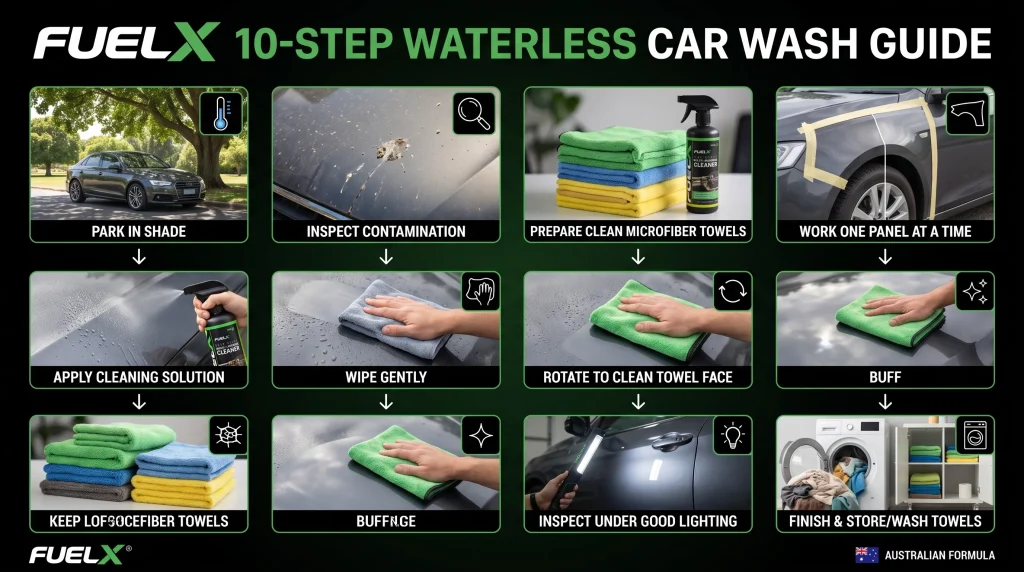
Step 2: Inspect the Vehicle Before Touching It
Walk around the vehicle.
Look closely at:
- bonnet
- roof
- doors
- mirrors
- rear bumper
- lower doors
- wheel arches
- boot
Then ask:
Is this light dust or heavy contamination?
For example:
A thin layer of dust after the car has been parked overnight may be suitable.
A lower door covered in dried mud after driving through a muddy road is not.
This 10-second inspection can prevent you from using the wrong cleaning method.
Step 3: Prepare Multiple Clean Microfiber Towels
Don’t plan to clean an entire vehicle with one towel.
Prepare several clean microfiber towels before starting.
You can separate them for:
- Paint
- Glass
- Final buffing
- Wheels/tyres
The reason is simple: microfiber collects contamination.
Once a towel has picked up significant dirt, you don’t want to keep moving that same dirt back onto clean paint.
FuelX also recommends dedicated microfiber towels as part of proper car-care routines, particularly when different surfaces require different cleaning approaches.
Step 4: Work One Panel at a Time
Don’t spray the entire car and then start wiping.
Work systematically.
A practical order is:
- Roof
- Upper windows
- Bonnet
- Front fenders
- Front doors
- Rear doors
- Boot
- Rear panels
Leave the dirtiest lower sections until later—or use a more appropriate wash method for them.
Step 5: Apply Enough Cleaning Solution
Follow the instructions for the specific product you are using.
You want enough solution to provide proper lubrication.
Using too little product can make the towel drag over the surface more than necessary.
At the same time, using excessive amounts doesn’t automatically make the cleaning safer. Follow the manufacturer’s recommended application method.
Step 6: Wipe With Minimal Pressure
Use gentle, controlled movements.
Don’t scrub.
Don’t press hard.
Don’t repeatedly attack the same dirty spot.
The objective is to lift contamination, not force it off through pressure.
If a mark does not come away with gentle cleaning, stop and reassess the contamination.
Step 7: Rotate to a Clean Towel Face
This is one of the most important steps.
Fold the microfiber towel so you have several usable faces.
Once one face collects dirt, rotate to a clean face.
When the usable faces are contaminated, replace the towel.
This simple habit reduces the amount of contamination being dragged across the paint.
Step 8: Buff With a Clean Towel
After cleaning the panel, use a separate clean microfiber towel for final buffing if recommended by the product instructions.
This removes remaining residue and helps reveal an even finish.
Inspect the panel before moving to the next section.
Step 9: Inspect Under Good Lighting
Once you’ve finished a section, look at it from different angles.
Check for:
- streaks
- remaining dust
- residue
- missed spots
- water spots
- contamination around badges and panel gaps
Good lighting can reveal problems that aren’t obvious in a shaded parking area.
How Much Water Can a Waterless Wash Save?
This is one of the most interesting questions—and one where it’s important to avoid unrealistic marketing claims.
There isn’t a universal number such as:
“Every waterless wash saves exactly 200 litres.”
The amount of water saved depends on what washing method you’re replacing.
However, research gives us a useful idea of the scale of water consumption associated with conventional vehicle washing.
Pakistan-specific examples
A study of car-wash stations in Karachi estimated that approximately 255 litres of water were consumed to wash one vehicle at the surveyed facilities.
Another study surveyed 29 car-wash stations in Peshawar and estimated an average consumption of about 450 litres per vehicle. The study estimated approximately 351,300 litres per day of water consumption across those 29 surveyed stations.
A separate study of vehicle-washing facilities found that complete professional washes can consume approximately 150–600 litres of freshwater per vehicle, depending on the facility and vehicle/washing conditions.
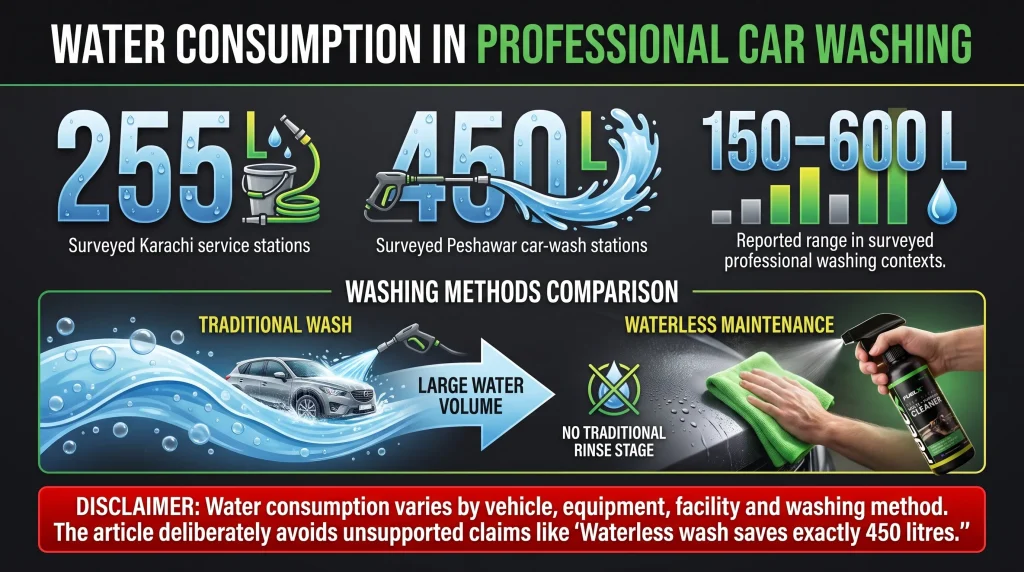
These numbers aren’t contradictory so much as they demonstrate how dramatically water consumption can vary.
Equipment, pressure, washing time, vehicle size and facility practices all matter.
A simple example
Suppose a particular conventional wash uses 200 litres.
If you replace that wash with a waterless maintenance clean that requires only a small amount of product and no running water, the potential freshwater saving could be substantial.
But if the car actually needs a full wash because it is covered in mud, forcing a waterless method isn’t necessarily the responsible option.
The goal is not zero water at all costs. The goal is appropriate water use.
Why Can Waterless Washing Be More Eco-Friendly?
1. It Reduces Freshwater Use
The biggest potential benefit is eliminating the traditional rinse stage for suitable light-maintenance jobs.
If a car has only accumulated a light layer of dust, using a hose and large volume of rinse water may be unnecessary.
2. It Can Reduce Wash-Related Wastewater
Traditional vehicle washing produces wastewater containing substances such as:
- dirt
- sand
- grease
- oils
- detergents
- suspended solids
Research into car-wash wastewater has documented significant contaminant loads, including suspended solids and chemical oxygen demand.
Using less running water can reduce the volume of wastewater generated during a particular cleaning session.
However, it’s important not to confuse less wastewater with zero environmental impact.
Cleaning chemicals, microfiber laundering, packaging and energy consumption still matter.
3. No Hose Is Required
This makes waterless maintenance particularly practical for:
- apartment residents
- office parking
- indoor garages
- workplaces
- locations without convenient outdoor taps
You don’t need to drag a hose across the parking area just to remove a small amount of dust.
4. Less Setup
A quick maintenance clean can eliminate the need to prepare:
- multiple buckets
- hose
- rinse water
- drying area
- large amounts of wash equipment
That convenience is one reason waterless products are often positioned as between-wash maintenance solutions. Recent testing of waterless products similarly found them useful for maintaining an already-clean finish between traditional washes.
5. It Encourages Smarter Cleaning
The most sustainable habit is not simply:
“Never use water.”
It’s:
“Don’t use more resources than the cleaning job requires.”
A lightly dusty car and a muddy car require different cleaning strategies.
Waterless Wash vs Traditional Car Wash: Which Should You Use?
There is no universal winner.
The correct method depends on the vehicle’s condition.
Choose a waterless maintenance method when:
- The car has light dust.
- You’re removing fingerprints.
- You need a quick exterior refresh.
- The vehicle was recently washed.
- You’re maintaining the car between deeper washes.
- Water access is limited.
Choose a traditional wash when:
- The car has heavy mud.
- Sand is accumulated on the paint.
- There is thick road grime.
- The lower body is heavily contaminated.
- The vehicle has been driven through muddy conditions.
- You need a deeper exterior clean.
A practical decision rule
Light dust → Waterless
Light-to-moderate dirt → Consider rinseless
Heavy dirt/mud → Pre-rinse + conventional wash
This approach provides a better balance between water conservation and paint safety.
Waterless Wash vs Rinseless Wash
If you live in an area where water availability is a concern, understanding this difference is useful.
Waterless
Process:
Spray → Wipe → Buff
Best for:
Light dust and maintenance cleaning.
Rinseless
Process:
Dilute → Wash with solution → Dry
Best for:
Light-to-moderate contamination where you want to use significantly less water than a conventional wash.
Traditional
Process:
Pre-rinse → Shampoo → Agitate → Rinse → Dry
Best for:
Heavy contamination.
The important point is that a rinseless wash and a waterless wash are not interchangeable terms. A rinseless method still uses water, but much less than a typical hose-based wash. A waterless method removes the need for a traditional rinse altogether.
When Should You NOT Use a Waterless Wash?
Heavy Mud
If the car has dried mud on the body, don’t try to wipe it away with a microfiber towel.
Rinse it first.
Heavy Sand
Sand is abrasive.
If you can see or feel significant grit, don’t drag a towel across the surface.
Thick Road Grime
Lower doors, bumpers and rear sections can accumulate substantial road contamination.
These areas often require more aggressive cleaning methods—but that doesn’t mean more pressure. It means the right process.
Monsoon Sludge
Pakistan’s rainy season can create a combination of:
- mud
- dust
- road debris
- oily road residue
That’s not the ideal environment for a waterless spray-and-wipe process.
Contamination That Resists Gentle Cleaning
This is the simplest warning sign.
If you have to press harder and harder to remove something:
Stop.
The product or method may not be appropriate for that contamination.
Common Waterless Wash Mistakes
Mistake 1: Wiping a Completely Dry, Dusty Surface
A dry towel provides little lubrication.
Always use an appropriate cleaning solution according to its instructions.
Mistake 2: Using Too Little Product
Insufficient lubrication can make the process unnecessarily abrasive.
Mistake 3: Using One Towel for the Entire Car
The towel becomes increasingly contaminated as you work.
Use multiple towels.
Mistake 4: Applying Excessive Pressure
Pressure doesn’t make a waterless wash safer.
If dirt won’t come off gently, change the cleaning method.
Mistake 5: Reusing a Dirty Towel Face
Rotate the towel.
Clean face in contact with paint.
Dirty face away from paint.
Mistake 6: Working in Direct Sunlight
Hot panels can cause the product to dry prematurely.
Mistake 7: Trying to Clean a Muddy Car Without Water
This is probably the most serious mistake.
Saving water isn’t worth unnecessarily increasing the risk of damaging the paint.
How to Make Your Waterless Wash More Eco-Friendly
Waterless cleaning is already designed to minimize water use, but you can improve the overall environmental footprint of your routine.
Use Reusable Microfiber Towels
Instead of disposable wipes, use good-quality reusable microfiber towels and care for them properly.
Wash Towels Responsibly
Collect used towels and wash them together when practical rather than running very small laundry loads repeatedly.
Separate Heavily Contaminated Towels
Towels used on wheels, tyres and heavily dirty areas shouldn’t automatically return to paint-cleaning duties.
Use the Recommended Amount of Product
Using twice as much chemical doesn’t necessarily mean twice as much cleaning.
Follow the product instructions.
Don’t Force the Wrong Method
This sounds strange, but it is important.
If a conventional wash is genuinely required, don’t turn a water-saving technique into an unsafe paint-cleaning technique.
Environmental responsibility includes using the correct process.
Is Waterless Washing Suitable for Cars in Pakistan?
It can be particularly useful for certain Pakistani driving and parking situations.
Pakistan’s cities experience significant dust, traffic pollution, seasonal rain and, in many areas, water-supply pressure.
For example, UNDP has previously highlighted water shortages in Islamabad and supported water-recycling initiatives for sectors including car service stations.
More recently, Punjab authorities have also taken measures related to water use at car-washing stations during periods of water scarcity and drought concerns. A 2025 report on the provincial restrictions cited concerns over water consumption by car-washing stations.
This makes water-efficient car care a relevant topic—not simply a global sustainability trend.
Waterless maintenance can be useful for:
- Apartment parking
- Office parking
- Indoor garages
- Lightly dusty daily drivers
- Quick weekend maintenance
- Recently washed vehicles
- Between full washes
But Pakistani weather also creates situations where a waterless method isn’t appropriate.
After:
- heavy rain
- muddy roads
- construction-zone driving
- dusty unpaved roads
- monsoon conditions
inspect the car before deciding how to clean it.
Can You Use Waterless Washing Every Time?
Not necessarily.
Think of waterless washing as one tool in your car-care routine.
For example:
Scenario 1: The car was washed yesterday
There’s a light layer of dust.
Waterless maintenance may be suitable.
Scenario 2: The car has moderate road film
A rinseless or conventional wash may be more appropriate depending on the product and contamination.
Scenario 3: The car has mud on the lower doors
Use a proper rinse and wash.
Scenario 4: The car is heavily contaminated after monsoon driving
Use a thorough conventional wash rather than attempting a spray-and-wipe clean.
This approach protects the paint while still allowing you to reduce water consumption when conditions permit.
Where FuelX Fits Into a Low-Water Car-Care Routine
FuelX offers products for different stages of exterior car care, including Car Wash Shampoo, Quick Detailer, Glass Cleaner, Tyre Shiner and microfiber detailing towels.
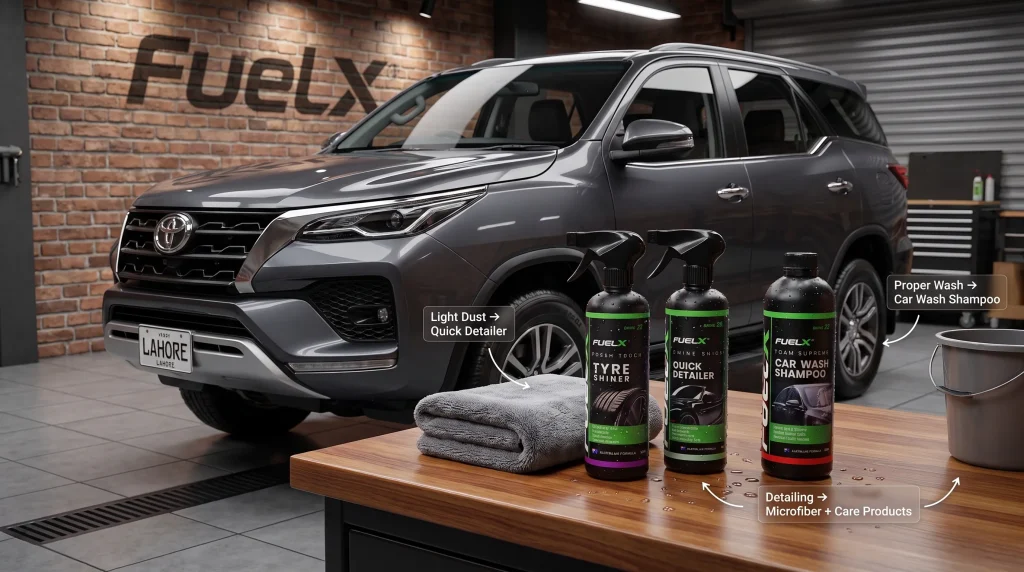
The important thing is to match the product to the job.
FuelX Quick Detailer
FuelX describes its Quick Detailer as suitable for light dust, fingerprints, smudges and quick exterior refreshes, while recommending that heavy dirt be removed before use.
That makes it relevant to light-maintenance detailing.
However, it should not automatically be described as a dedicated waterless-wash product unless its current product instructions specifically support that application.
FuelX Premium Microfiber Detailing Towel
A clean microfiber towel is essential for low-water detailing.
FuelX’s accessories range includes dedicated microfiber detailing towels intended for car-care applications.
FuelX Car Wash Shampoo
When the vehicle is genuinely dirty, don’t force a waterless process.
A proper wash with suitable car shampoo and water is the better approach for heavier contamination.
FuelX’s exterior range includes Car Wash Shampoo for this type of cleaning.
The objective isn’t to use the maximum number of products.
It’s to use the right product and method for the condition of the vehicle.
Final Thoughts
An eco-friendly car wash isn’t necessarily about eliminating water from every cleaning session.
It’s about using water intelligently.
If your car has only light dust, fingerprints or minor surface contamination, a properly performed waterless maintenance clean can reduce water use and make everyday car care much easier.
But if your vehicle is covered in mud, sand or heavy road grime, don’t wipe it aggressively just because you’re trying to save water. A proper rinse and wash can be the safer choice for your paint.
A simple decision system works well:
Light dust → Waterless maintenance
Light-to-moderate dirt → Rinseless or appropriate low-water wash
Heavy contamination → Pre-rinse + conventional wash
Research from Pakistan shows why the water-saving discussion matters: surveyed car-wash facilities have reported water use in the hundreds of litres per vehicle, although actual consumption varies substantially by location and washing method.
So the goal isn’t to claim that every car should be washed without water.
The smarter goal is:
Use less water when the condition of the car allows it—and use the right cleaning method when it doesn’t.
That’s a more practical approach to sustainable car care.
FAQ’s
What is a waterless car wash?
A waterless car wash is a spray-and-wipe cleaning method that uses a specialized cleaning solution and microfiber towels instead of a traditional hose-and-rinse process.
Is waterless car washing safe for car paint?
It can be safe when used correctly on light contamination with sufficient lubrication and clean microfiber towels. It is not appropriate for heavily contaminated surfaces covered in mud, sand or thick road grime.
Does a waterless car wash really save water?
It can significantly reduce freshwater use because it eliminates the traditional rinse stage. The exact amount saved depends on the conventional washing method being replaced.
For context, studies in Pakistan have reported approximately 255 litres per vehicle in surveyed Karachi service stations and approximately 450 litres per vehicle in surveyed Peshawar car-wash stations.
Can I use a waterless wash on a very dirty car?
No. Heavy mud, sand and thick road grime should generally be removed with a suitable pre-rinse or conventional wash rather than being wiped across the paint.
How many microfiber towels do I need?
There isn’t one universal number. The important principle is to use multiple clean towels and rotate to a clean towel face as contamination builds up.
Is waterless washing better than a traditional car wash?
Neither is universally better.
Waterless washing uses very little water and is convenient for light contamination, while traditional washing is more suitable for heavily contaminated vehicles.
What is the difference between waterless and rinseless washing?
Waterless washing generally uses a ready-to-use spray and microfiber towels.
Rinseless washing uses a diluted solution in a bucket and wash media, but doesn’t require a traditional running-water rinse.
Can I waterless wash my car in direct sunlight?
It’s better to work in shade and on cool panels. Direct sunlight can cause the product to dry quickly and make the surface harder to clean evenly.
How often can I use a waterless car wash?
There is no universal schedule. It depends on how quickly the vehicle becomes contaminated and whether the contamination remains within the safe range for the product and method you’re using.
Is waterless car washing suitable for Pakistani weather?
It can be useful for light dust and maintenance cleaning, particularly where water access is limited. However, heavy monsoon mud, sand and road grime require a more thorough cleaning method.
About FuelX Research & Detailing Lab
FuelX engineers high-performance automotive cooling solutions and specialized car detailing products engineered for Pakistan's demanding driving conditions. All guides and tips are validated by our technical team to ensure engine longevity and lasting vehicle protection.
Keep Your Engine Cool & Your Ride Shining
Shop FuelX certified Long Life Coolants, high-gloss tyre shine, safe car wash shampoo, and lint-free microfiber accessories.