Foam vs. Bucket: Foam Cannon Car Wash Guide
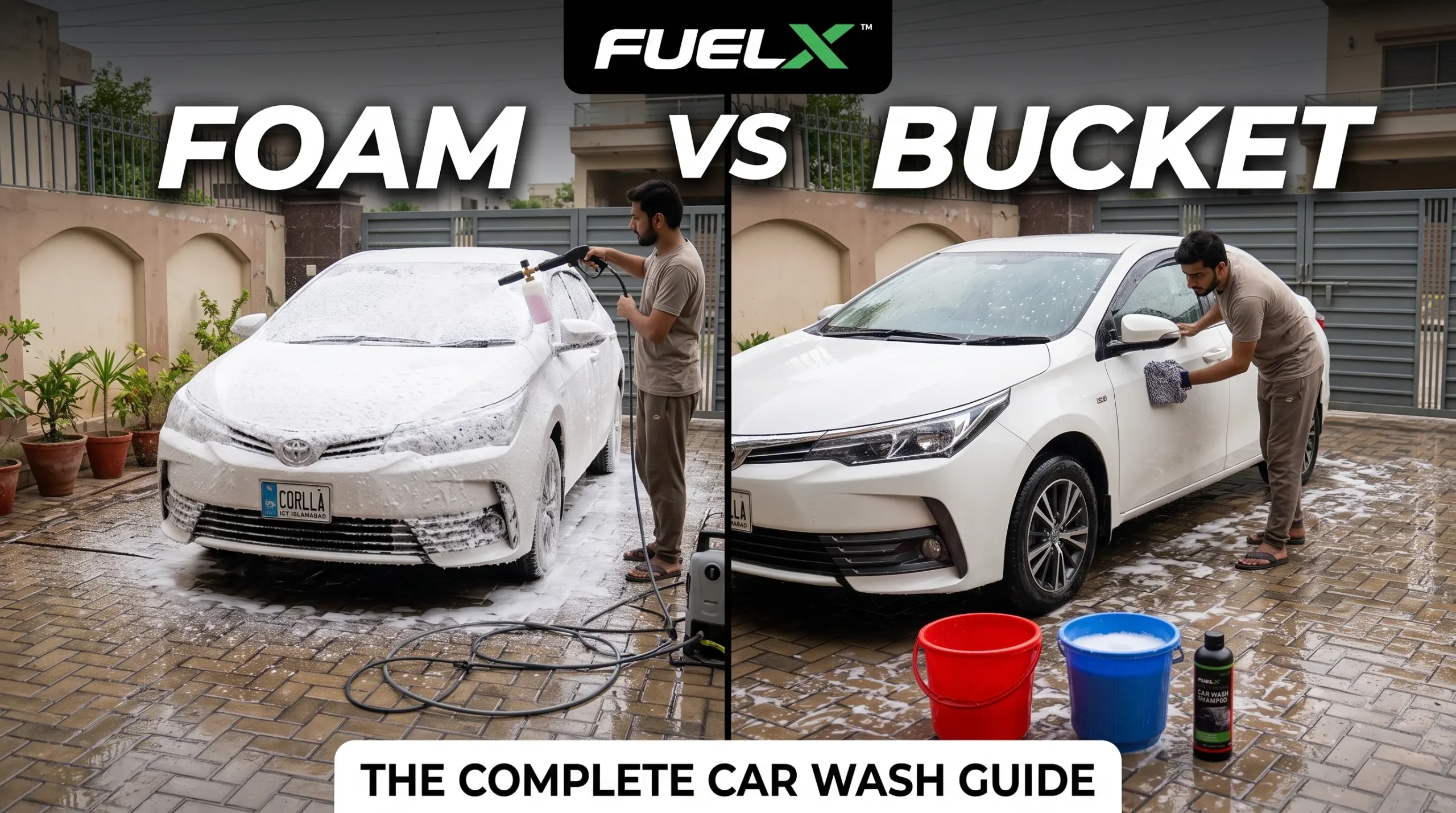
If you enjoy keeping your car clean, you have probably seen two popular approaches to washing: the traditional two-bucket method and the modern foam cannon car wash.
A foam cannon can cover a vehicle in a thick layer of suds, while the two-bucket method uses separate buckets for shampoo and rinsing your wash mitt. That naturally raises a question:
Is a foam cannon actually better than washing your car with buckets?
The answer is more practical than simply choosing one over the other.
A foam cannon and a two-bucket wash perform different jobs. A foam pre-wash can help loosen and remove some loose contamination before you touch the paint, while the two-bucket method helps manage contamination during the contact-washing stage. For many DIY car owners, the most sensible process is therefore:
Pre-rinse → Foam → Rinse → Contact wash → Final rinse → Dry
This guide explains how both methods work, when to use each one, how to use a foam cannon correctly, and how to build a practical car-washing routine for Pakistan’s dusty and often hot conditions.
Foam Cannon vs. Bucket Wash: What’s the Difference?
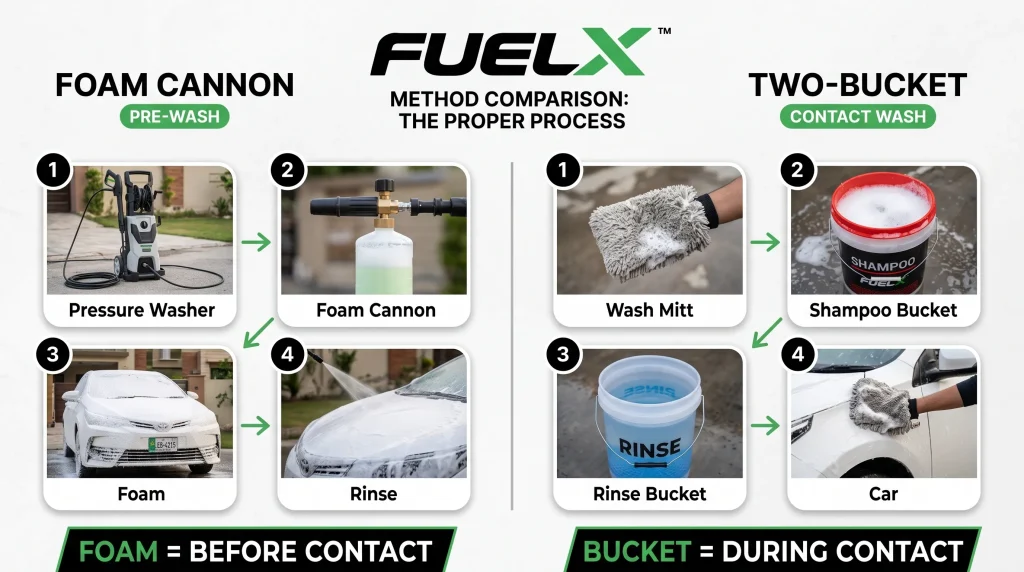
Before comparing them, it is important to understand that a foam cannon and a bucket are not direct replacements for one another.
What Is a Foam Cannon Car Wash?
A foam cannon is an attachment normally used with a pressure washer. It mixes water, air and car-wash solution to produce a layer of foam that clings to the vehicle.
Its main role is pre-washing.
Instead of immediately putting a wash mitt against dusty paint, you first rinse the vehicle, apply foam, allow it to dwell for an appropriate period, and then rinse it away.
This process can loosen some contamination before the mitt touches the surface. The basic idea is simple:
The less loose dirt your wash mitt encounters, the less contamination you potentially drag across the paint during contact washing.
A foam cannon does not, however, magically make every vehicle clean without touching it. Road film, stuck-on dirt, insects and other contamination may remain after rinsing.
What Is the Two-Bucket Car Wash Method?
The two-bucket method is a controlled hand-washing system.
You use:
- One bucket for shampoo solution
- One bucket for clean rinse water
- A suitable microfiber wash mitt
After washing a section of the car, you rinse the dirty mitt in the clean-water bucket before returning it to the shampoo solution.
The idea is to separate the contamination removed from your car from the clean shampoo solution as much as reasonably possible.
Some detailing setups also use grit guards or wash screens at the bottom of the buckets to help keep released particles below the mitt.
The Key Difference
Think of the two systems this way:
Foam cannon: helps reduce contamination before contact.
Two-bucket wash: helps manage contamination during contact.
That’s why they can work together rather than compete with each other.
Is a Foam Cannon Better Than a Bucket Wash?
It depends on what you are trying to achieve.
If your car is lightly dusty and you already have a careful hand-washing routine, a two-bucket wash can be perfectly practical.
If your vehicle regularly collects road dust, mud or traffic film, adding a foam pre-wash can provide another opportunity to loosen contamination before you use a wash mitt.
For many DIY car owners, a practical routine is:
Pre-rinse → Foam → Rinse → Two-bucket contact wash → Final rinse → Dry
The important point is that thicker foam does not automatically mean a better wash.
Cleaning performance depends on several factors, including:
- Shampoo formulation
- Correct dilution
- Water quality
- Foam-cannon settings
- Dwell time
- Type of contamination
- Rinsing technique
- Wash-media cleanliness
- Drying technique
So don’t judge a foam cannon simply by how impressive the vehicle looks covered in white foam.
Foam Cannon vs. Two-Bucket Wash: Quick Comparison
| Factor | Foam Cannon | Two-Bucket Wash |
| Main purpose | Pre-wash | Contact wash |
| Pressure washer | Normally required | Not required |
| Paint contact | Can reduce initial contact | Requires contact |
| Dirt management | Before contact | During contact |
| Equipment cost | Higher | Lower |
| Setup | More equipment | Relatively simple |
| Best use | Pre-washing | Hand washing |
| Suitable for beginners | Yes, after learning setup | Yes |
| Can be combined? | Yes | Yes |
The most useful conclusion isn’t that one method is universally better.
It is that foam and buckets can perform different stages of the same wash.
How Does a Foam Cannon Help Protect Car Paint?
The objective of careful washing is not simply to create lots of bubbles.
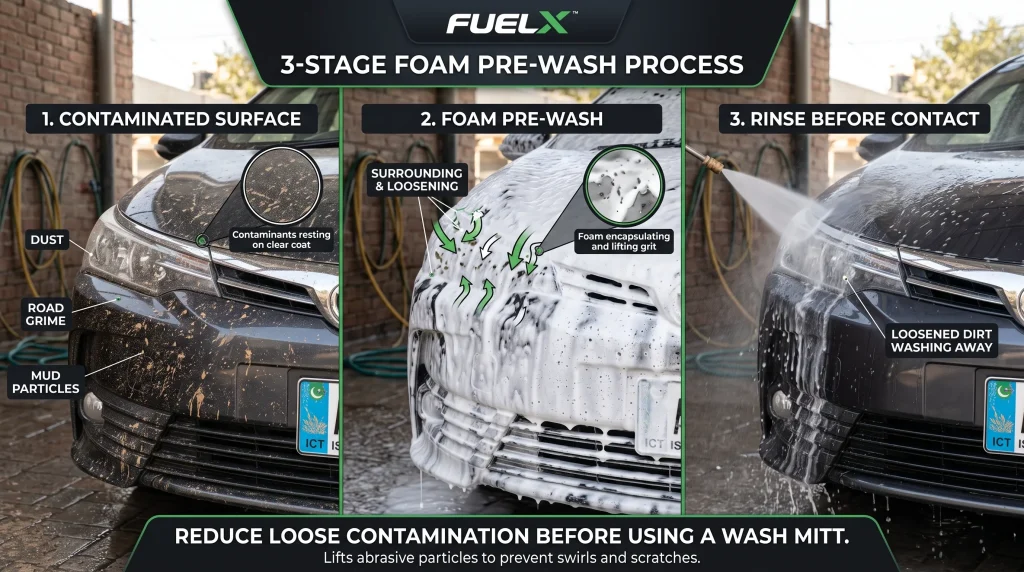
The real goal is to remove contamination while minimizing unnecessary friction between dirt, your wash media and the paint.
Why Is Dirt a Problem?
A vehicle can collect:
- Road dust
- Mud
- Fine grit
- Traffic film
- Insects
- Bird droppings
- Tree residue
- Construction dust
- Other environmental contamination
When a contaminated wash mitt is repeatedly dragged across paint, those particles can contribute to visible marring and swirl marks.
This is especially noticeable on dark-colored vehicles because fine defects reflect light and become easier to see.
That’s why washing technique matters.
What Does the Foam Actually Do?
A foam pre-wash typically works through this sequence:
- The vehicle is pre-rinsed.
- Foam is applied.
- The product is allowed to dwell.
- Contamination is loosened.
- The vehicle is rinsed.
- Remaining contamination is assessed.
- Contact washing is performed if required.
Some current detailing guidance recommends approximately 1–2 minutes of dwell time for a foam stage, provided the product remains wet and is not allowed to dry on the vehicle. Exact dwell time should always follow the shampoo manufacturer’s instructions and the actual weather conditions.
The purpose is not to guarantee a scratch-free wash. It is to reduce the contamination present before contact washing.
Why Doesn’t More Foam Always Mean Better Cleaning?
This is one of the biggest foam-cannon misconceptions.
A car covered in extremely thick foam may look impressive, but foam thickness by itself doesn’t tell you how effectively the product is cleaning.
Imagine two situations:
Car A: lots of foam but poor shampoo dilution and inadequate rinsing.
Car B: moderate foam, correct product dilution, proper dwell time and thorough rinsing.
Car B can have the better washing process even though it looks less dramatic.
So: Don’t chase the thickest foam. Chase the correct process.
What Do You Need for a Foam Cannon Car Wash?
You don’t need a professional detailing studio to wash your car properly.
Essential Equipment
A basic foam-cannon setup generally includes:
- Pressure washer
- Compatible foam cannon
- Suitable automotive shampoo
- Clean water
- Microfiber wash mitt
- Microfiber drying towel
Helpful Equipment
You can also add:
- Two buckets
- Grit guards
- Dedicated wheel-washing tools
- Separate microfiber towels
- Hose or spray nozzle
If you don’t have a pressure washer, don’t worry.
A traditional two-bucket wash remains a practical option. A foam cannon is an additional tool, not a requirement for keeping a vehicle clean.
Step-by-Step Foam Cannon Car Wash
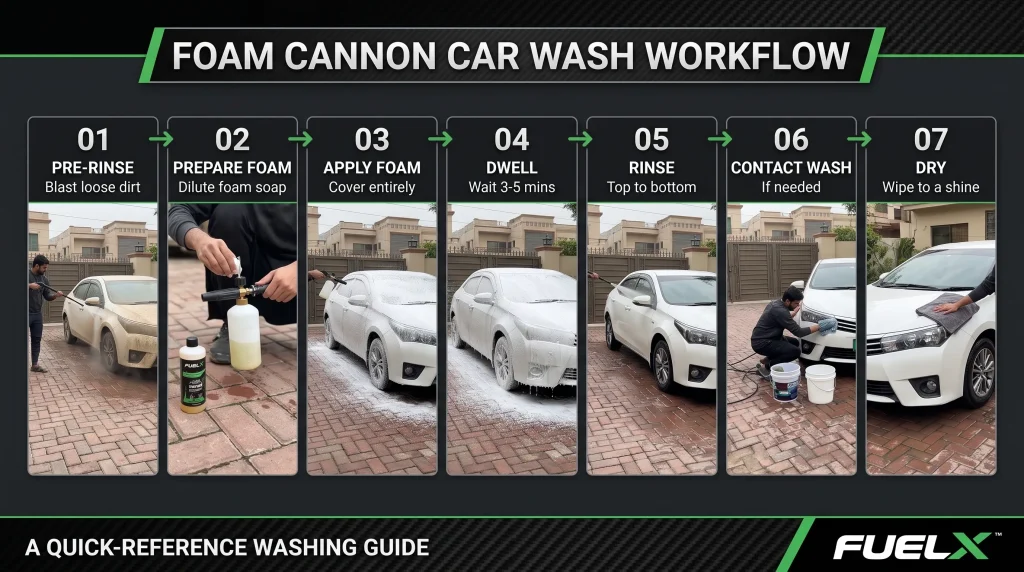
Now let’s turn the theory into a practical process.
Step 1: Park in the Shade
Whenever possible, wash the car in the shade with the paint cool to the touch.
This is particularly useful during hot weather because water and shampoo can evaporate faster from hot panels.
A simple example:
If the roof is hot and you apply foam to the entire vehicle, the roof may start drying while you are still working around the lower doors.
Instead, choose a shaded location and work in manageable conditions.
Step 2: Pre-Rinse the Vehicle
Before applying foam, rinse the vehicle thoroughly.
Start from the roof and work downward.
Pay particular attention to:
- Lower doors
- Wheel arches
- Bumpers
- Mud flaps
- Areas with visible mud
- Panel gaps
The objective is to remove as much loose contamination as possible before introducing a wash mitt.
FuelX’s own Car Wash Shampoo instructions also begin with a pre-rinse to remove loose dust, mud and dirt.
Why this matters
Suppose the vehicle has a visible layer of road dust.
If you immediately wipe that surface with a wash mitt, you’re putting the dirt between the mitt and paint.
Pre-rinsing gives loose particles an opportunity to leave the surface before contact begins.
Step 3: Prepare the Foam Cannon
Prepare your foam cannon according to the shampoo and foam-cannon manufacturer’s instructions.
This is where beginners often make a mistake:
They assume more shampoo automatically produces a better wash.
It doesn’t.
Use the recommended dilution rather than randomly increasing the amount of product.
FuelX’s Car Wash Shampoo is described by the company as a high-foaming, pH-neutral formula intended for exterior vehicle cleaning, and its usage instructions recommend preparing a shampoo solution before applying it with a sponge or wash mitt.
For foam-cannon use specifically, follow the dilution guidance applicable to your equipment.
Step 4: Apply Foam From Top to Bottom
Apply an even layer across the vehicle.
A practical order is:
Roof → Glass → Upper panels → Lower panels → Bumpers
The exact spray pattern isn’t important as much as achieving consistent coverage.
Avoid spending excessive time trying to create an extremely thick layer.
The goal is useful coverage and dwell, not a social-media-style wall of foam.
Step 5: Allow the Foam to Dwell
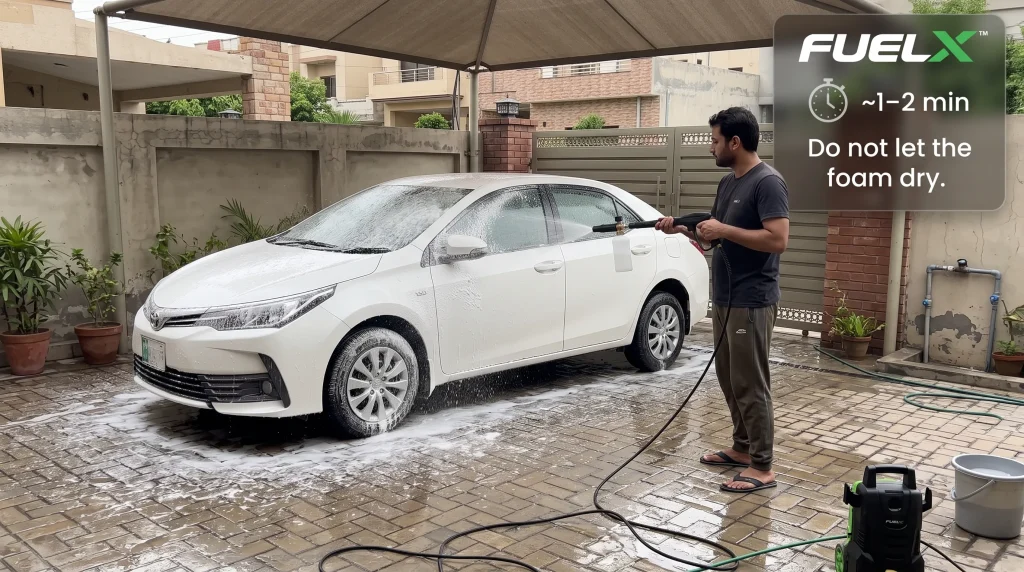
Let the foam remain on the surface for an appropriate period.
A practical reference for some foam-washing procedures is around 1–2 minutes, but this is not a universal rule. Product chemistry, temperature, sunlight and contamination level can change the appropriate dwell time.
The most important rule:
Do not allow the foam to dry on the vehicle.
If the surface starts drying, rinse it.
Hot Pakistani weather can make this especially important during summer.
Step 6: Rinse Thoroughly
Rinse from top to bottom.
Remove the foam and loosened contamination completely.
Pay attention to:
- Side mirrors
- Door handles
- Badges
- Trim
- Panel gaps
- Bumpers
- Lower bodywork
After rinsing, inspect the paint.
If substantial road film or dirt remains, the vehicle still needs a contact wash.
Step 7: Decide Whether a Contact Wash Is Needed
This is one of the most important steps in the entire process.
A foam cannon isn’t automatically the final stage.
After rinsing, ask:
Does the surface still have visible or tactile contamination?
If yes, proceed with a contact wash.
For a typical daily driver, the practical sequence can therefore be:
Foam pre-wash + two-bucket contact wash
This approach combines contamination reduction before contact with contamination control during contact. Current detailing guidance recommends this type of combined process.
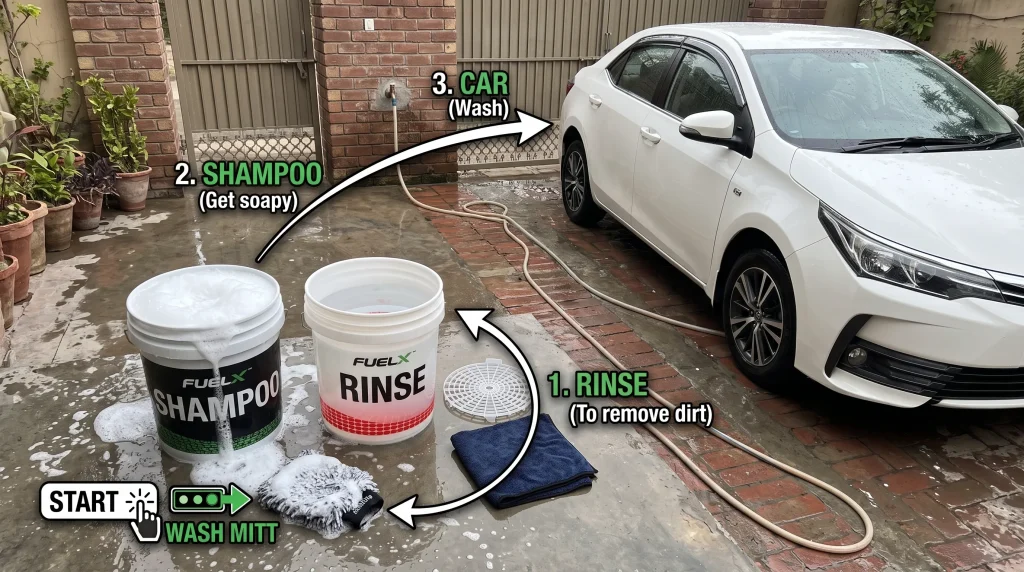
How to Combine a Foam Cannon With the Two-Bucket Method
For many home detailers, this is the most complete and practical approach.
Step 1: Pre-Rinse
Remove loose dirt with clean water.
Step 2: Apply Foam
Cover the vehicle evenly.
Step 3: Allow Suitable Dwell Time
Let the product work while ensuring it doesn’t dry.
Step 4: Rinse
Remove the foam and loosened contamination.
Step 5: Prepare Two Buckets
Use:
Bucket 1: shampoo solution
Bucket 2: clean rinse water
As a practical reference, some professional detailing instructions use 5-gallon buckets, which hold about 18.9 litres each. You do not have to use exactly that size at home; the important principle is having enough solution to work comfortably and a separate rinse supply.
Step 6: Load the Wash Mitt
Put the clean mitt into the shampoo bucket.
Allow it to become well lubricated before contacting the paint.
Step 7: Wash One Section at a Time
Start at the roof and upper panels.
Use gentle, straight overlapping passes rather than aggressive circular scrubbing.
Step 8: Rinse the Mitt
After cleaning a panel, rinse the mitt in the clean-water bucket.
The goal is to release collected dirt before returning the mitt to the shampoo bucket.
Step 9: Reload With Shampoo
Once the mitt has been rinsed, return it to the shampoo solution and continue.
Step 10: Leave the Dirtiest Areas for Last
Lower doors, bumpers and areas behind the wheels generally collect more contamination.
Don’t wash these areas first and then carry their dirt onto the cleaner roof and upper panels.
Step 11: Final Rinse
Rinse the complete vehicle from top to bottom.
Step 12: Dry Carefully
Use a clean microfiber drying towel.
Avoid using an old household cloth that may contain dust or hard particles.
The drying stage matters because rubbing a contaminated towel over freshly washed paint can undo some of the care you took during washing.
Why Use Two Buckets?
The principle is simple.
Imagine washing a dirty car with only one bucket.
You wash a panel.
Your mitt collects dirt.
You put the dirty mitt back into the same bucket.
Some contamination is released into the water.
You then load the mitt with shampoo again and put it back on the car.
The second bucket interrupts this cycle.
You first rinse the dirty mitt in clean water, then return it to the shampoo solution.
This is the basic logic behind the two-bucket method.
A simple visual:
Car → Dirty Mitt → Rinse Bucket → Cleaned Mitt → Shampoo Bucket → Car
rather than:
Car → Dirty Mitt → Same Bucket → Dirty Mitt → Car
Common Foam Cannon Car Wash Mistakes
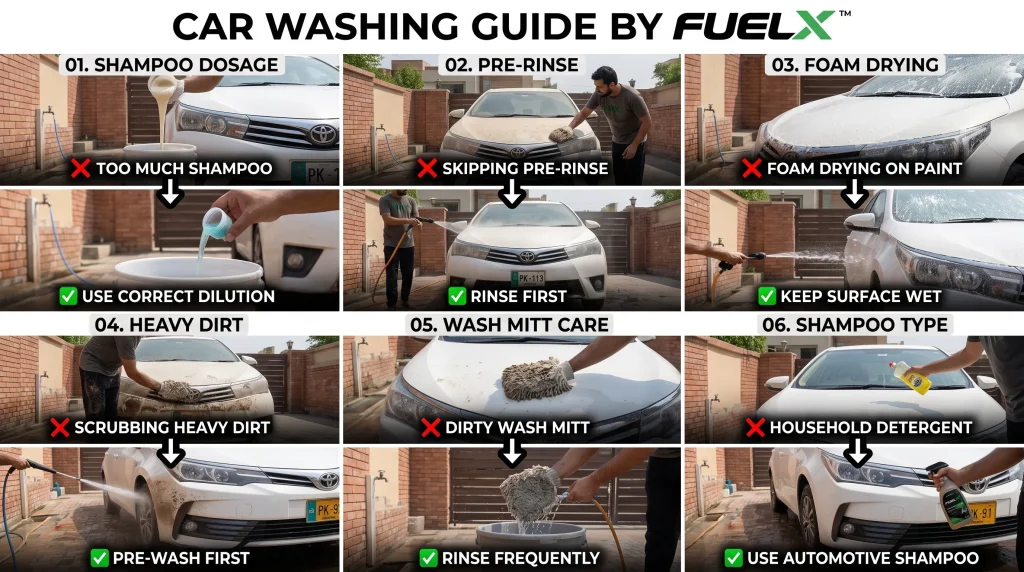
1. Using Too Much Shampoo
More shampoo does not automatically mean more cleaning.
Better approach: Follow the product’s recommended dilution and adjust only according to the manufacturer’s instructions.
2. Skipping the Pre-Rinse
Applying foam directly to heavy loose dirt increases the amount of contamination that has to be managed during the wash.
Better approach: Rinse → Foam → Rinse → Contact wash
3. Letting Foam Dry
Drying foam can leave residue and make the wash more difficult.
Better approach: Work in shade and rinse before the product dries.
4. Scrubbing Before Rinsing
This is particularly risky when a vehicle has visible dust or mud.
Better approach: Give loose contamination an opportunity to leave the surface before contact washing.
5. Using a Dirty Wash Mitt
A dirty mitt can carry contamination from one panel to another.
Better approach: Rinse the mitt frequently and use dedicated tools for especially dirty areas.
6. Using Household Detergent
Laundry detergent and dishwashing products are designed for very different cleaning jobs.
For regular vehicle washing, a purpose-made automotive shampoo gives you a more appropriate formulation and lubrication for the task.
FuelX Car Wash Shampoo, for example, is marketed as a pH-neutral automotive shampoo designed for regular exterior cleaning.
7. Assuming Foam Makes the Wash Scratch-Proof
It doesn’t.
Foam can help reduce contamination before contact washing, but no washing method makes paint immune to marring.
Your entire process matters:
- Pre-rinse
- Shampoo
- Wash media
- Rinsing
- Contact pressure
- Drying
- Towel cleanliness
Foam Cannon Car Washing in Pakistan
Car-washing conditions vary depending on location, season and driving habits.
Pakistan’s vehicles can encounter combinations of:
- Road dust
- Construction dust
- Mud
- Traffic grime
- Heat
- Pollution
- Rain
FuelX specifically markets its Car Wash Shampoo for conditions involving heat and dust in Pakistan.
Dusty Roads
If your car has a visible layer of dust, don’t immediately wipe it with a dry cloth.
A rinse is the safer starting point.
If you have a foam cannon, you can then use a pre-wash stage before contact cleaning.
Hot Weather
During hot weather, the biggest practical issue is preventing products from drying on the paint.
If you’re washing at midday in direct sunlight, even a small job can become frustrating because water and shampoo disappear from the surface quickly.
A shaded area and cool panels make the process easier.
Monsoon and Mud
Rain doesn’t necessarily mean a vehicle has been cleaned.
Rainwater can combine with road dirt and leave a layer of muddy contamination on the lower body.
After driving through muddy conditions:
Rinse → Foam → Rinse → Inspect → Contact wash if required
is more sensible than simply wiping the vehicle.
City Driving
A car can look relatively clean while still carrying a thin layer of road film.
That is where a pre-wash can be particularly useful.
Rather than judging cleanliness only by appearance, pay attention to what remains after the initial rinse.
Can You Wash a Car With Only a Foam Cannon?
Sometimes, but don’t assume that foam plus rinsing removes everything.
For a lightly dusty vehicle, an appropriate pre-wash followed by a thorough rinse may remove much of the loose contamination.
But if the surface still has:
- Road film
- Greasy contamination
- Stuck-on dirt
- Insects
- Other bonded contamination
you may need a contact wash.
A sensible decision process is:
Foam → Rinse → Inspect → Contact wash if needed
This is why a foam cannon is better understood as a pre-wash tool, rather than a guaranteed replacement for hand washing.
Can You Wash a Car Without a Foam Cannon?
Absolutely.
You do not need a pressure washer to establish a good car-washing routine.
A two-bucket setup can be enough.
Basic process:
- Pre-rinse the vehicle.
- Prepare shampoo solution.
- Prepare a separate rinse bucket.
- Load a clean wash mitt.
- Wash from top to bottom.
- Rinse the mitt regularly.
- Final rinse.
- Dry with a clean microfiber towel.
FuelX’s Car Wash Shampoo is also intended for a conventional wash process, with its instructions recommending a shampoo solution and application using a sponge or wash mitt.
Foam Cannon vs. Bucket: Which Setup Is Right for You?
Instead of asking which method is universally “better,” choose according to your situation.
Choose a Traditional Bucket Wash If:
- You don’t own a pressure washer.
- You want a simple setup.
- You’re new to detailing.
- You wash your vehicle regularly.
- You want to keep equipment costs relatively low.
Consider a Foam Cannon If:
- You already own a pressure washer.
- You wash your vehicle frequently.
- You want a dedicated pre-wash stage.
- Your car regularly accumulates loose road contamination.
- You enjoy a more detailed washing routine.
Consider Combining Both If:
- You want a more comprehensive DIY wash.
- Your car regularly accumulates road film.
- You want to reduce loose contamination before contact washing.
- You already have the equipment.
The important point is:
Foam and buckets don’t have to compete.
They can work together.
A Practical FuelX Car Wash Setup
If you’re building a home car-care setup from scratch, you don’t need to buy every detailing product at once.
Start with the basics.
Basic Wash Setup
A practical starting setup can include:
- FuelX Car Wash Shampoo
- Wash mitt
- Two buckets
- Microfiber drying towel
FuelX describes its Car Wash Shampoo as a high-foaming, pH-neutral product designed for removing dirt, dust, mud and road grime during regular vehicle washing.
Beginner Setup
For someone who wants a more convenient collection of basic car-washing products, FuelX also offers its Starter Wash Kit.
The idea is simple: rather than buying every detailing product separately, start with the products you will actually use regularly.
More Complete Setup
As your detailing routine develops, you can add products such as:
- Glass Cleaner
- Quick Detailer
- Tyre Shiner
- Microfiber Detailing Towel
FuelX’s product range includes these types of exterior-care products alongside its Car Wash Shampoo.
How Often Should You Foam-Wash Your Car?
There isn’t one correct number for every vehicle.
Your washing frequency should depend on:
- How often you drive
- Road conditions
- Weather
- Dust exposure
- Parking conditions
- Whether the vehicle is garaged
- How dirty the vehicle becomes
For example, a car driven daily on dusty roads may need attention considerably sooner than a weekend vehicle kept indoors.
The better rule is:
Wash based on contamination rather than blindly following a fixed calendar.
If the vehicle is visibly dirty, don’t wait for an arbitrary date simply because you washed it seven days ago.
How Much Water Does a Two-Bucket Wash Need?
This also varies by setup and technique.
A common detailing reference is two 5-gallon buckets, equivalent to roughly 18.9 litres each. That gives approximately 38 litres of bucket capacity, although the actual amount of water used during a wash can differ because additional water may be used for pre-rinsing and final rinsing.
You don’t need exactly 18.9-litre buckets.
The important principle is:
One clean wash solution + one separate rinse supply.
If your buckets are smaller, simply make sure there is enough water to rinse the mitt properly without constantly running out.
Foam Cannon vs. Bucket: The Best Practical Workflow
For a DIY enthusiast who owns a pressure washer, a highly practical routine looks like this:
1. Pre-Rinse
Remove loose dirt.
2. Foam
Apply the appropriate shampoo solution.
3. Dwell
Allow approximately 1–2 minutes where appropriate, while preventing the product from drying. Follow the product instructions.
4. Rinse
Remove foam and loosened contamination.
5. Inspect
Decide whether the vehicle needs contact washing.
6. Two-Bucket Wash
Use separate wash and rinse buckets.
7. Final Rinse
Remove remaining shampoo.
8. Dry
Use clean microfiber drying media.
In simple form:
Pre-rinse → Foam → Dwell → Rinse → Two-bucket wash → Final rinse → Dry
This is not about using the most equipment possible.
It is about giving each tool a specific job.
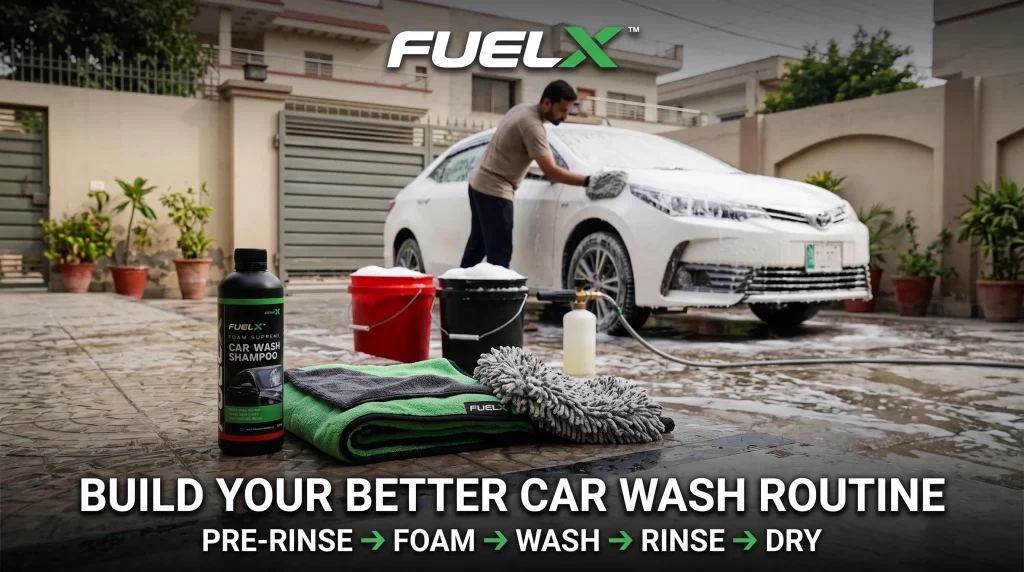
Final Takeaway
A foam cannon isn’t simply a modern replacement for the bucket.
And the two-bucket method isn’t obsolete because foam cannons look more impressive.
They perform different jobs.
A foam cannon can help loosen and remove some contamination before you touch the paint.
A two-bucket wash helps manage contamination once your wash mitt is making contact with the vehicle.
For many everyday car owners, the practical approach is:
Pre-rinse → Foam → Rinse → Two-bucket wash → Final rinse → Dry
If you don’t own a pressure washer, don’t feel that you’re missing an essential piece of equipment. A careful two-bucket wash using a suitable automotive shampoo, clean wash media and proper technique can still form the foundation of an effective home car-care routine.
And remember:
The goal isn’t the thickest foam or the biggest bucket. The goal is removing dirt while minimizing unnecessary friction against your car’s paint.
FAQ’s
Is a foam cannon better than a two-bucket wash?
They perform different functions. A foam cannon is primarily useful as a pre-wash, while the two-bucket method is designed for contact washing and contamination management.
Does a foam cannon prevent scratches?
No washing system can guarantee scratch-free results. A foam pre-wash can help reduce loose contamination before contact, while careful wash and drying techniques further reduce the opportunity for paint marring.
How long should foam sit on a car?
A practical reference for some foam-washing procedures is around 1–2 minutes, but the correct dwell time depends on the product, temperature and conditions. Most importantly, don’t allow the foam to dry on the vehicle.
Do I still need two buckets with a foam cannon?
If you’re going to perform a contact wash after foaming, using separate wash and rinse buckets is a sensible way to manage contamination.
Can I use regular car shampoo in a foam cannon?
Only if the product is appropriate for foam-cannon use and the manufacturer’s instructions support that application. Follow the product’s recommended dilution rather than assuming that any shampoo will behave the same way.
Can I wash a car with only a foam cannon?
For light contamination, a suitable pre-wash and thorough rinse may remove much of the loose dirt. However, remaining road film or bonded contamination may still require contact washing.
Can I wash a car without a pressure washer?
Yes. A careful two-bucket wash remains a practical option for home car care.
Is foam cannon washing safe for ceramic-coated cars?
Generally, the key is using products compatible with the coating and following the coating manufacturer’s maintenance instructions. Avoid assuming that every cleaning chemical is suitable simply because it creates foam.
What is the best way to dry a car after washing?
Use a clean, suitable microfiber drying towel and minimize unnecessary rubbing. Drying should be treated as part of the paint-care process, not just a way to remove visible water.
About FuelX Research & Detailing Lab
FuelX engineers high-performance automotive cooling solutions and specialized car detailing products engineered for Pakistan's demanding driving conditions. All guides and tips are validated by our technical team to ensure engine longevity and lasting vehicle protection.
Keep Your Engine Cool & Your Ride Shining
Shop FuelX certified Long Life Coolants, high-gloss tyre shine, safe car wash shampoo, and lint-free microfiber accessories.