Engine Coolant: When and How to Change It
Engine coolant is one of the most important fluids in your car, yet many drivers only think about it when the temperature gauge starts moving toward the red zone.
That’s a problem because the cooling system is working every time the engine is running. During combustion, temperatures inside the engine can become extremely high. Toyota explains that typical combustion temperatures can reach around 2,000°F (about 1,093°C) and may rise as high as 4,500°F (about 2,482°C) in extreme cases. The cooling system has to continuously manage that heat to prevent engine damage.
Engine coolant helps transfer this heat away from the engine while also providing corrosion protection and, depending on the formulation, protection against freezing and boil-over.
But here’s the important part:
There is no single coolant-change interval that applies to every car.
Some vehicles use conventional coolant with relatively short service intervals, while extended-life coolant systems can remain in service for several years. Toyota, for example, says coolant replacement depends on the vehicle and coolant type and gives examples ranging from around 2 years/30,000 miles for certain silicate-based coolants to around 5 years/100,000 miles for certain extended-drain coolants.
So, when should you change your coolant? And what is the correct way to do it?
Let’s break it down.
What Does Engine Coolant Actually Do?
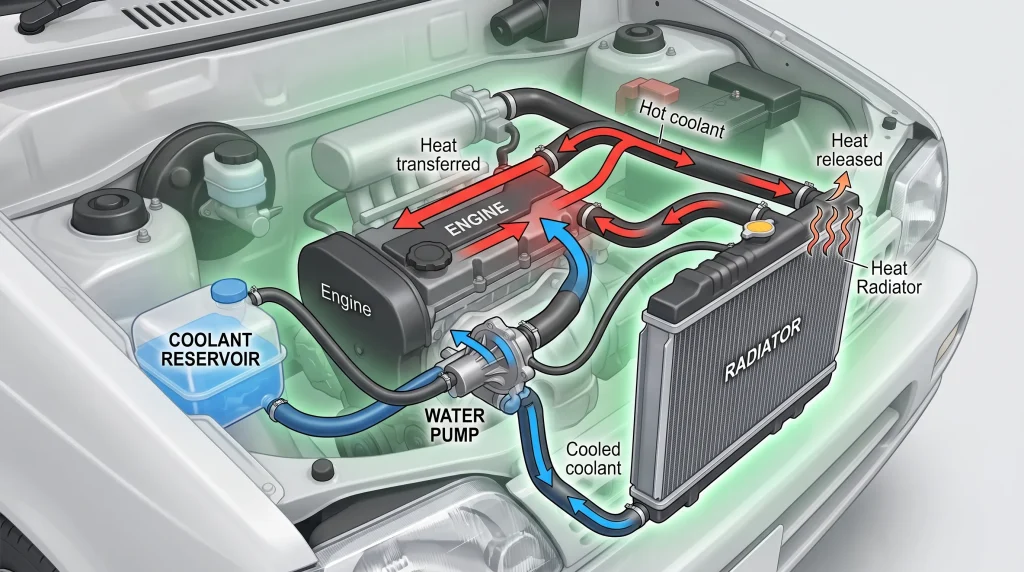
Think of engine coolant as your car’s heat-transfer and cooling-system protection fluid.
When fuel burns inside the engine, a large amount of heat is produced. Coolant circulates through passages around the engine, absorbs heat and carries it toward the radiator. The radiator then releases that heat into the surrounding air.
Without this continuous process, engine temperatures could quickly rise beyond safe operating conditions.
But temperature control is only one part of the job.
1. It helps control engine temperature
Coolant constantly moves between the engine and radiator.
A simplified version of the process looks like this:
Engine produces heat → coolant absorbs heat → radiator releases heat → coolant returns to engine
This cycle happens continuously while the engine is operating.
If coolant level is too low, contaminated or otherwise unsuitable for the vehicle, the cooling system may not operate as intended.
Prestone notes that low coolant means less heat transfer and therefore increases the risk of overheating.
2. It helps protect against corrosion
Modern coolant isn’t simply coloured water.
Coolant formulations contain additives designed to help protect cooling-system components against corrosion, rust, scale and deposits.
As coolant ages or becomes contaminated, its protective performance can deteriorate. Dirty coolant can accelerate corrosion, reduce fluid flow and contribute to clogging.
That’s why replacing old coolant isn’t only about preventing overheating.
It is also about maintaining the condition of the:
- Radiator
- Water pump
- Engine cooling passages
- Hoses
- Thermostat housing
- Other cooling-system components
3. It provides boil-over and freeze protection
The water component of a coolant mixture is excellent at transferring heat, but water alone has limitations.
Coolant/antifreeze formulations are designed to provide additional protection against boiling and freezing and to include corrosion-inhibiting additives. Toyota explains that coolant is generally based on a mixture of water and antifreeze, with the exact requirements depending on the vehicle and conditions.
For a driver in Pakistan, freezing temperatures may not be the main concern in most regions, but boil-over protection and corrosion protection remain important.
4. It helps protect the cooling system itself
A cooling system isn’t just a radiator.
It includes a network of components that must work together:
- Radiator
- Water pump
- Hoses
- Thermostat
- Engine coolant passages
- Expansion/recovery reservoir
- Cooling fan system
For example, if deposits restrict coolant flow through the radiator or engine passages, the system’s ability to transfer heat can be affected.
Prestone states that even 1/16 inch of radiator buildup can reduce cooling capability by roughly 40%. This is a manufacturer claim rather than a universal measurement for every cooling system, but it illustrates why contamination and deposits shouldn’t be ignored.
When Should You Change Engine Coolant?
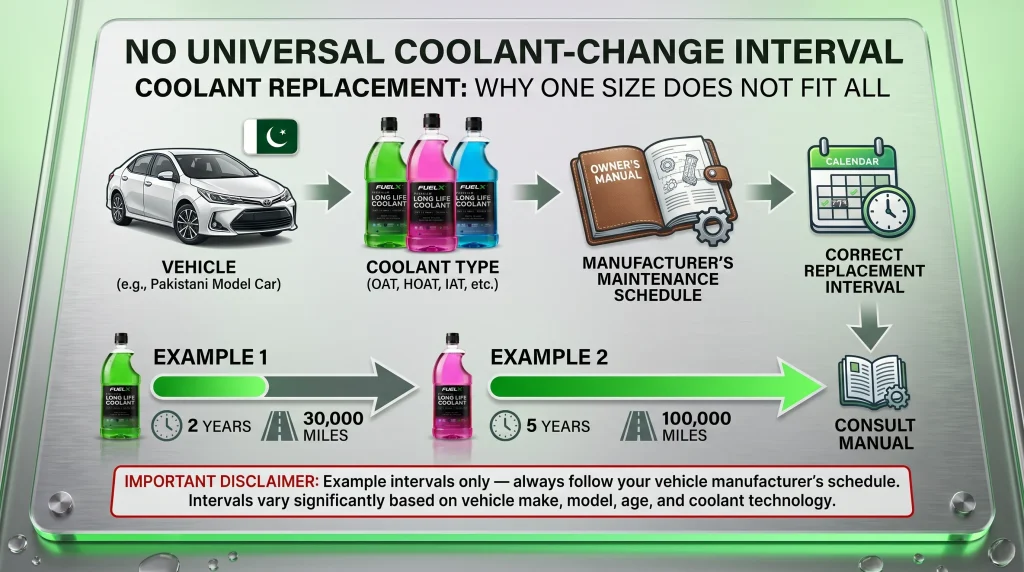
The safest answer is:
Follow the coolant replacement interval specified by your vehicle manufacturer.
There isn’t one magic number such as “every two years” that works for every car.
The correct interval depends on factors including:
- Vehicle make and model
- Model year
- Coolant formulation
- Cooling-system design
- Driving conditions
- Manufacturer’s maintenance schedule
Toyota specifically recommends following the interval provided in the vehicle’s owner’s manual.
What do actual coolant intervals look like?
This is where things get interesting.
Toyota gives examples of approximately:
| Coolant type/example | Example replacement interval |
| Certain silicate-based coolant | About 2 years / 30,000 miles |
| Certain extended-life coolant | Up to 5 years / 100,000 miles |
These are examples, not universal rules. Your vehicle may specify a different interval.
For example, 30,000 miles is roughly 48,000 kilometres, while 100,000 miles is approximately 161,000 kilometres.
That’s a huge difference.
This is why blindly following a mechanic’s generic “change coolant every two years” recommendation may not be appropriate for every vehicle.
Follow these four sources of information
Before changing coolant, check:
- Owner’s manual
- Manufacturer maintenance schedule
- Required coolant specification
- Instructions on the coolant product
If you cannot establish what coolant is currently in the car, especially after purchasing a used vehicle, have the cooling system inspected rather than guessing.
7 Signs Your Engine Coolant May Need Attention
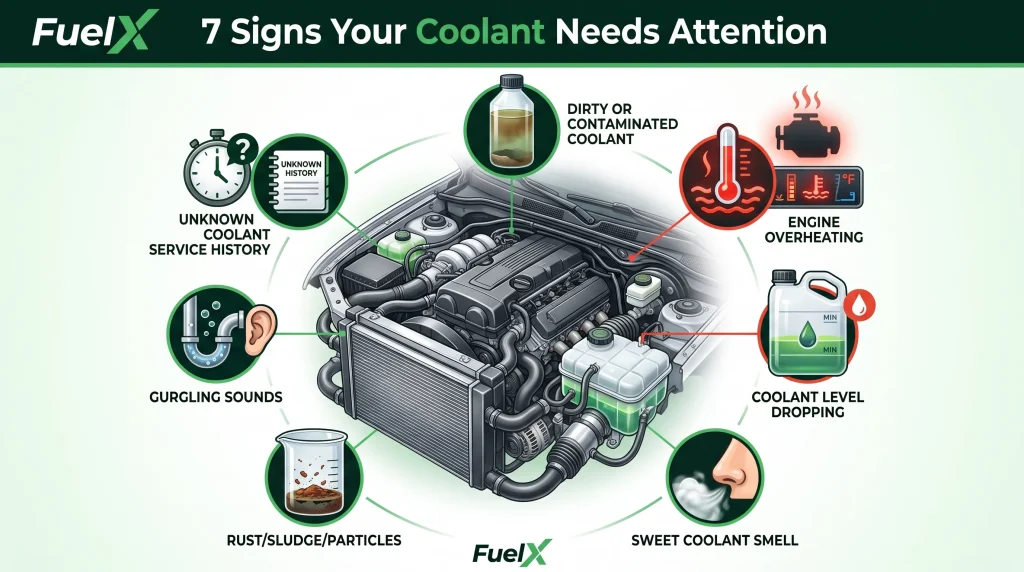
The service interval isn’t the only reason to inspect your coolant.
Your vehicle can develop a cooling-system problem between scheduled services.
1. The coolant looks dirty or contaminated
Healthy coolant shouldn’t contain obvious sludge, heavy sediment, excessive rust particles or other contamination.
If the fluid looks dirty, don’t simply pour new coolant into the reservoir and assume the problem is solved.
Depending on the condition, the system may need a drain-and-fill, flushing or further inspection.
Prestone specifically recommends replacing dirty coolant because contamination can accelerate corrosion, rust and damage while reducing fluid flow and increasing the possibility of clogging.
2. Your engine starts overheating
This is one of the most important warning signs.
You may notice:
- Temperature gauge moving unusually high
- Temperature warning light
- Steam from the engine bay
- Loss of power
- Repeated overheating during traffic
However, overheating doesn’t automatically mean that the coolant itself needs replacing.
Possible causes include:
- Low coolant
- Coolant leak
- Faulty thermostat
- Radiator problem
- Water-pump failure
- Cooling-fan problem
- Restricted coolant passages
If the temperature gauge reaches the danger zone, stop safely and allow the engine to cool. Don’t continue driving simply because the car still starts.
Toyota similarly advises stopping safely when an engine coolant-temperature warning indicates overheating.
3. The coolant level keeps dropping
A cooling system should not require frequent unexplained top-ups.
For example, imagine you fill the reservoir to the correct level today and discover that it has fallen significantly a week later.
Instead of repeatedly adding coolant, ask:
Where is the coolant going?
Possible causes include:
- Radiator leak
- Hose leak
- Water-pump leak
- Reservoir leak
- Faulty cap
- Other cooling-system faults
Prestone recommends checking for leaks if coolant levels remain low after topping up.
4. You notice a sweet smell
A sweet smell around the engine bay can be a sign of leaking coolant.
You may notice it:
- After parking
- Around the engine bay
- Near the radiator
- Inside the cabin if the heater system has a problem
Don’t investigate a hot cooling system by opening the radiator cap.
Wait until the engine is completely cool.
5. You see rust, sludge or particles
If the coolant contains visible rust-coloured particles, sludge or sediment, the cooling system deserves attention.
Contamination can interfere with coolant flow and contribute to deposits and corrosion.
Again, the answer isn’t necessarily “buy another bottle of coolant.”
The correct solution may involve draining, flushing and diagnosing the cause of the contamination.
6. You hear gurgling or unusual cooling-system noises
A gurgling sound can sometimes occur when air is present in the cooling system or when coolant levels are low.
It isn’t a diagnosis by itself.
But if the noise keeps returning—especially alongside coolant loss or overheating—have the cooling system inspected.
Toyota identifies gurgling as a possible sign associated with air pockets resulting from insufficient coolant.
7. You don’t know when the coolant was last changed
This is extremely common with used cars.
Suppose you purchase a 7-year-old vehicle and the previous owner cannot provide any coolant-service records.
Even if the coolant looks clean, you don’t know:
- What coolant was used
- When it was installed
- Whether it was mixed with another formulation
- Whether the correct concentration was used
In this situation, establishing a documented maintenance baseline can make more sense than guessing.
Coolant Change vs Coolant Flush: What’s the Difference?
These terms are often used interchangeably, but they don’t necessarily mean exactly the same thing.
Drain and refill
A basic coolant replacement generally involves:
- Draining the old coolant
- Closing the drain point
- Refilling with the correct coolant
- Removing trapped air according to the vehicle procedure
- Checking the system for leaks
- Rechecking the coolant level
This may be appropriate when the coolant is due for scheduled replacement and the cooling system is otherwise healthy.
Flush and refill
A flush goes further.
The old coolant is removed and the cooling system is flushed to help remove contaminants, rust, deposits or old coolant before fresh coolant is installed.
A flush may be appropriate when:
- Coolant is heavily contaminated
- There is significant sediment
- The wrong coolant was previously used
- The manufacturer specifies flushing
- The cooling system has been repaired
- The condition of the old coolant requires more extensive cleaning
Prestone describes both drain-and-fill and flush-and-fill procedures for dealing with dirty coolant.
Important: Don’t assume every coolant replacement requires an aggressive chemical flush.
The appropriate procedure depends on the vehicle and the condition of the cooling system.
What You Need Before Changing Engine Coolant
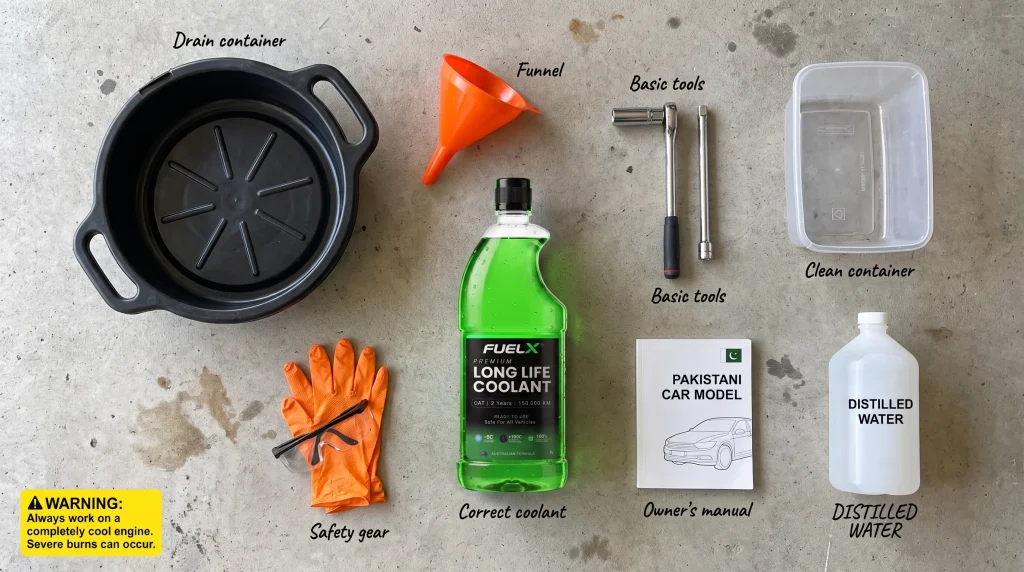
If you’re performing the service yourself, preparation matters.
You’ll typically need:
- Correct replacement coolant
- Suitable drain pan
- Gloves
- Safety glasses
- Funnel
- Appropriate hand tools
- Distilled/deionized water if required for a concentrate
- Owner’s manual
The most important tool, however, is something that costs nothing:
Patience.
Let the engine cool completely
Never remove a radiator or pressure cap from a hot, pressurized cooling system.
Hot coolant can cause serious burns.
Prestone and vehicle manufacturers specifically instruct owners to work with the pressure cap when the engine is cold.
If you’ve just driven for 30 minutes, don’t immediately open the radiator.
Give the engine sufficient time to cool completely.
How to Change Engine Coolant Safely
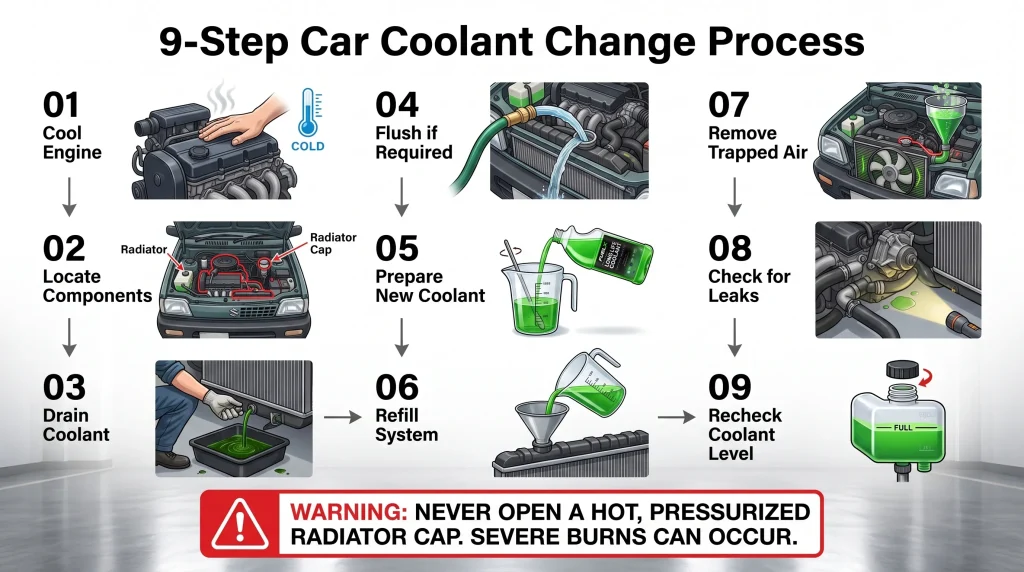
The exact process varies by vehicle, so consider this a general guide rather than a substitute for the owner’s manual.
Step 1: Park safely and let the engine cool
Park on a level surface.
Switch off the engine and wait until it has completely cooled.
If you’ve just driven the car, don’t rush this step.
Step 2: Locate the cooling-system components
Identify:
- Radiator
- Coolant reservoir
- Radiator/pressure cap
- Drain point
- Relevant hoses
Your owner’s manual can help identify the correct components.
Different vehicles use different layouts.
Step 3: Drain the old coolant
Place a suitable drain container beneath the drain point.
Drain the old coolant according to the manufacturer’s procedure.
Don’t allow coolant to run onto the ground.
Coolant/antifreeze can be poisonous, particularly to animals, and should be kept away from children and pets.
Step 4: Flush the system if required
If the coolant is heavily contaminated or the vehicle’s service procedure calls for flushing, perform the appropriate flush.
The objective is to remove unwanted:
- Rust
- Sediment
- Deposits
- Old coolant
- Contamination
A cooling-system cleaner may sometimes be used where appropriate, but always follow the vehicle and product instructions.
Step 5: Prepare the new coolant
This is where many DIY coolant changes go wrong.
First determine whether your product is:
Premixed
Ready to use according to the label.
Concentrated
Requires dilution according to the manufacturer’s instructions.
For example, some coolant concentrates are mixed with water to achieve the required coolant-to-water ratio. Prestone recommends distilled water when preparing its concentrate.
Never assume that every coolant bottle is ready to pour directly into the radiator.
Read the label.
Step 6: Refill the cooling system
Fill the system with the correct coolant according to the vehicle’s procedure.
Don’t simply fill the reservoir to the top.
Many reservoirs have markings such as:
MIN / MAX
or
LOW / FULL
The coolant needs room to expand as it heats.
Prestone warns that overfilling can also create problems because coolant needs room to expand.
Step 7: Remove trapped air
Some vehicles require a specific bleeding procedure.
This is important because air trapped inside the cooling system can interfere with coolant circulation.
Don’t assume that every vehicle can be bled using the same method.
Follow the manufacturer’s procedure.
If the vehicle has a complicated bleeding process, professional service may be the safer option.
Step 8: Check for leaks
Inspect the cooling system after servicing.
Look around:
- Radiator
- Hoses
- Drain plug
- Reservoir
- Water-pump area
- Connections
A small leak can eventually become a major cooling-system problem.
Step 9: Recheck the coolant level
After the system has been serviced and the engine has cooled again, check the coolant level.
If the level drops repeatedly, don’t keep adding coolant without investigating.
A recurring drop indicates that something may be wrong.
How to Choose the Right Engine Coolant
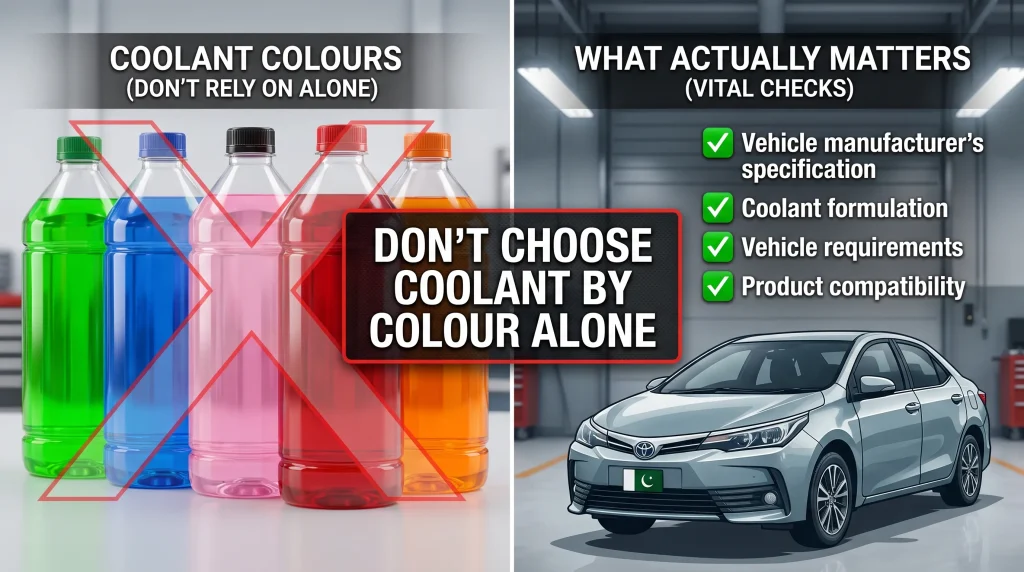
Buying coolant should not be as simple as walking into a shop and saying:
“Give me the green one.”
That’s because coolant colour is not a universal compatibility standard.
Don’t choose coolant by colour alone
You may see:
- Green
- Blue
- Pink
- Red
- Orange
- Yellow
But colour doesn’t tell you everything about coolant chemistry or compatibility.
Two products with different colours may have different formulations, while two products with similar colours aren’t necessarily interchangeable.
Toyota, for example, specifies particular coolant formulations for its vehicles rather than relying simply on colour.
Check your manufacturer’s specification
Before purchasing, check:
- Vehicle owner’s manual
- Manufacturer service documentation
- Required coolant specification
- Product label
If you aren’t sure, ask a qualified technician.
Can You Use Water Instead of Engine Coolant?
This is one of the most common questions among Pakistani drivers.
The short answer is:
Plain water should not be treated as a permanent replacement for the correct coolant.
Water can transfer heat effectively, but it doesn’t provide the same complete package of corrosion protection and boiling/freezing protection provided by an appropriate coolant mixture.
Toyota specifically states that water alone should not be used as engine coolant.
What about an emergency?
If your coolant level is dangerously low while you’re away from a workshop, the appropriate temporary response depends on your vehicle, circumstances and manufacturer’s instructions.
But there is an important distinction:
Emergency top-up ≠ proper coolant maintenance.
If you repeatedly have to add water, stop treating it as a normal routine.
Find out why the coolant level is dropping.
How Often Should You Check Coolant Level?
Checking coolant level is not the same thing as replacing coolant.
You can inspect the level much more frequently than you replace the fluid.
A quick check before a long trip can take less than a minute when the engine is cold.
Look at the coolant reservoir and compare the level with the manufacturer’s markings.
For example, if the reservoir has:
MIN ───────── MAX
the level should generally sit within the specified range when cold.
Don’t remove the radiator cap simply to check the level if your vehicle uses a pressurized expansion tank system. Follow the vehicle’s instructions.
8 Common Engine Coolant Mistakes to Avoid
Mistake 1: Opening the radiator cap while hot
Why it’s dangerous: Pressurized coolant can cause serious burns.
Better approach: Wait until the engine is completely cold.
Mistake 2: Choosing coolant only by colour
Why it’s risky: Colour doesn’t establish compatibility.
Better approach: Follow the required coolant specification.
Mistake 3: Mixing unknown coolant types
Why it’s risky: You may create an incompatible mixture.
Better approach: Confirm compatibility or have the system properly serviced.
Mistake 4: Using plain water permanently
Why it’s risky: Water doesn’t provide the complete protection offered by the correct coolant formulation.
Better approach: Use the coolant specified for your vehicle.
Mistake 5: Ignoring repeated coolant loss
Why it’s risky: You’re treating the symptom rather than finding the cause.
Better approach: Inspect the system for leaks or mechanical faults.
Mistake 6: Assuming overheating always means “add coolant”
Why it’s risky: The problem could be a thermostat, radiator, fan, water pump or another component.
Better approach: Diagnose the cooling system.
Mistake 7: Forgetting to bleed trapped air
Why it’s risky: Some vehicles require air removal for proper coolant circulation.
Better approach: Follow the manufacturer’s bleeding procedure.
Mistake 8: Pouring used coolant onto the ground
Why it’s risky: Coolant can be hazardous to people, pets and the environment.
Better approach: Collect it safely and use an appropriate disposal/recycling route.
Engine Coolant Maintenance Tips for Pakistani Drivers
Pakistan presents some demanding driving conditions for cooling systems.
During summer, ambient temperatures in many parts of the country can become very high. Heavy traffic can also mean the vehicle spends long periods moving slowly or idling, while dusty roads can add additional maintenance concerns.
PakWheels’ 2026 summer car-care guidance specifically recommends checking coolant levels only when the engine is completely cold and visually inspecting radiator hoses for cracking, swelling and leaks.
That doesn’t mean every Pakistani vehicle needs a shorter coolant replacement interval.
Instead, it means cooling-system inspection becomes particularly important.
Check coolant before long summer trips
Before heading out on a long journey:
- Check the coolant level
- Inspect visible hoses
- Look for leaks
- Check the temperature gauge behaviour
- Confirm the cooling system has been serviced according to schedule
A five-minute inspection can help identify an obvious problem before it becomes a roadside breakdown.
Pay attention in heavy traffic
Imagine sitting in Lahore traffic on a 42°C afternoon with the air conditioner running and the engine idling for an extended period.
Your cooling system is still responsible for controlling engine temperature.
If the temperature gauge suddenly behaves differently from normal, don’t ignore it.
Inspect after cooling-system repairs
If you’ve recently replaced:
- Radiator
- Hose
- Water pump
- Thermostat
- Radiator cap
check the system according to the manufacturer’s procedure afterward.
Don’t normalize frequent top-ups
If you’re adding coolant every few days or weeks, that’s not a maintenance routine.
It’s a warning.
A healthy system should not continuously lose coolant.
FuelX Long Life Coolant: Choosing the Right Option
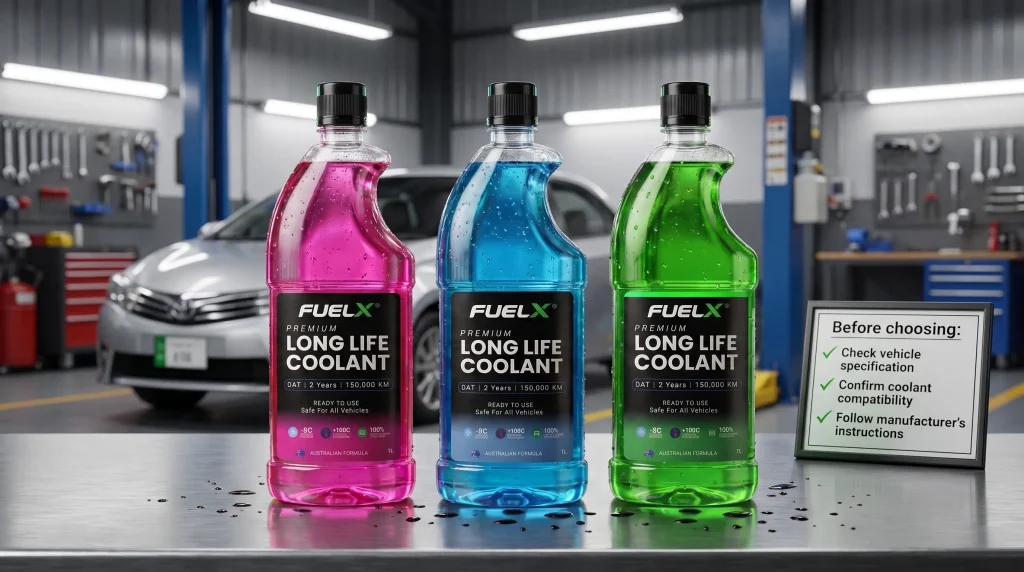
When your vehicle’s maintenance schedule calls for coolant replacement, choosing the correct product matters.
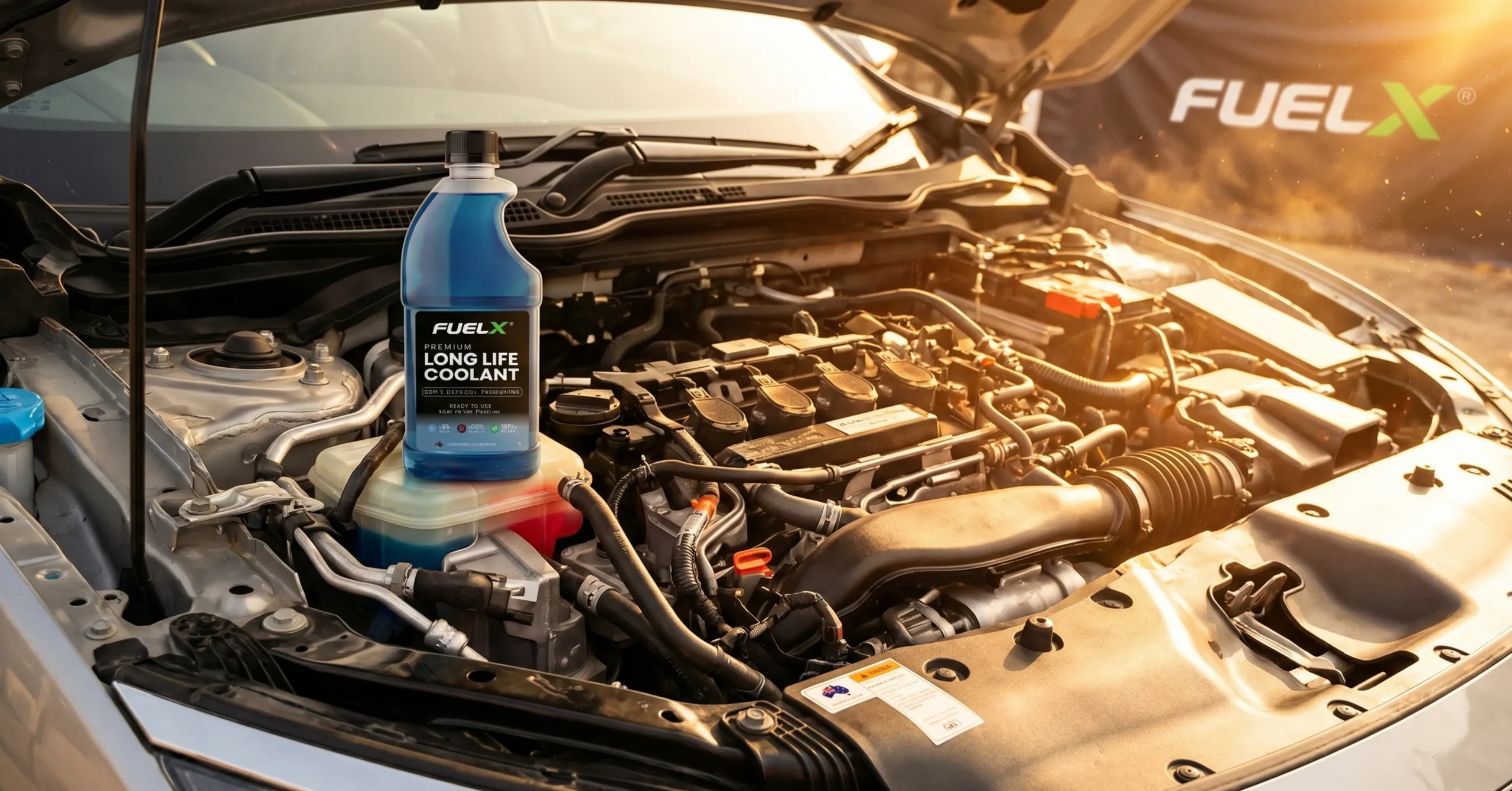
FuelX offers several Long Life Coolant options, including:
- FuelX Long Life Coolant — Pink
- FuelX Long Life Coolant — Blue
- FuelX Long Life Coolant — Green
However, don’t select one simply because its colour matches the coolant already in your reservoir.
Start with your vehicle manufacturer’s specification.
Then check whether the FuelX coolant you’re considering is suitable for that requirement.
The goal is not:
“Find the same colour.”
The goal is:
“Use the correct coolant specification for the vehicle.”
When Should You Have a Mechanic Change the Coolant?
DIY coolant replacement can be manageable on some vehicles, but professional service is a better choice when the job involves uncertainty or a more complicated cooling system.
Consider getting professional help if:
- You cannot identify the correct coolant specification.
- You don’t know how to safely drain the system.
- The vehicle requires a special bleeding procedure.
- The engine is overheating.
- Coolant keeps disappearing.
- You find oil-like contamination in coolant.
- The coolant contains heavy rust or sludge.
- The radiator or water pump is leaking.
- The cooling system has recently been repaired.
- You don’t have a safe method for collecting used coolant.
Remember:
Changing coolant is maintenance. Diagnosing an overheating engine is a repair job.
Don’t use a coolant change to try to hide a mechanical problem.
Final Takeaway
Engine coolant isn’t something you should replace simply because someone told you:
“Change it every two years.”
Your car may have a completely different maintenance schedule.
Instead, use this simple approach:
Check → Follow → Match → Replace → Inspect
- Check the coolant level and condition.
- Follow the manufacturer’s replacement interval.
- Match the coolant to the required vehicle specification.
- Replace the coolant using the correct procedure.
- Inspect the system if coolant keeps disappearing or the engine overheats.
For Pakistani drivers, this is especially important during hot-weather driving and long journeys. A cooling system that is properly maintained has a much better chance of handling the heat and traffic conditions your vehicle encounters.
And remember one of the most important coolant rules:
Don’t choose coolant by colour alone. Choose it by specification.
If your vehicle is due for coolant replacement, explore the FuelX Long Life Coolant range and select the product that matches your vehicle manufacturer’s requirements.
FAQ’s
How often should engine coolant be changed?
There is no universal interval. Follow your vehicle manufacturer’s schedule because coolant service intervals vary by vehicle and coolant formulation. Toyota gives examples ranging from approximately 2 years/30,000 miles for certain conventional formulations to around 5 years/100,000 miles for certain extended-life coolants.
How do I know if my coolant needs changing?
Check the manufacturer’s service interval, maintenance history and coolant condition. Visible contamination, repeated overheating or unexplained coolant loss are reasons to investigate the cooling system.
Can I change engine coolant myself?
Some vehicles allow straightforward drain-and-refill procedures, while others require special bleeding procedures or equipment. If you’re uncertain about the procedure, professional service is safer.
Can I mix different coolant colours?
Don’t make the decision based on colour. Check the coolant specifications and compatibility first.
Can I use tap water with coolant?
It depends on the coolant and vehicle requirements. Some concentrates require a particular dilution method and water type. Follow the coolant manufacturer’s and vehicle manufacturer’s instructions.
What happens if you never change coolant?
Over time, coolant’s protective additives can deteriorate. Contamination, corrosion and deposits can affect coolant flow and cooling-system components.
Should I flush the radiator or just replace the coolant?
It depends on the condition of the coolant and the vehicle’s requirements. A routine replacement doesn’t automatically mean an aggressive flush is necessary. Heavily contaminated coolant may require more extensive cleaning.
Is low coolant always caused by evaporation?
No. Repeated coolant loss can indicate a leak or another cooling-system problem. If the level keeps falling, have the system inspected instead of repeatedly topping it up.
About FuelX Research & Detailing Lab
FuelX engineers high-performance automotive cooling solutions and specialized car detailing products engineered for Pakistan's demanding driving conditions. All guides and tips are validated by our technical team to ensure engine longevity and lasting vehicle protection.
Keep Your Engine Cool & Your Ride Shining
Shop FuelX certified Long Life Coolants, high-gloss tyre shine, safe car wash shampoo, and lint-free microfiber accessories.