Quick Detailer vs. Wax: Which Should You Use?
If you want your car to stay clean, glossy, and well-maintained, you have probably come across two common detailing products: quick detailer and car wax.
At first glance, they can seem like alternatives. Both can improve the appearance of automotive paint, add gloss, and make a freshly detailed car look better. But they are designed for different stages of car care.
A quick detailer is primarily a maintenance product for light contamination between washes, while car wax is primarily used to provide a protective layer and enhance the appearance of properly prepared paint.
For Pakistani car owners, knowing the difference is particularly useful. A car parked outside can collect dust, fingerprints and light road contamination soon after washing. At the same time, regular exposure to sunlight, rain, dust and everyday driving makes periodic paint protection an important part of exterior maintenance.
So, which should you use?
Use a quick detailer for appropriate light, between-wash maintenance. Use wax when you want to apply or refresh dedicated paint protection. In a well-planned detailing routine, you may use both.
What Is a Quick Detailer?
A quick detailer is a spray-on exterior-care product designed to refresh a relatively clean vehicle between regular washes.
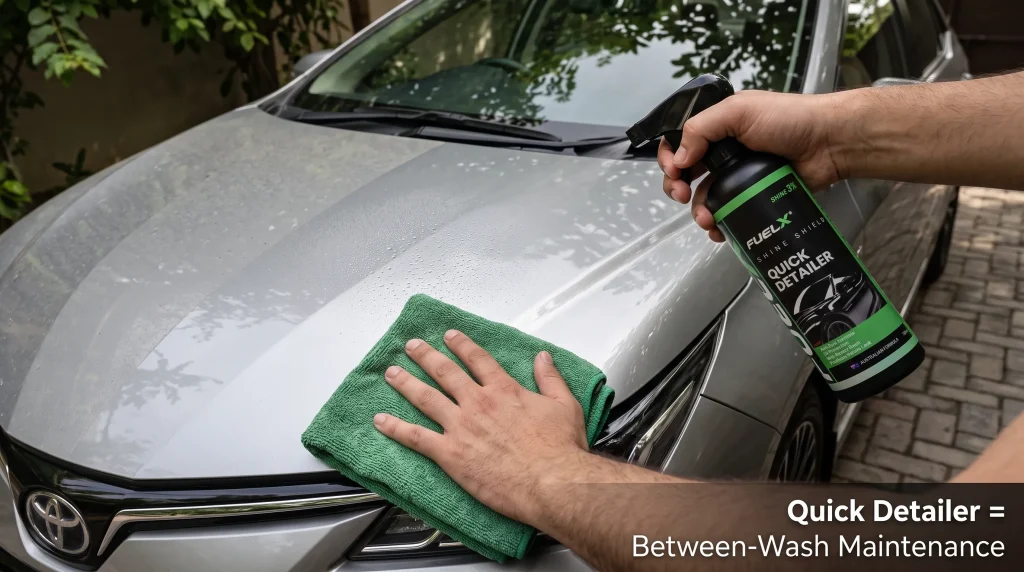
Depending on the formulation, it can help deal with light contamination such as:
- Light dust
- Fingerprints
- Minor smudges
- Fresh water spots
- Light surface residue
Quick detailers are formulated with lubricating ingredients that help the towel move more smoothly across the paint. This is important because wiping dry dust directly across automotive paint can increase the risk of creating fine marks.
For example, imagine you washed your car on Sunday. You drive it to work for several days and park outdoors. By Wednesday or Thursday, there may be a thin layer of dust and a few fingerprints on the doors or bonnet.
If the contamination is genuinely light, a suitable quick detailer can be useful for a fast maintenance session instead of immediately performing another full detailing routine.
FuelX describes its Quick Detailer as a spray-on product for light dust, fingerprints and light dirt, with the additional purpose of enhancing gloss. Its instructions also specifically state that heavy mud or thick dirt should be removed before using the product.
An Important Limitation
A quick detailer is not a replacement for washing a heavily dirty car.
If your vehicle has mud, sand, thick road grime or substantial contamination, don’t simply spray detailer over it and start wiping.
Think about it like cleaning a table.
A few fingerprints can be wiped away easily. But if the table is covered with wet mud and grit, you would clean it properly rather than rubbing the contamination around.
The same principle applies to car paint.
Meguiar’s detailing guidance similarly distinguishes quick detailers from proper washing, recommending detailers for light or fresh contamination and a traditional wash when dirt and debris become moderate or heavy.
When Should You Use a Quick Detailer?
A quick detailer can be useful when:
- Your car was recently washed.
- Only light dust has accumulated.
- You have fingerprints or small smudges.
- You want to refresh the paint’s gloss.
- You need a quick exterior touch-up.
- You want to maintain a recently detailed finish.
For example, if you wash your car once or twice a week but notice light dust between washes, a quick detailer can become a convenient maintenance step.
FuelX’s current product instructions describe a spray, gentle wipe and buff process and recommend working section by section across the vehicle.
What Is Car Wax?
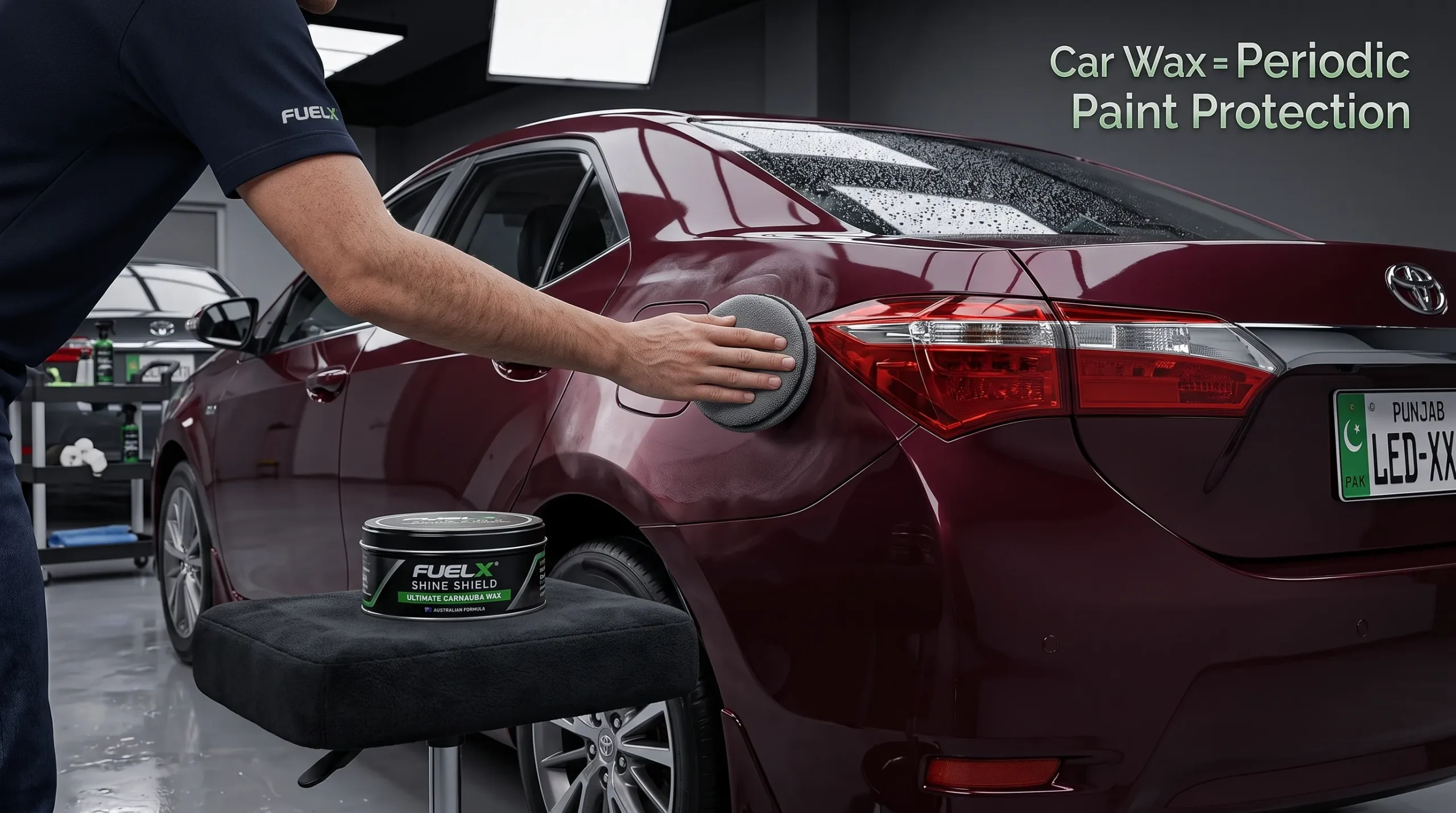
Car wax is primarily a paint-protection product.
It is normally applied to properly cleaned paint to leave a protective layer over the surface. Wax can also improve gloss, slickness and water beading.
The exact characteristics depend on the product. Traditional waxes may contain natural waxes such as carnauba, while modern products can use synthetic polymers or blends.
That means two products marketed as “wax” don’t necessarily provide exactly the same durability or appearance.
What Does Wax Do?
A suitable wax can help:
- Enhance paint gloss
- Improve surface slickness
- Encourage water to bead
- Provide a degree of protection from everyday environmental exposure
- Improve the appearance of properly maintained paint
But wax is not a permanent shield.
Sunlight, rain, washing, dust, road contamination and normal driving gradually affect protective products. The useful life of a wax therefore depends on the formulation and the conditions in which the vehicle is used.
That’s why waxing should be considered periodic maintenance, rather than a one-time treatment that permanently protects your paint.
When Should You Wax Your Car?
Wax makes the most sense when you’re already performing a more thorough exterior-care session.
A simple routine can be:
Wash → Dry → Prepare the surface → Apply wax → Finish according to instructions
The important part is surface preparation.
If your car has several weeks of accumulated dirt, mud and road grime, applying wax directly isn’t the correct first step.
Clean the surface first.
Wax should be applied according to the manufacturer’s instructions and to a suitably clean surface.
Quick Detailer vs. Wax: What’s the Difference?
The easiest way to remember the distinction is:
Quick detailer = maintenance.
Wax = periodic protection.
| Feature | Quick Detailer | Car Wax |
| Main purpose | Light exterior maintenance | Periodic paint protection |
| Typical use | Between washes | Periodically |
| Application | Usually spray and wipe | Usually requires more preparation |
| Light dust | Suitable when product allows | Not its primary purpose |
| Heavy dirt | No | No |
| Gloss enhancement | Yes | Yes |
| Protection | Depends on formulation | Main purpose |
| Best for | Quick upkeep | Exterior detailing |
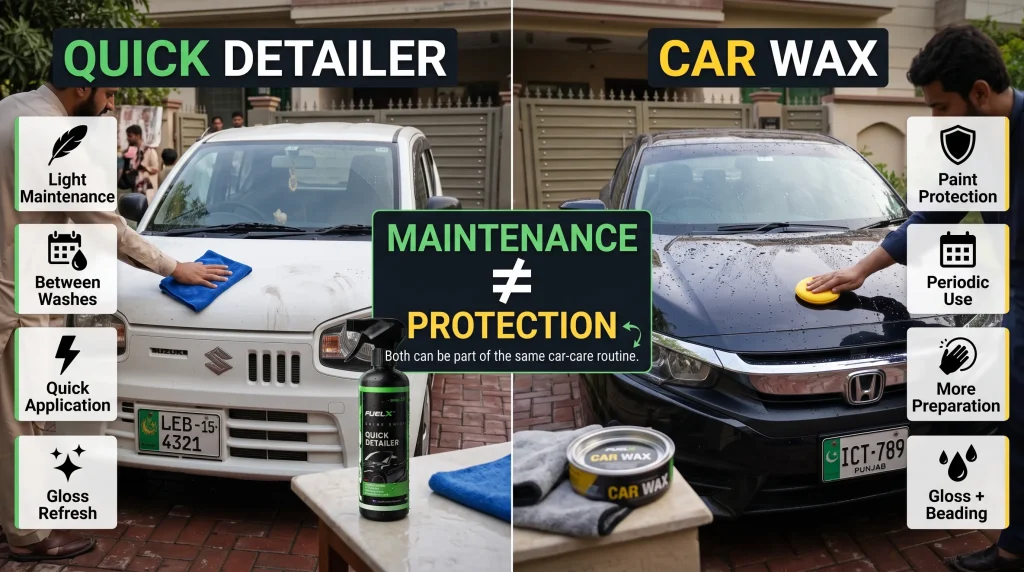
This is a general comparison rather than an absolute rule.
Some modern quick detailers contain ingredients that provide some level of protection, while some spray waxes are designed specifically for fast maintenance.
For example, Meguiar’s describes its Quik Detailer as a product for light contamination and maintaining a freshly waxed appearance, while its quick-wax products are positioned more toward adding protection and shine.
So, always check the specific product’s instructions instead of assuming that every quick detailer or every wax behaves identically.
Can Quick Detailer Replace Wax?
Generally, no.
A quick detailer and wax are better viewed as complementary products.
Suppose your car was washed two days ago and now has a small amount of dust and a few fingerprints.
You may not need to repeat the entire wash-and-wax process. If the contamination is light enough for the product you’re using, a quick detailer can be appropriate.
Later, during a more thorough detailing session, you can clean the vehicle properly and apply wax to refresh the protective layer.
This is more practical than expecting one product to perform every job.
Can You Use Quick Detailer After Waxing?
Yes, a suitable quick detailer can be used as part of a maintenance routine after waxing.
The basic sequence is:
1. Wash the vehicle
Remove dirt, dust, mud and other substantial contamination.
2. Apply wax
Follow the wax manufacturer’s instructions.
3. Maintain the finish
Between subsequent washes, use an appropriate quick detailer when the vehicle has only light contamination.
Meguiar’s specifically describes its Quik Detailer as suitable for maintaining paint between washes and wax applications and says its formulation is designed to preserve existing wax protection.
However, product formulations vary, so don’t assume that every detailing spray is compatible with every coating, wax or specialty finish.
Quick Detailer vs. Wax in Pakistan
Pakistan’s driving conditions make this distinction particularly practical.
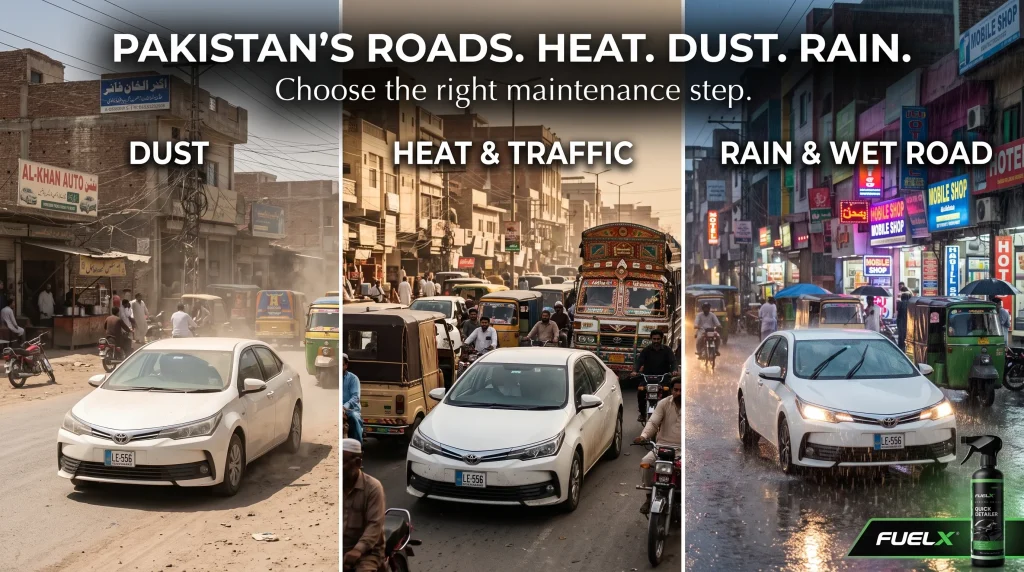
Depending on where you drive and park, your vehicle may encounter:
- Fine road dust
- Construction dust
- Traffic pollution
- Strong sunlight
- Rain
- Mud
- Road grime
- Bird droppings
- Frequent outdoor parking
This means exterior maintenance isn’t necessarily a once-a-month activity.
Dust and Road Grime
A clean car can become dusty surprisingly quickly after driving or parking outdoors.
For example, a car driven around a busy urban area for 20–30 kilometres during the week may collect noticeable dust even when it hasn’t encountered mud or heavy contamination.
If the surface only has light contamination and the product instructions allow it, a quick detailer can be useful.
But if that dust is mixed with grit, mud or heavy road grime, wash the car properly first.
The objective isn’t simply to make the vehicle look clean. You also want to reduce unnecessary friction between abrasive contamination and the paint.
Heat and Direct Sunlight
Dark-colored vehicles can become particularly uncomfortable to work on in direct sunlight because their panels can heat up quickly.
When applying detailing products, follow the manufacturer’s instructions and, where appropriate, work on a cool surface in the shade.
A shaded location also gives you more control over how quickly the product dries.
For home detailing, early morning or late afternoon can often be more convenient than working on a hot panel in direct midday sunlight.
Rain and Water Spots
Rain doesn’t necessarily clean your car.
Rainwater can pick up airborne contamination before reaching the vehicle. When droplets evaporate, minerals and other residues can remain on the surface depending on the water and environmental conditions.
This is why a vehicle can look dirty or develop visible water spots even after rain.
A useful routine is:
Wash when necessary → Dry properly → Inspect the paint → Use an appropriate finishing product
FuelX’s own recent guidance similarly recommends washing and drying before using a quick detailer as a finishing step.
Which One Should You Choose?
The right choice depends on what your car needs at that moment.
Choose a Quick Detailer If:
- Your car is relatively clean.
- You have light dust.
- You have fingerprints or small smudges.
- You want a quick gloss refresh.
- You recently washed the vehicle.
- You want to maintain the appearance between washes.
Example
You washed your car Sunday morning.
By Wednesday, the bonnet has light dust and the driver’s door has fingerprints.
You don’t necessarily need another full wash.
A suitable quick detailer and clean microfiber towel can be a practical maintenance option.
Choose Car Wax If:
- You’re performing a more thorough exterior-detailing session.
- You want to refresh paint protection.
- You want additional gloss and water beading.
- The paint has been properly cleaned.
- You’re following a periodic protection routine.
Example
You’ve washed and dried the car, prepared the paint as needed, and now want to add a protective layer.
That’s when wax makes more sense than a simple quick-detailing spray.
Consider Using Both If:
For enthusiasts and regular car-care users, there is no reason to treat the products as competitors.
A simple routine can be:
Wash → Wax periodically → Maintain with Quick Detailer → Wash → Repeat
The exact frequency depends on:
- Driving conditions
- Parking conditions
- Washing frequency
- Weather exposure
- Product formulation
- Manufacturer recommendations
How to Use a Quick Detailer Correctly
Technique matters just as much as the product.
FuelX recommends removing heavy dirt first, shaking the bottle, applying the product lightly, wiping with a clean microfiber, buffing the surface and working section by section.
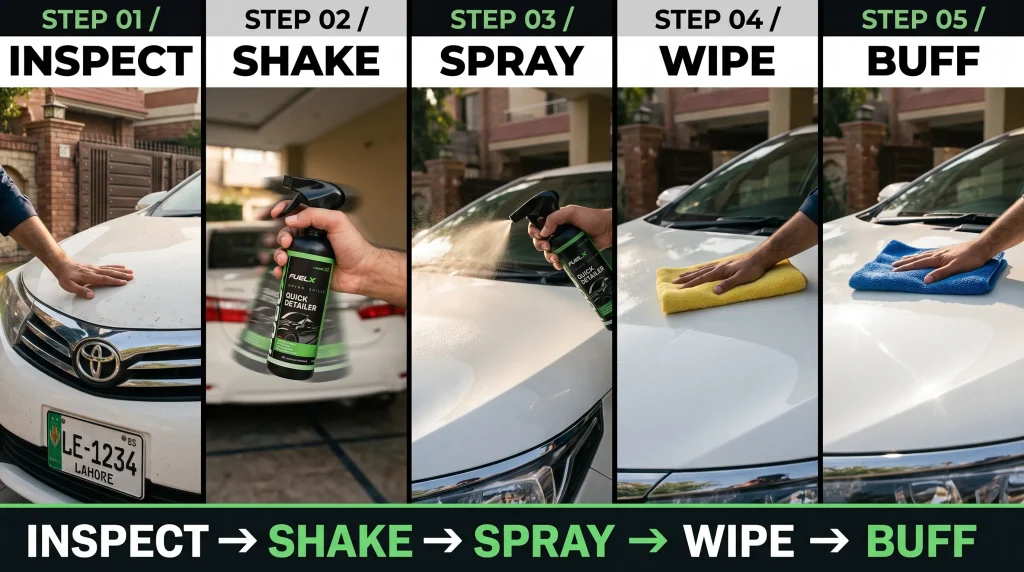
Step 1: Inspect the Paint
Look closely before touching the surface.
If you see only light dust or fingerprints, a quick detailer may be appropriate.
If you see:
- Mud
- Sand
- Thick road grime
- Heavy dirt
Wash the car first.
Step 2: Work in the Shade When Appropriate
If the paint is extremely hot, products may dry faster and become more difficult to work with.
A cool, shaded surface generally gives you better control.
Always prioritize the specific product instructions.
Step 3: Shake the Product
Shake the bottle well before use so the formula is properly mixed.
FuelX specifically recommends shaking its Quick Detailer before application.
Step 4: Work on a Small Section
Instead of spraying the entire vehicle at once, work panel by panel.
For example:
Bonnet → Front fender → Door → Rear quarter panel
This makes it easier to control product quantity and inspect the finish.
Meguiar’s demonstrates working in small sections, approximately 1–2 square feet at a time, for spray-detailer application.
Step 5: Use a Clean Microfiber Towel
Microfiber matters because you don’t want to redistribute contamination across the paint.
Fold the towel so you have multiple clean sections available.
When one section becomes dirty or saturated, turn the towel to a clean section.
Meguiar’s specifically recommends fresh, clean microfiber towels and changing to a clean section during the wiping process.
Step 6: Wipe Gently
Don’t press aggressively.
Let the product and microfiber do the work.
If contamination isn’t coming off easily, stop and reconsider whether the vehicle needs a proper wash instead.
Step 7: Buff the Surface
Use a clean, dry section of the towel to finish the panel.
You should end up with an even appearance without obvious residue or streaking.
FuelX’s instructions similarly recommend using the dry side of the cloth to buff the surface and enhance gloss.
Common Quick Detailer and Wax Mistakes
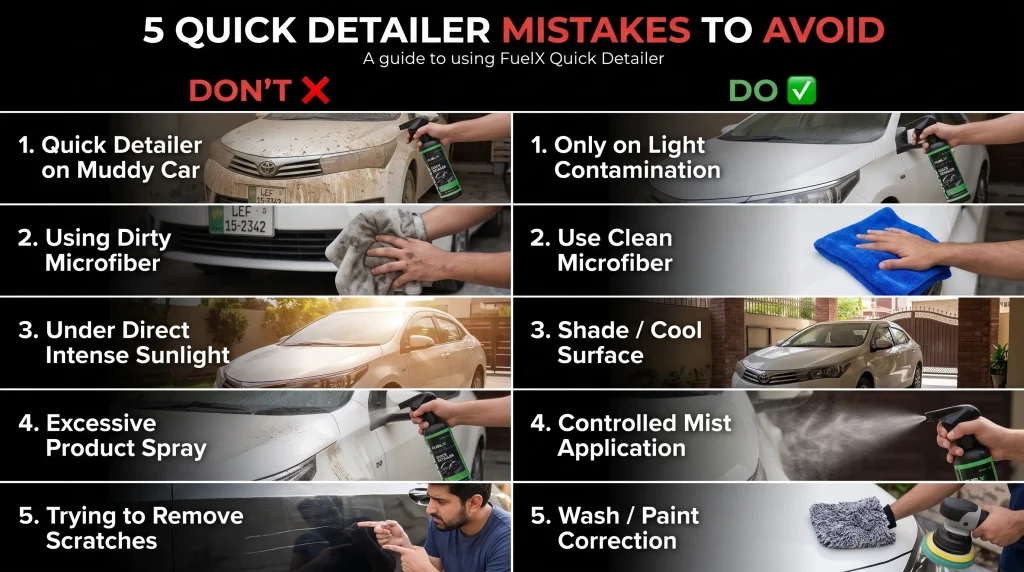
1. Using Quick Detailer on Heavy Dirt
This is one of the most important mistakes to avoid.
If the vehicle has heavy contamination, wash it first.
A spray-and-wipe product isn’t intended to replace a normal wash for a heavily dirty vehicle.
2. Using a Dirty Microfiber
A microfiber towel that has already picked up grit can become a liability when used on clean paint.
Keep towels clean and, where practical, separate towels for different jobs such as:
- Paint
- Wheels
- Tyres
- Interior
- Glass
3. Working on an Extremely Hot Surface
Hot paint can make product application more difficult.
When appropriate, work in shade and on a cooler surface.
4. Using Too Much Product
More product doesn’t automatically mean more shine.
Excess product can make buffing harder and may leave unnecessary residue.
Use the amount recommended by the manufacturer.
5. Expecting Quick Detailer to Remove Scratches
A quick detailer is not a paint-correction product.
It can improve the appearance of properly maintained paint, but it won’t repair genuine scratches.
Think of the difference as:
Detailer → maintenance
Polish → paint correction/refinement
Wax → protection
They serve different purposes.
6. Expecting Wax to Clean a Dirty Car
Wax isn’t a replacement for washing.
Clean and prepare the paint first.
Where FuelX Quick Detailer Fits
FuelX Quick Detailer is designed specifically around the between-wash maintenance use case.
FuelX currently describes it as a spray-on product for light dust, fingerprints and light dirt, while also positioning it as a gloss-enhancement product for maintaining the appearance of the vehicle between washes.
The current listed price on FuelX’s website is Rs. 1,399.
Its recommended process is straightforward:
Remove heavy dirt → Shake → Spray → Wipe → Buff → Move to the next section
For someone who doesn’t want to perform a complete wash every time the car picks up a small amount of dust or fingerprints, this makes it a practical addition to a home detailing routine.
FuelX Quick Detailer for Regular Exterior Maintenance
Imagine this routine:
Sunday
You perform a proper car wash.
Monday–Tuesday
The vehicle remains relatively clean.
Wednesday
Light dust and fingerprints appear.
Thursday
Instead of immediately performing another full wash, you inspect the surface.
If contamination remains light and the product is appropriate, use the quick detailer with a clean microfiber towel.
Weekend
When the vehicle has accumulated more substantial contamination, perform another proper wash.
This approach makes your detailing routine more practical because you’re not treating every small amount of dust as a reason for a complete detailing session.
What About the FuelX Exterior Shine Kit?
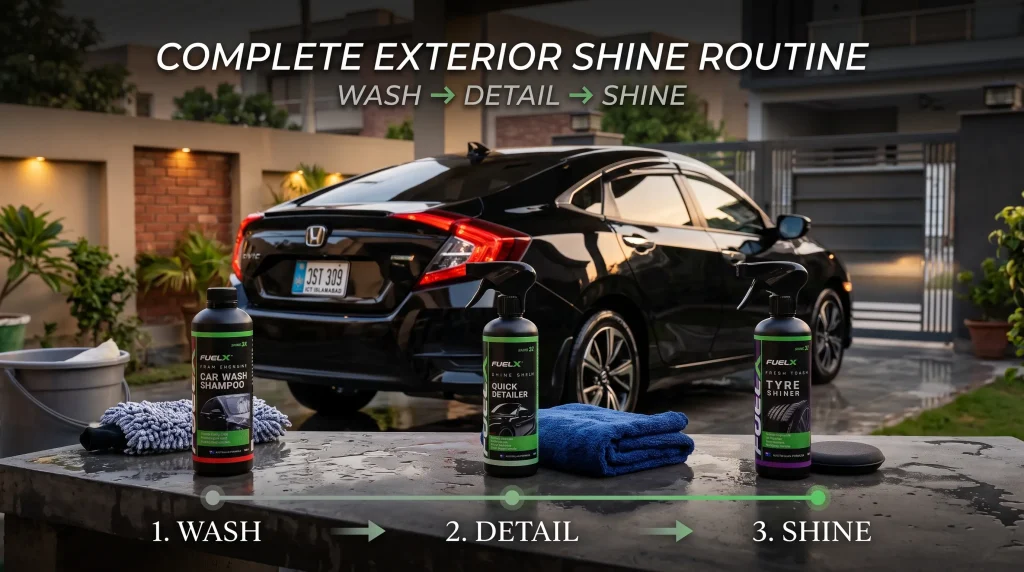
If you want a more complete exterior-care routine, FuelX’s Exterior Shine Kit combines:
- FuelX Car Wash Shampoo
- FuelX Quick Detailer
- FuelX Tyre Shiner
FuelX positions the Quick Detailer as the paint-gloss step after washing and drying.
A simple workflow is:
Wash → Dry → Quick Detailer → Buff → Tyre Shiner
This is a better approach than trying to use Quick Detailer as a replacement for the complete washing process.
Quick Detailer vs. Wax: A Simple Routine for Beginners
If you’re new to detailing, don’t feel that you need to use every product every time.
Regular cleaning
Wash → Rinse → Dry
Light dust between washes
Inspect → Quick Detailer → Microfiber → Buff
Periodic protection
Wash → Prepare → Wax → Finish
Heavy contamination
Wash first
This simple decision process is enough for most beginners.
The important thing is to match the product to the condition of the vehicle.
Quick Detailer vs. Wax: Which One Should You Use?
There isn’t a universal winner because quick detailer and wax perform different jobs.
Choose a quick detailer when your car is already relatively clean and you need a fast maintenance touch-up.
Choose wax when you’re performing periodic exterior detailing and want to apply or refresh a dedicated protective layer.
And when appropriate, use both:
Wash → Wax periodically → Maintain with Quick Detailer → Wash → Repeat
For Pakistani driving conditions, this approach can make exterior maintenance easier without turning every small amount of dust into a full detailing session.
The key is simple:
Don’t use more products just because you have them. Use the right product for the right job.
Final Takeaway
Quick detailer and wax aren’t competitors. They’re different tools for different stages of car care.
Use quick detailer for appropriate light, between-wash maintenance.
Use wax for periodic paint protection and appearance enhancement.
And when conditions are right, combine them as part of a simple routine:
Wash regularly → Wax periodically → Maintain with Quick Detailer → Repeat
For FuelX users, the important lesson is not simply which product to buy. It’s understanding when to wash, when to maintain and when to protect.
A clean car doesn’t require a complicated routine.
It requires the right product, the right technique and the right timing.
FAQ’s
Is quick detailer the same as car wax?
No.
A quick detailer is primarily designed for light exterior maintenance and gloss enhancement, while wax is primarily used for periodic paint protection and appearance enhancement.
Can quick detailer replace wax?
Generally, no.
Some quick detailers may provide a degree of protection depending on their formulation, but they shouldn’t automatically be treated as replacements for dedicated protective products.
Can I use quick detailer after waxing my car?
Yes, a suitable quick detailer can be used as part of a maintenance routine after waxing, provided the products are compatible and the vehicle only has light contamination.
Does quick detailer protect car paint?
Protection varies by formulation.
Some products may leave some protective properties, while others focus mainly on cleaning and gloss enhancement.
Check the manufacturer’s product claims rather than assuming all quick detailers provide the same level of protection.
Can I use quick detailer on a dusty car?
Yes, if the dust is light and the product instructions allow it.
If the vehicle has heavy dust mixed with grit, mud or road grime, wash it first.
Does quick detailer remove scratches?
No.
Quick detailer is intended for maintenance, not paint correction. Scratches generally require an appropriate polishing or paint-correction process.
How often should I wax my car?
There is no universal schedule.
Wax durability varies according to the formulation, washing routine, weather, parking conditions, driving habits and environmental exposure.
Follow the product manufacturer’s recommendations and inspect the existing protection before reapplying.
Can I use quick detailer every day?
You don’t necessarily need to.
Use it when the vehicle has suitable light contamination and the product instructions allow it. If the vehicle becomes heavily dirty, proper washing is the better approach.
Does quick detailer make a car shine?
It can enhance the appearance and gloss of properly maintained paint.
FuelX specifically positions its Quick Detailer as a product for refreshing gloss and shine between washes.
About FuelX Research & Detailing Lab
FuelX engineers high-performance automotive cooling solutions and specialized car detailing products engineered for Pakistan's demanding driving conditions. All guides and tips are validated by our technical team to ensure engine longevity and lasting vehicle protection.
Keep Your Engine Cool & Your Ride Shining
Shop FuelX certified Long Life Coolants, high-gloss tyre shine, safe car wash shampoo, and lint-free microfiber accessories.