Interview: A FuelX Engineer Explains How Fuel Additives Work

Fuel additives are often marketed with big promises: cleaner injectors, better mileage, smoother performance and even more power. But what actually happens when an additive enters your fuel tank?
The answer is more technical—and more practical—than many advertisements suggest.
A fuel additive is not a magic liquid that can transform any engine. Different formulations are designed for different purposes, including deposit control, corrosion protection, lubricity, fuel stability and combustion-related properties.
To understand what drivers should realistically expect, we spoke with a FuelX engineering perspective about how fuel additives work, where they can help, how they should be used and which common claims deserve a closer look.
Important note: The engineering responses in this article should be reviewed and approved by the named FuelX engineer before publication. Technical information and third-party test results are included to provide context and are not presented as testing of a specific FuelX formulation.
What Is a Fuel Additive?
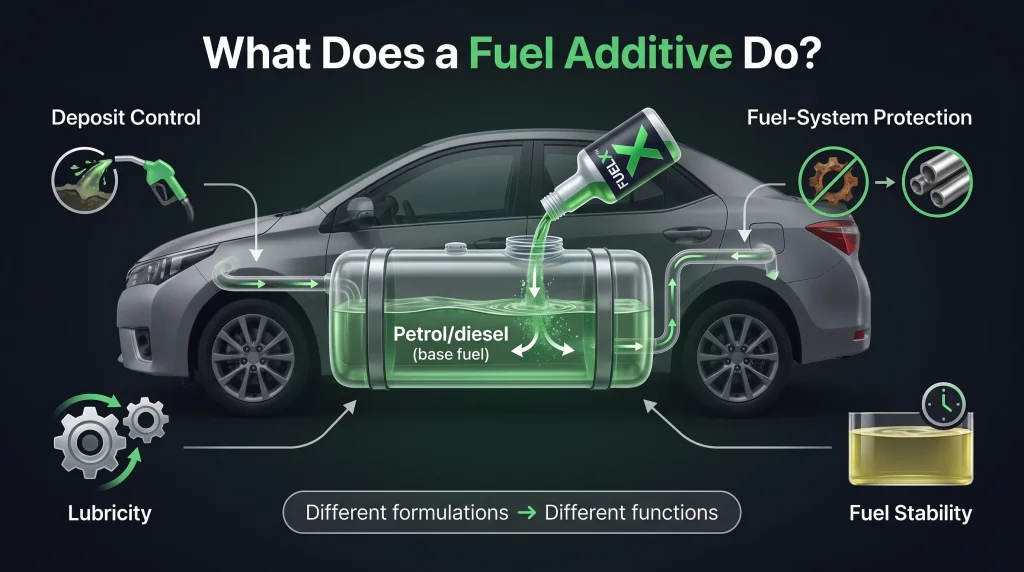
FuelX Engineer: A fuel additive is a chemical formulation that is mixed with fuel to provide a particular function.
The important word is particular.
There isn’t one universal type of fuel additive. A detergent-based product may be formulated to control deposits, while another product may focus on lubricity, corrosion protection, fuel stability or combustion-related properties.
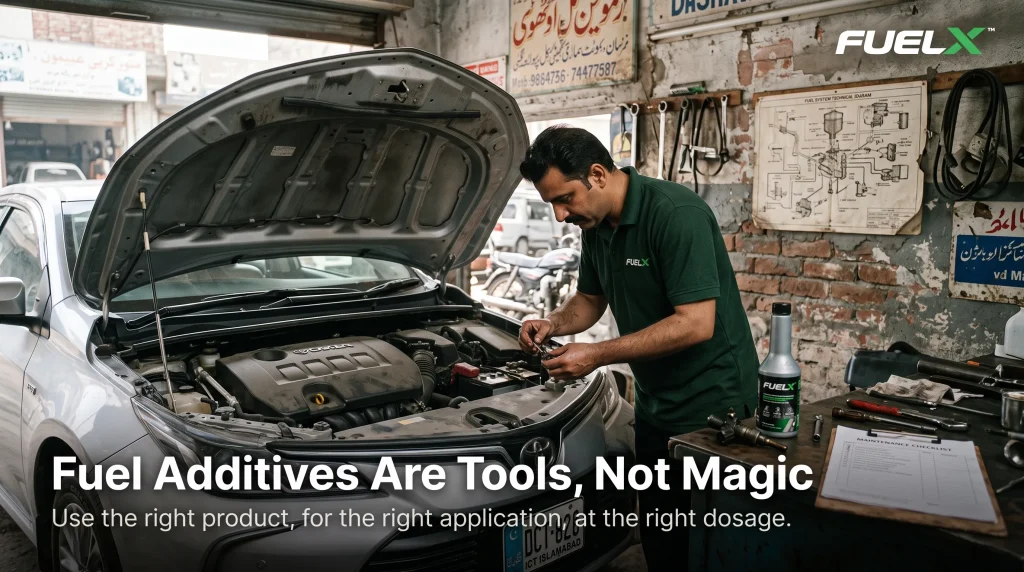
Think of fuel additives like specialized tools in a workshop. You wouldn’t use a tyre-pressure gauge to diagnose an overheating engine. In the same way, you shouldn’t expect every fuel additive to solve every fuel-system problem.
Modern fuel standards demonstrate how specific these functions can be. Current TOP TIER gasoline standards include deposit-control requirements covering fuel injectors, intake valves and combustion chambers, while its diesel standards address areas including detergency, contamination cleanliness, lubricity and fuel stability.
Why Would Fuel Need Additives If Petrol or Diesel Is Already a Finished Product?
FuelX Engineer: Fuel is already formulated to meet required specifications, but additive chemistry can provide additional performance characteristics.
One of the most important areas is deposit control.
As fuel passes through an engine repeatedly, deposits can develop on fuel-system and combustion-related components. These deposits can affect how fuel is delivered and how efficiently the engine operates.
This isn’t merely theoretical. In a controlled AAA study, gasoline meeting the TOP TIER detergent standard produced an average of 34.1 mg of intake-valve deposits per valve, compared with 660.6 mg for the non-TOP-TIER gasoline tested after approximately 4,000 simulated miles. That’s about 19 times fewer deposits in that specific test.
That number should not be interpreted as “every good fuel produces 19 times better mileage.” It was a specific laboratory comparison of deposit formation.
But it demonstrates an important principle:
Fuel chemistry can influence engine cleanliness.
What Happens Inside the Fuel System?
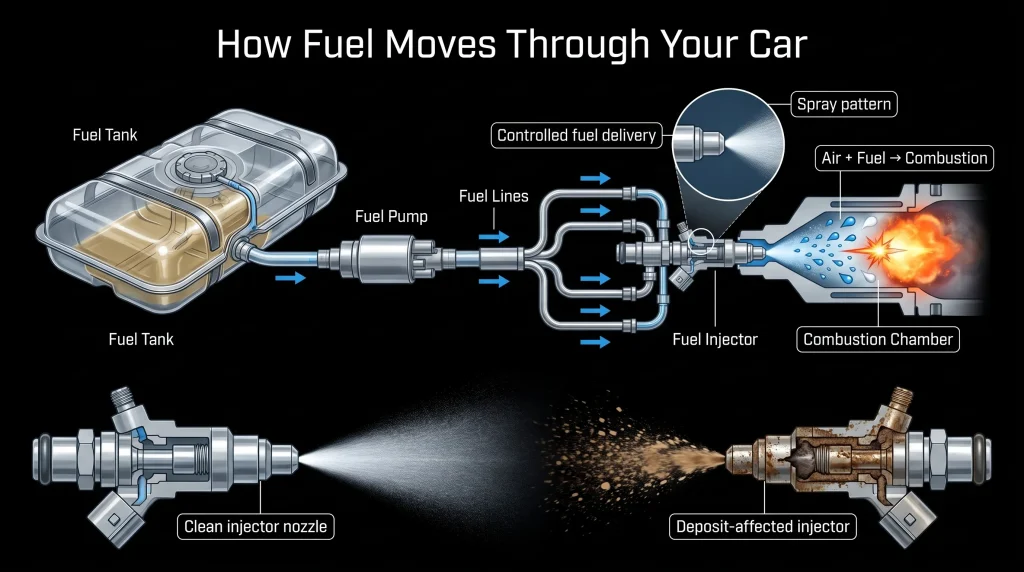
To understand where an additive can work, follow the fuel’s journey:
Fuel tank → fuel pump → fuel lines → injectors → combustion chamber
The injector is particularly important because it must deliver fuel in a controlled manner.
Imagine spraying water through a clean garden nozzle. You get a predictable spray pattern. Now imagine that the nozzle gradually becomes contaminated or partially restricted. The spray can change.
Fuel injectors operate under much more demanding conditions, but the basic concept is similar: consistent fuel delivery matters.
Research into gasoline direct-injection engines has found that injector deposits can be associated with changes in combustion behavior, misfire and increased emissions. Research also identifies fuel detergent chemistry as an important method of controlling injector deposits when the chemistry and dosage are properly optimized.
That’s why modern fuel standards increasingly include dedicated injector-cleanliness testing. The 2025 revision of the TOP TIER gasoline standard added testing specifically aimed at fuel-injector cleanliness for gasoline direct-injection engines.
What Are the Main Types of Fuel Additives?
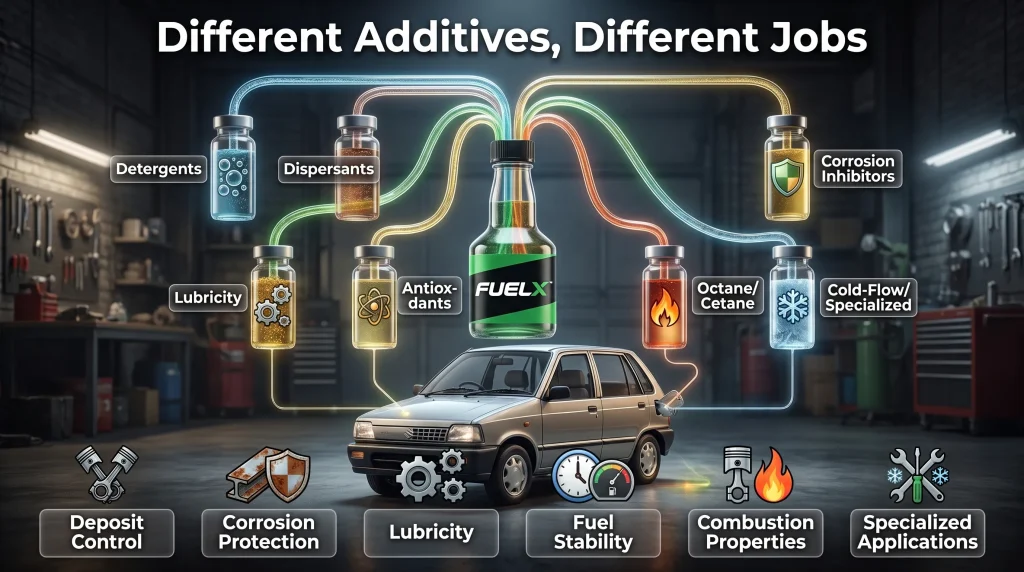
Different formulations target different problems.
1. Detergent Additives
Detergents are designed to help control deposits in fuel-system and engine components.
Their job can involve both:
- Keep-clean performance: helping prevent deposits from accumulating.
- Clean-up performance: helping remove certain existing deposits.
The exact result depends on the chemistry, concentration, engine and type of deposit.
2. Dispersants
Dispersants help control certain deposit-forming materials and contaminants so that they are less likely to accumulate in problematic locations.
They are commonly used as part of broader additive packages rather than as a standalone “cleaning solution.”
3. Corrosion Inhibitors
Fuel-system components contain metals and other materials that can be vulnerable to corrosion under certain conditions.
Corrosion-inhibiting additives are designed to provide protection to susceptible components.
For drivers, the practical point is that fuel-system protection isn’t only about cleaning. Preventing problems can be just as important as removing them.
4. Lubricity Additives
Lubricity becomes particularly important in diesel fuel systems.
Modern diesel engines can use high-pressure common-rail systems that operate under demanding conditions. TOP TIER’s current diesel standards specifically include lubricity requirements intended to address wear protection for fuel pumps and injectors.
This is one reason why drivers should never assume that a petrol additive and diesel additive are interchangeable.
5. Antioxidants and Fuel-Stability Additives
Fuel can undergo oxidation during storage.
A fuel-stability additive may help control degradation processes, depending on its formulation.
This becomes particularly relevant where fuel may be stored for extended periods.
6. Octane- or Cetane-Related Additives
Some products are designed to influence fuel’s combustion characteristics.
For gasoline, this may involve octane-related performance.
For diesel, additives may target cetane characteristics.
However, these products should not be confused with detergent-based fuel-system cleaners. Different chemistry means different objectives.
7. Cold-Flow and Other Specialized Additives
Some diesel applications require additives designed around low-temperature fuel behavior or other specialized operating conditions.
Again, this reinforces the central rule:
Choose an additive based on its intended application—not simply because the label says “fuel additive.”
Can Fuel Additives Clean Fuel Injectors?
FuelX Engineer: They can, when the formulation is specifically designed for deposit control and is used at the correct concentration.
There is an important difference between preventing deposits and removing existing deposits.
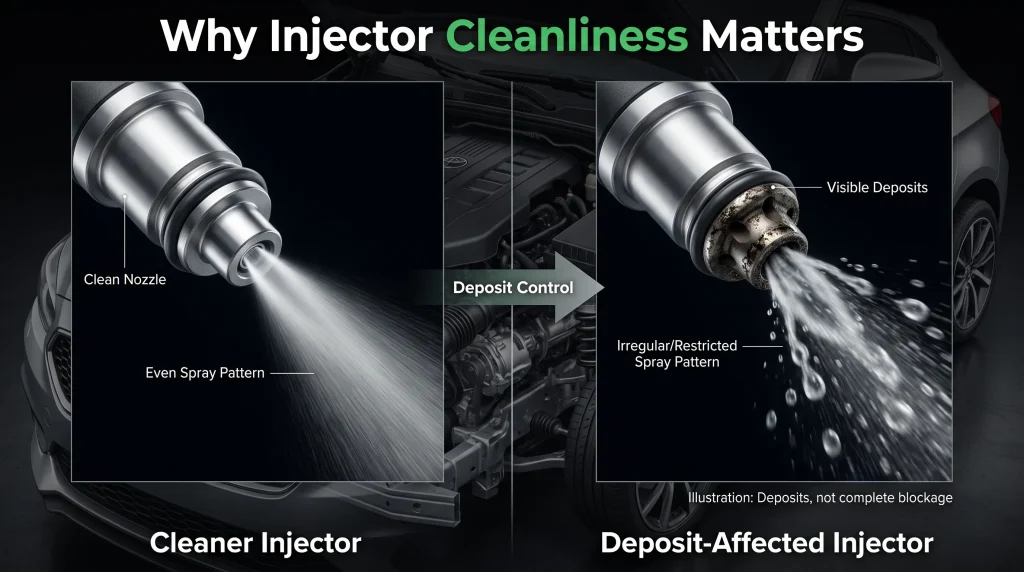
Imagine two cars:
Car A
The fuel system is relatively clean.
A detergent additive may help maintain that cleanliness.
Car B
The vehicle has significant deposits.
A suitable cleaning formulation may help remove some deposits, but the result will depend on the deposit type, severity, formulation and treatment conditions.
The industry takes injector cleanliness seriously enough that modern fuel standards include specific deposit-control testing. The 2025 TOP TIER gasoline standard, for example, added a gasoline direct-injection injector-cleanliness engine dynamometer test.
So when you see “cleans injectors” on an additive bottle, the useful follow-up question is:
What formulation, concentration and test method support that claim?
Can Fuel Additives Improve Fuel Economy?
FuelX Engineer: They may help maintain or restore intended operation when deposits are affecting fuel-system performance, but there is no universal percentage improvement that applies to every vehicle.

Fuel economy is influenced by many variables:
- Driving style
- Traffic
- Tyre pressure
- Vehicle weight
- Engine condition
- Air-conditioning use
- Fuel quality
- Road conditions
- Vehicle maintenance
- Engine deposits
AAA’s controlled testing provides useful context. Its gasoline study found dramatically different deposit levels between the tested fuels, and AAA notes that deposits can negatively affect fuel economy and drivability.
However, that doesn’t mean a driver should expect a fixed 5%, 10% or 20% fuel-economy improvement from an aftermarket additive.
In fact, the U.S. EPA has historically estimated only a 0.06% average fuel-economy improvement from its baseline gasoline detergent program in the vehicle fleet it analyzed, while noting that changes in vehicle technology and gasoline composition make modern effects difficult to quantify.
That is an important reality check.
A good fuel additive should not be sold as a guaranteed mileage miracle.
Can Fuel Additives Increase Engine Power?
FuelX Engineer: Drivers should be cautious about dramatic horsepower claims.
A detergent fuel additive is generally intended to help control deposits and maintain fuel-system cleanliness—not to turn a standard engine into a higher-output engine.
There is an important difference between:
Restoring performance that has been affected by deposits
and
Increasing an engine’s designed power output.
For example, if an engine has accumulated deposits that interfere with proper fuel delivery, cleaning those deposits may help it operate closer to its intended condition.
That isn’t the same thing as adding a performance modification.
Are Fuel Additives Safe for Modern Cars?
FuelX Engineer: They can be, provided the product is appropriate for the application and used exactly as instructed.
Modern vehicles use sophisticated fuel-injection, emissions-control and after-treatment systems.
That means compatibility matters.
Before using a fuel additive, check:
- Fuel type
- Vehicle/application compatibility
- Recommended dosage
- Product instructions
- Vehicle manufacturer’s recommendations
This is particularly important because some additive chemistries can have unintended consequences if misused.
For example, TOP TIER’s gasoline standard explicitly prohibits certain organometallic additives because of their potential to damage emissions after-treatment systems.
The lesson is simple:
More chemistry does not automatically mean better performance. The chemistry has to be appropriate.
How Often Should You Use a Fuel Additive?
FuelX Engineer: There is no universal “every 1,000 km” or “every three months” rule for every fuel additive.
The correct interval depends on the product’s formulation and intended purpose.
A product designed for periodic fuel-system cleaning may have completely different usage instructions from a product designed for another fuel-related function.
So drivers should follow:
- The product’s recommended dosage.
- The recommended treatment interval.
- The vehicle manufacturer’s guidance where applicable.
Think of it like engine oil.
You wouldn’t choose an oil-change interval simply because another car uses that interval. You consider the vehicle, oil specification, operating conditions and manufacturer’s recommendations.
Fuel additives deserve the same level of care.
Can the Same Additive Be Used in Petrol and Diesel?
FuelX Engineer: Not automatically.
Petrol and diesel engines have different combustion processes and fuel-system requirements.
Modern diesel engines, for example, may use high-pressure common-rail injection systems. TOP TIER’s current diesel standard specifically addresses injector cleanliness, lubricity, fuel stability, water/sediment contamination and corrosion-related concerns.
Therefore:
Petrol additive ≠ automatically suitable for diesel.
And:
Diesel additive ≠ automatically suitable for petrol.
Always verify the fuel type and application printed on the product.
What About Pakistan’s Driving Conditions?
FuelX Engineer: Operating conditions matter, regardless of the country. In Pakistan, drivers can encounter high ambient temperatures, heavy traffic, dusty roads and significant variation between urban and highway driving.
Consider a typical city journey.
A driver may spend 30–45 minutes travelling a relatively short distance because of congestion, with repeated acceleration, braking and periods of idling.
Another driver may spend the same amount of time cruising steadily on a highway.
The engines have experienced the same clock time, but not necessarily the same operating conditions.
Pakistan’s hot weather can also place additional demands on vehicle systems generally. However, these conditions should not automatically be interpreted as proof that every vehicle needs a fuel additive.
Instead, drivers should look at:
- Vehicle age
- Maintenance history
- Fuel-system symptoms
- Driving conditions
- Manufacturer recommendations
- Product compatibility
Fuel additives should be targeted maintenance tools, not automatic treatments for every car.
What Are the Biggest Fuel-Additive Myths?
Myth 1: More additive means more performance.
Reality: Additives are formulated around specific concentrations. Increasing the dosage beyond the recommended level does not automatically increase the benefit.
Fuel detergent standards themselves are based on defined test methods and additive concentrations.
Myth 2: Every fuel additive cleans everything.
Reality: Different formulations have different functions.
A detergent cleaner isn’t automatically a solution for:
- Mechanical injector failure
- Fuel-pump failure
- Electrical problems
- Compression problems
- Severe fuel contamination
Myth 3: Fuel additives replace maintenance.
Reality: They don’t.
An additive cannot replace:
- Engine oil changes
- Air-filter maintenance
- Spark-plug replacement where applicable
- Fuel-filter maintenance
- Cooling-system maintenance
- Professional diagnosis
Think of additives as one tool in the maintenance toolbox.
Myth 4: Every additive works in petrol and diesel.
Reality: Fuel systems have different requirements.
Always check the label and technical documentation.
Myth 5: Every additive automatically improves mileage.
Reality: There is no universal mileage improvement.
Real-world fuel economy depends on many factors, and any benefit from deposit control will vary according to vehicle condition and operating circumstances.
Myth 6: A more expensive additive must work better.
Reality: Price alone does not prove performance.
Look for:
- Intended application
- Clear dosage instructions
- Technical information
- Compatibility information
- Testing or performance evidence where available
When Should a Driver NOT Use a Fuel Additive?
FuelX Engineer: An additive shouldn’t be used to hide a mechanical problem.
Suppose a vehicle suddenly develops:
- Severe misfiring
- A persistent check-engine light
- Major loss of power
- Fuel-pressure problems
- Difficult starting
- Unusual engine noise
The first step should be diagnosis, not automatically adding a bottle of fuel treatment.
For example, if an injector has an electrical fault, a detergent additive cannot repair the failed electrical component.
Likewise, if a fuel pump is mechanically damaged, adding an additive won’t restore a damaged pump.
This is one of the most important distinctions for consumers:
Cleaning chemistry can address deposits. It cannot repair broken hardware.
What Should Drivers Look for on a Fuel-Additive Bottle?
Before buying, look beyond phrases such as “maximum power” or “better mileage.”
1. Fuel Type
Is it designed for:
- Petrol?
- Diesel?
- Both?
2. Intended Function
Is it designed for:
- Injector cleaning?
- Deposit control?
- Lubricity?
- Fuel stability?
- Another specific application?
3. Dosage
How much additive should be used with the amount of fuel in your tank?
For example, if a product specifies a treatment ratio of 1:1,000, then 50 litres of fuel would require 50 mL of additive.
But this is only an illustration. Drivers should always follow the actual dosage printed for the specific product rather than copying a generic ratio.
4. Compatibility
Check the manufacturer’s compatibility information.
5. Instructions
Good instructions should tell you how and when to use the product.
6. Technical Evidence
Where available, look for testing or technical documentation supporting the product’s intended function.
From an Engineer’s Perspective, What Makes a Fuel Additive Useful?
FuelX Engineer: It starts with formulation.
A useful additive should be designed around a clearly defined objective and should work at an appropriate concentration without creating compatibility problems.
This is why professional fuel standards use controlled testing instead of judging an additive simply by appearance or marketing claims.
For example, the U.S. EPA’s gasoline deposit-control regulations require detergent manufacturers to establish a lowest additive concentration using specified testing methods. One approved method requires the test fuel without detergent to produce an average of at least 290 mg of deposits per valve, while the detergent-treated fuel must produce less than 100 mg per valve.
That illustrates something important:
Engine-cleaning performance can be measured.
A good formulation isn’t simply about putting more chemical into the fuel. It’s about selecting appropriate chemistry and concentration to achieve the intended result.
How Should Drivers Actually Use a Fuel Additive?

If the product is suitable for your vehicle, follow these basic steps.
Step 1: Confirm compatibility
Check the fuel type and intended application.
Step 2: Read the label
Find the manufacturer’s recommended treatment amount.
Step 3: Measure the correct quantity
Don’t guess the dosage.
Step 4: Add it according to the instructions
Follow the product’s recommended procedure.
Step 5: Use the vehicle normally
The additive should work within the operating conditions for which it was designed.
Step 6: Monitor the vehicle
If symptoms continue, investigate the underlying cause rather than repeatedly increasing additive use.
Step 7: Continue normal maintenance
An additive should complement—not replace—routine servicing.
Three Pieces of Advice From a FuelX Engineer
Question: If you could give Pakistani drivers just three pieces of advice about fuel additives, what would they be?
FuelX Engineer:
1. Use the right additive for the right application.
Start with the vehicle and fuel type. Then identify what you actually want the product to accomplish.
2. Follow the recommended dosage.
If the manufacturer recommends a particular amount, use that amount. Don’t assume that doubling the dose will double the benefit.
3. Treat additives as part of maintenance—not a replacement for maintenance.
Good fuel, proper servicing, correct tyre pressure, timely oil changes and professional diagnosis all remain important.
Final Takeaway
Fuel additives have a legitimate technical role in modern fuel systems.
Depending on their formulation, they can be designed to help with deposit control, fuel-system cleanliness, corrosion protection, lubricity, fuel stability and other specific fuel properties.
Controlled testing demonstrates that additive chemistry can make a measurable difference to deposit formation. For example, AAA’s laboratory testing found approximately 19 times fewer intake-valve deposits with the tested TOP TIER gasoline than with the tested non-TOP-TIER gasoline after about 4,000 simulated miles.
But that number shouldn’t be turned into a blanket promise about fuel economy, horsepower or every vehicle on the road.
The more useful way to think about fuel additives is:
Right formulation + right fuel + right dosage + right application = the best chance of achieving the intended result.
Before using any fuel additive, ask three questions:
Is it designed for my fuel type?
Is it designed for the problem I am trying to address?
Am I using the manufacturer’s recommended dosage?
If the answer is yes to all three, you’re approaching fuel-additive use as a maintenance decision rather than expecting a bottle to transform your engine.
For Pakistani drivers, that’s ultimately the more practical approach: understand the vehicle, identify the actual maintenance need, choose the appropriate product and use it correctly.
FAQ’s
What is a fuel additive?
A fuel additive is a chemical formulation added to fuel to perform a specific function, such as deposit control, corrosion protection, lubricity or fuel stability.
Do fuel additives really work?
Some fuel additives have measurable functions, particularly in areas such as deposit control. However, results depend on the formulation, dosage, fuel, vehicle and condition of the fuel system. Controlled industry testing demonstrates that detergent chemistry can significantly affect deposit formation.
Can fuel additives clean fuel injectors?
A properly formulated detergent or fuel-system cleaner can help control or remove certain deposits. Modern fuel standards include dedicated injector and deposit-control testing because injector cleanliness can affect engine operation.
Can fuel additives improve fuel economy?
They should not be treated as guaranteed fuel-economy boosters. Deposit control can help maintain intended engine operation, but actual fuel economy depends on many factors.
Can fuel additives increase horsepower?
A normal fuel-system cleaner shouldn’t be considered an engine-power modification. It may help restore performance affected by deposits, but that is different from increasing an engine’s designed output.
How often should you use a fuel additive?
Follow the instructions for the specific product. There is no single interval that applies to every fuel additive.
Are fuel additives safe for petrol engines?
A product should be used only when it is specifically intended for the relevant petrol application and used according to its instructions.
Can petrol additives be used in diesel engines?
Not automatically. Petrol and diesel fuels and fuel systems have different requirements. Always verify compatibility.
Do fuel additives replace fuel-system maintenance?
No. They may support a specific maintenance objective, but they cannot replace routine servicing or professional diagnosis of mechanical faults.
About FuelX Research & Detailing Lab
FuelX engineers high-performance automotive cooling solutions and specialized car detailing products engineered for Pakistan's demanding driving conditions. All guides and tips are validated by our technical team to ensure engine longevity and lasting vehicle protection.
Keep Your Engine Cool & Your Ride Shining
Shop FuelX certified Long Life Coolants, high-gloss tyre shine, safe car wash shampoo, and lint-free microfiber accessories.