5 Tyre-Care Mistakes & How to Fix Them
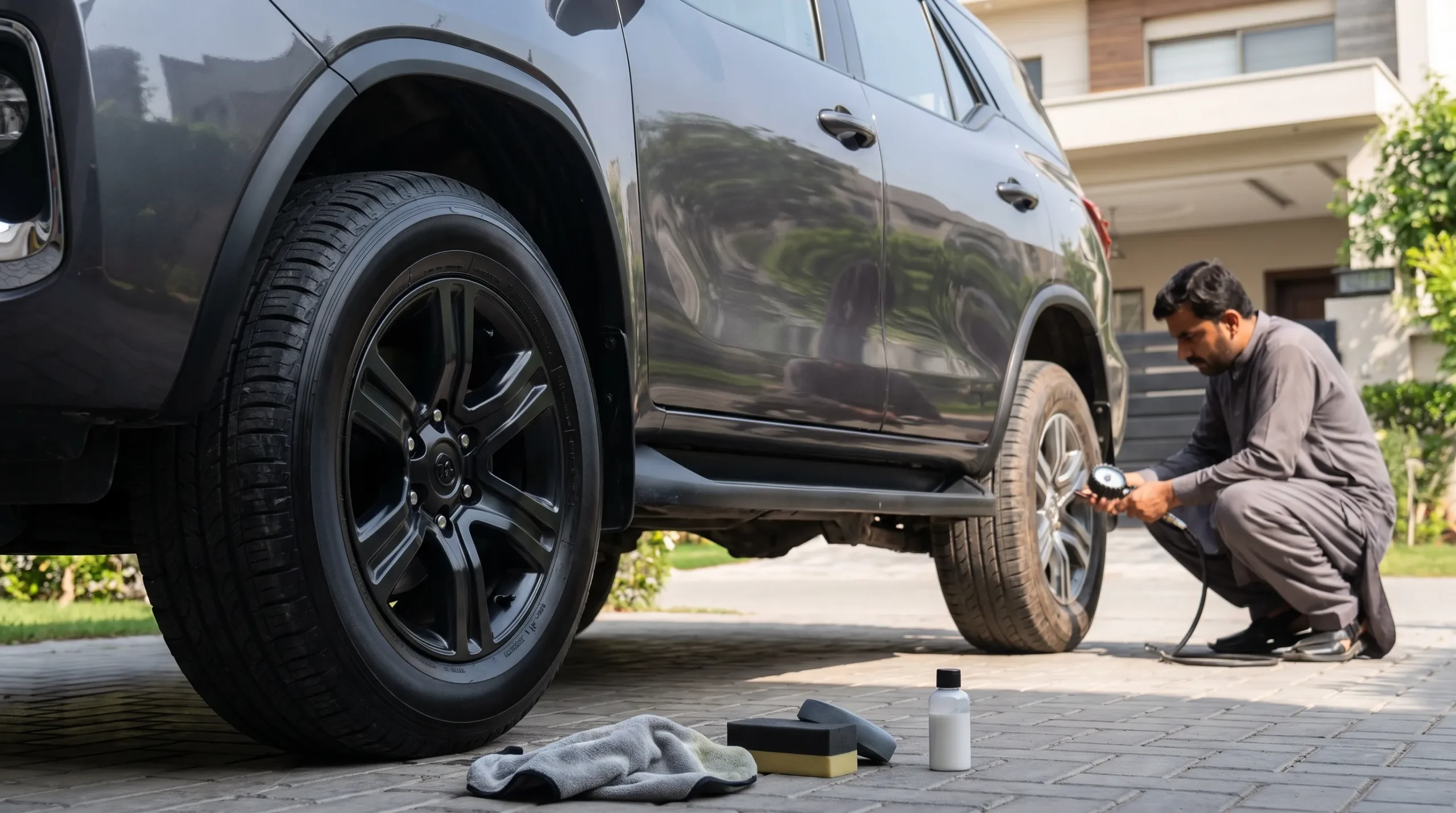
Your car can have spotless paint, crystal-clear windows and a clean interior, but if the tyres are dusty, poorly maintained or visibly worn, the whole vehicle can still look neglected.
More importantly, tyre care isn’t just about making tyres look black and shiny. Your tyres are the only parts of the vehicle continuously touching the road, so their condition directly affects how the car grips, steers and behaves.
For Pakistani drivers, tyre care deserves even more attention. Daily driving can expose tyres to potholes, broken road surfaces, dust, standing water, sharp road debris and long highway journeys. A tyre that looks fine from a distance can still have incorrect pressure, uneven wear or visible damage.
The good news is that many tyre-care mistakes are easy to prevent.
Here are 5 common tyre-care mistakes and how to fix them, plus a simple routine you can follow at home.
1. Ignoring Tyre Pressure
One of the simplest tyre-care tasks is also one of the easiest to forget: checking tyre pressure.
Many drivers only check pressure when a tyre looks noticeably flat or before a long road trip. The problem is that a tyre doesn’t have to look flat to be underinflated.
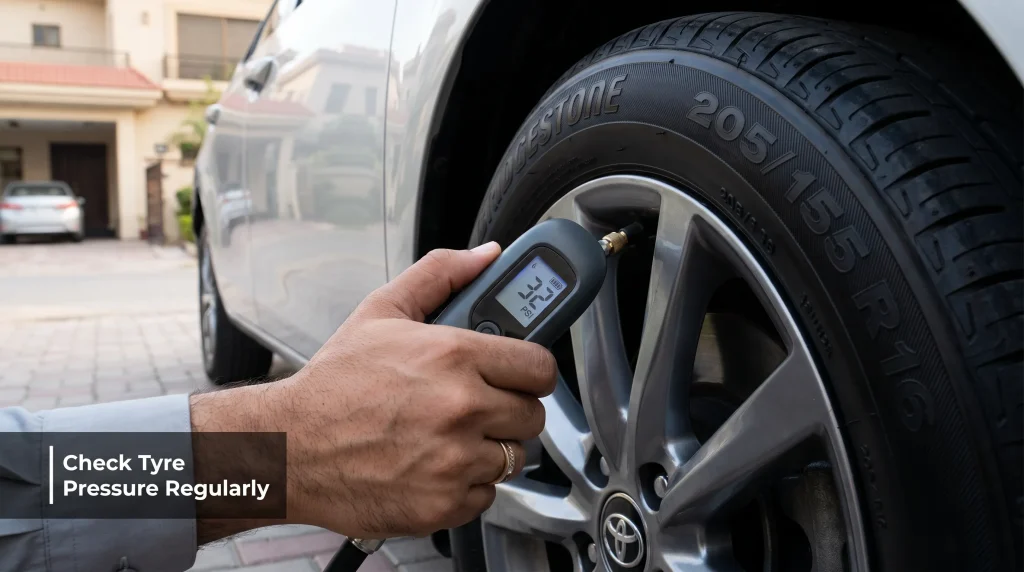
Tyres naturally lose some air over time, and pressure can also change because of temperature and small leaks. A pothole or hard impact can cause a sudden pressure loss as well. NHTSA recommends checking all tyres, including the spare, at least once a month when they are cold.
Why does tyre pressure matter?
Incorrect pressure can affect:
- Handling
- Braking behaviour
- Tyre wear
- Tyre durability
- Fuel consumption
NHTSA describes correct inflation as the most important part of tyre maintenance and notes that properly inflated tyres can extend average tyre life by around 4,700 miles, or roughly 7,600 km, compared with tyres that are not properly maintained.
That doesn’t mean every driver will automatically gain 7,600 km from correct inflation—the actual result depends on driving style, road conditions, tyre type, vehicle and maintenance—but it shows how much pressure can matter over the life of a tyre.
Underinflation vs overinflation
An underinflated tyre can flex more as it rolls, increasing heat buildup and potentially contributing to accelerated wear.
Overinflation can also create problems by changing how the tyre contacts the road and contributing to uneven wear.
So don’t follow the common idea that “a little extra air is always better.”
How to fix it
Follow these steps:
- Find your vehicle manufacturer’s recommended tyre pressure.
- Look for it on the driver’s-door information label or in the owner’s manual.
- Check pressure when the tyres are cold.
- Check all four tyres.
- Check the spare tyre as well.
- Adjust pressure to the manufacturer’s specification.
- If one tyre repeatedly loses pressure, have it inspected.
Important: The pressure printed on the tyre sidewall is generally the tyre’s maximum permitted pressure, not necessarily the correct pressure for your particular vehicle. Use the vehicle manufacturer’s recommendation instead.
2. Waiting Until Tyres Look Bad Before Inspecting Them
Another common mistake is assuming that tyres only need attention when they are visibly flat, badly worn or completely damaged.
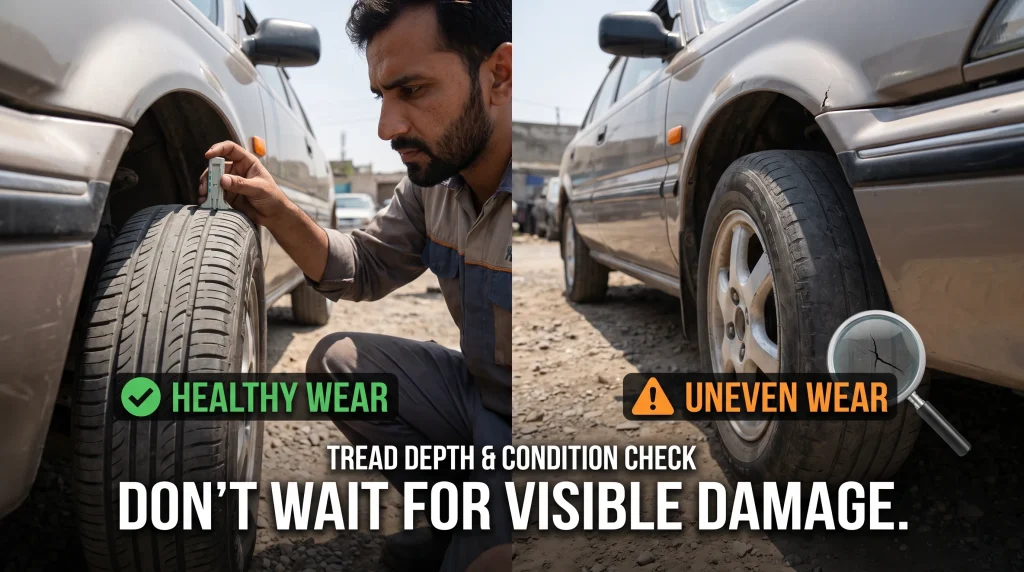
A tyre can develop problems gradually.
During your monthly inspection, look for:
- Uneven tread wear
- Cuts
- Cracks
- Bulges
- Punctures
- Objects stuck in the tyre
- Excessively worn tread
- One side wearing faster than the other
NHTSA recommends inspecting tread and tyre condition regularly and advises replacing tyres when tread is worn to the applicable minimum or when significant physical damage or irregular wear is present.
Why uneven wear matters
Think about the sole of a shoe.
If the outside edge of your shoe wears much faster than the rest, something about the way you are walking—or the shoe itself—may need attention.
Tyres can behave similarly.
If one section is wearing significantly faster than another, the cause may involve pressure, alignment, suspension, rotation or another mechanical issue.
Simply buying another tyre without investigating the reason can mean the replacement develops the same problem.
Don’t only look at the tread
Inspect the sidewalls too.
Look for:
- Bulges
- Deep cuts
- Cracking
- Scrapes
- Unusual deformation
A bulge is particularly important because it can indicate internal tyre damage.
If you notice significant damage, don’t try to hide it with tyre dressing or assume it will disappear after washing. Have the tyre inspected by a qualified professional.
What about tread depth?
NHTSA uses 2/32 inch (approximately 1.6 mm) as the minimum tread depth at which tyres should be replaced in its guidance. Many tyres also have built-in tread-wear indicators that help show when the tread has reached its limit.
However, don’t wait for the tyre to become completely worn before paying attention to it. Uneven wear, visible damage or poor performance can require earlier professional assessment.
3. Ignoring Wheel Alignment, Balancing and Tyre Rotation
You can maintain the correct tyre pressure and still experience tyre problems if you ignore alignment, balancing and rotation.
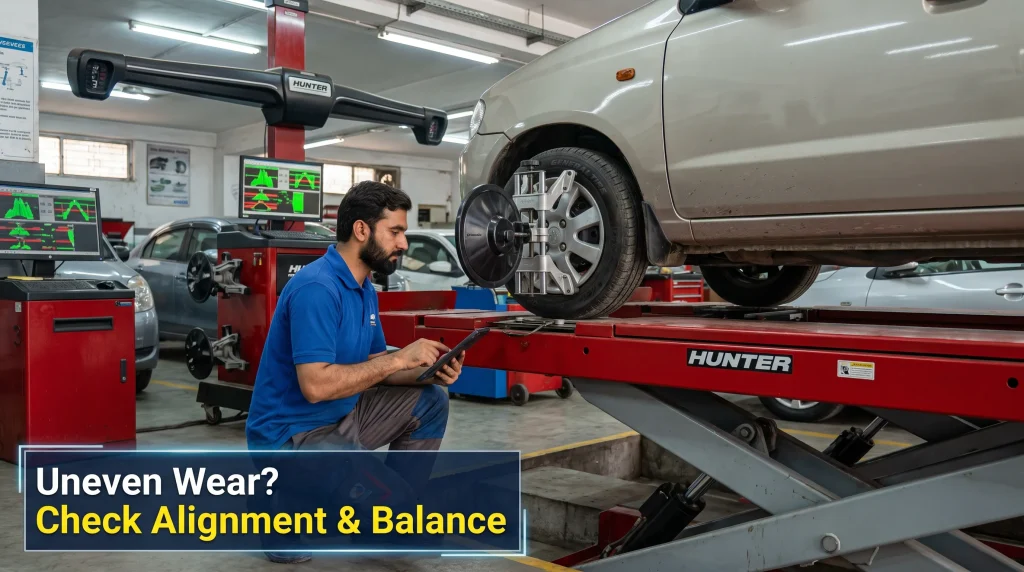
These terms are often mixed together, but they address different things.
Wheel alignment
Alignment concerns the positioning of the wheels relative to the vehicle and each other.
Poor alignment can contribute to irregular tyre wear and may cause the vehicle to pull to one side.
Wheel balancing
Balancing helps ensure the wheel-and-tyre assembly rotates smoothly.
An imbalance can cause vibration, particularly at certain speeds.
Tyre rotation
Rotation involves changing tyre positions according to the vehicle manufacturer’s recommended procedure.
The purpose is generally to help distribute wear more evenly.
NHTSA says balancing and alignment can help maximize tyre life, while rotation can reduce irregular wear. It also recommends following the vehicle manufacturer’s guidance because not every vehicle uses the same rotation pattern or schedule.
Where rotation is recommended, NHTSA gives 5,000–8,000 miles, approximately 8,000–12,900 km, as a general interval—but your owner’s manual should take priority. Some vehicles cannot use conventional rotation patterns because of different front/rear tyre sizes or other configurations.
Signs your car may need professional attention
Watch for:
- Steering-wheel vibration
- The vehicle pulling left or right
- Uneven tread wear
- Repeated wear on one side
- Vibration at particular speeds
- Steering behaviour that suddenly feels different
How to fix it
Don’t try to solve these problems with cleaning products.
If you notice abnormal wear or vibration, have the vehicle inspected by a qualified tyre or automotive technician.
For example, if your tyres look perfectly clean but the steering wheel starts vibrating at motorway speeds, applying tyre shiner won’t solve the underlying issue.
Maintenance problem → mechanical inspection.
Dirty tyre → cleaning.
Dull sidewall → cosmetic tyre product.
Keeping these three situations separate will save you time and potentially money.
4. Cleaning Tyres With the Wrong Method or Product
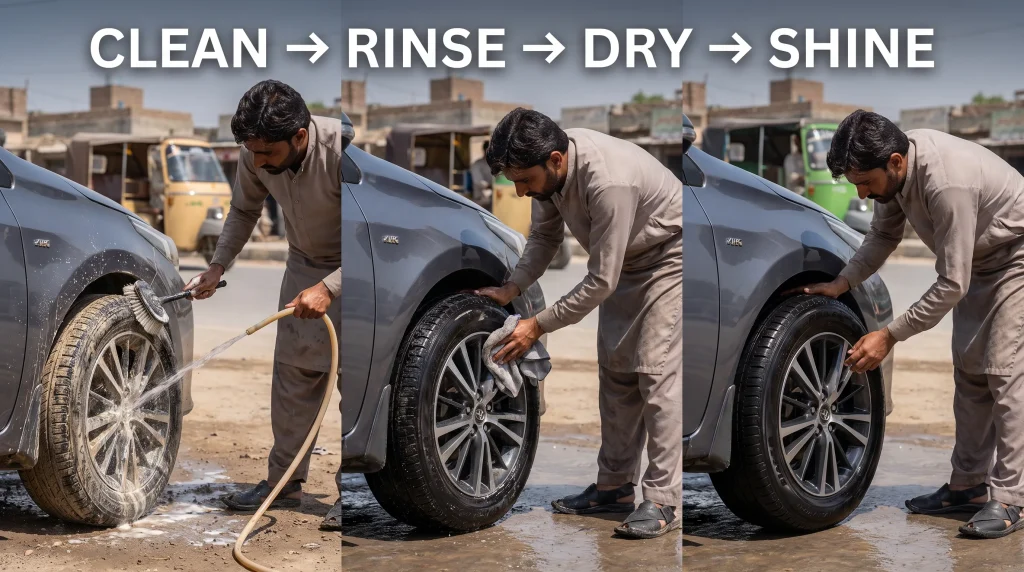
Now we move from tyre maintenance to tyre detailing.
Tyres are exposed to some of the dirtiest conditions on the road.
They collect:
- Road dust
- Mud
- Brake dust
- Water
- Oil and road grime
- Fine dirt from the road surface
During Pakistan’s rainy season, the situation can become even worse. Mud and dirty water are repeatedly thrown around the wheel arches and tyre sidewalls.
FuelX’s own post-monsoon guidance notes that tyres can collect mud, standing water, road dust, brake dust and other road grime and recommends cleaning the sidewalls and allowing them to dry before applying a tyre-finishing product.
The common mistake
Some people spray tyre shine directly onto a dirty tyre.
That may make the surface temporarily darker, but you’re still leaving the underlying contamination on the tyre.
A better rule is: Clean first. Dress second.
How to clean your tyres properly
Step 1: Rinse
Remove loose mud, dust and road grime.
Step 2: Clean
Clean the tyre using an appropriate automotive cleaning method.
Step 3: Rinse again
Remove the loosened dirt and cleaning residue.
Step 4: Dry
Allow excess water to drain and make sure the sidewall is sufficiently dry before applying a finishing product.
Step 5: Apply tyre dressing
Use an appropriate tyre-care product on the sidewall.
FuelX’s instructions similarly recommend cleaning and drying the tyre before applying FuelX Tyre Shiner.
Don’t apply tyre dressing everywhere
Cosmetic tyre products are intended for appropriate tyre surfaces.
FuelX specifically advises avoiding the tread and braking surfaces when using its Tyre Shiner.
The tread is responsible for maintaining road contact and traction. It isn’t the place for a cosmetic dressing.
5. Thinking More Tyre Shine Means Better Tyre Care
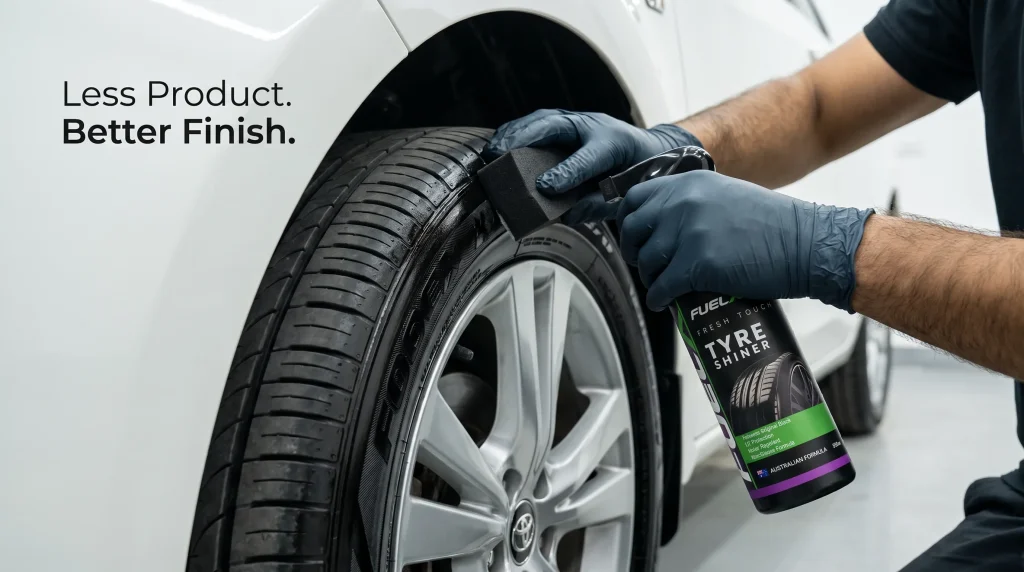
This is probably the easiest detailing mistake to make.
You apply some tyre shiner.
The tyre looks better.
So you apply another layer.
And another.
Eventually, instead of a clean, finished sidewall, you can end up with a surface that looks excessively wet or greasy.
More product does not automatically mean a better result.
In fact, excessive product can create another problem: sling.
As the wheel rotates, excess product can be thrown onto nearby body panels.
FuelX’s current tyre-care guidance recommends applying the product evenly and checking the finish after allowing it to set.
The better method
Use this simple process:
Clean → Dry → Apply a small amount → Spread evenly → Allow to set → Inspect
You can always add a little more if necessary. It is much easier to build up an even finish than to clean excess product from a body panel afterward.
Where FuelX Tyre Shiner fits
FuelX Tyre Shiner is designed as a tyre-sidewall finishing product. FuelX describes it as restoring a deep-black appearance, providing shine and helping protect against fading and cracking. The current listed price is ₨999.
Its recommended application is straightforward:
- Clean the tyre.
- Dry the sidewall.
- Shake the bottle.
- Apply the product to a sponge or tyre applicator.
- Spread it evenly across the sidewall.
- Allow it to set for a few minutes.
- Inspect for excess residue.
FuelX also sells dedicated applicator pads intended to help distribute detailing products evenly and reduce product waste.
The important point is that tyre shiner is a finishing step, not a replacement for tyre maintenance.
Correct pressure, adequate tread, physical inspection and appropriate mechanical maintenance come first.
Bonus Mistake: Forgetting the Spare Tyre
There is one tyre that many drivers completely forget about: The spare.
It can sit in the trunk for months or even years without being checked.
Then you get a puncture on the road.
You open the trunk and discover that the spare has low pressure or hasn’t been inspected for damage.
NHTSA specifically recommends checking the spare when checking tyre pressure.
Add the spare to your routine
Once a month, check:
- Pressure
- Visible cracks
- Cuts
- Bulges
- Tread condition
- General usability
If your vehicle uses a temporary spare, also follow the manufacturer’s instructions for its permitted use and speed limitations.
Tyre Care vs Tyre Shine: Don’t Confuse the Two
This distinction is important because the words “tyre care” and “tyre shine” are sometimes used as if they mean the same thing.
They don’t.
| Tyre Maintenance | Tyre Detailing |
| Checking tyre pressure | Cleaning sidewalls |
| Inspecting tread | Removing road grime |
| Checking for damage | Applying tyre dressing |
| Watching for uneven wear | Improving appearance |
| Alignment when required | Creating a finished look |
| Balancing when required | Restoring a darker appearance |
| Rotation when recommended | Maintaining exterior presentation |
Think of it like this:
Maintenance keeps your tyres properly maintained.
Detailing makes them look properly finished.
You need to handle maintenance problems as maintenance problems—not try to solve them with detailing products.
A Simple Tyre-Care Routine for Pakistani Drivers
You don’t need to spend hours every week looking after your tyres.
A simple routine is enough for most everyday drivers.
Once a week
Especially if you’re driving through dusty or muddy areas:
- Look at the tyres.
- Check for obvious damage.
- Remove heavy mud.
- Clean the sidewalls when washing the car.
- Look for anything unusual.
Once a month
Perform a more thorough inspection:
- Check tyre pressure when cold.
- Check all four tyres.
- Check the spare.
- Inspect tread wear.
- Inspect sidewalls.
- Look for cuts, cracks and bulges.
- Look for uneven wear.
NHTSA specifically recommends monthly checks covering inflation, treadwear and tyre damage.
Before a long road trip
Give the tyres extra attention before heading onto the motorway.
Check:
- Cold tyre pressure
- Tread condition
- Sidewall condition
- Spare tyre
- Any unusual vibration or steering behaviour
A five-minute inspection at home is much easier than discovering a tyre problem halfway through a long journey.
After washing your car
This is where the detailing routine begins:
- Clean the tyres.
- Rinse away dirt and grime.
- Dry the sidewalls.
- Apply tyre shiner if you want a finished appearance.
- Spread it evenly.
- Keep the product away from the tread and braking surfaces.
- Inspect for excess product before driving.
5 Tyre-Care Mistakes at a Glance
| Mistake | Why It Matters | Better Approach |
| Ignoring tyre pressure | Can affect wear, handling, durability and fuel consumption | Check the manufacturer’s recommended pressure monthly |
| Skipping inspections | Damage and uneven wear can go unnoticed | Inspect tread and sidewalls regularly |
| Ignoring alignment/balancing | Can contribute to vibration and irregular wear | Follow the vehicle manufacturer’s maintenance guidance |
| Applying products over dirty tyres | Creates an uneven finish and leaves contamination underneath | Clean and dry before applying tyre dressing |
| Using excessive tyre shine | Can create a greasy appearance and increase sling | Apply a thin, even layer and inspect before driving |
Final Thoughts
Good tyre care isn’t about making your tyres shiny.
It starts with the basics:
Correct pressure. Regular inspection. Healthy tread. Proper maintenance.
Then comes detailing.
Once your tyres are properly maintained and clean, you can finish the sidewalls with an appropriate tyre-care product to give the vehicle a cleaner and more complete appearance.
For drivers who want that deep-black finish after washing, FuelX Tyre Shiner is designed specifically for tyre-sidewall detailing. FuelX recommends cleaning and drying the tyre first, applying the product evenly, allowing it to set and checking for excess residue before driving.
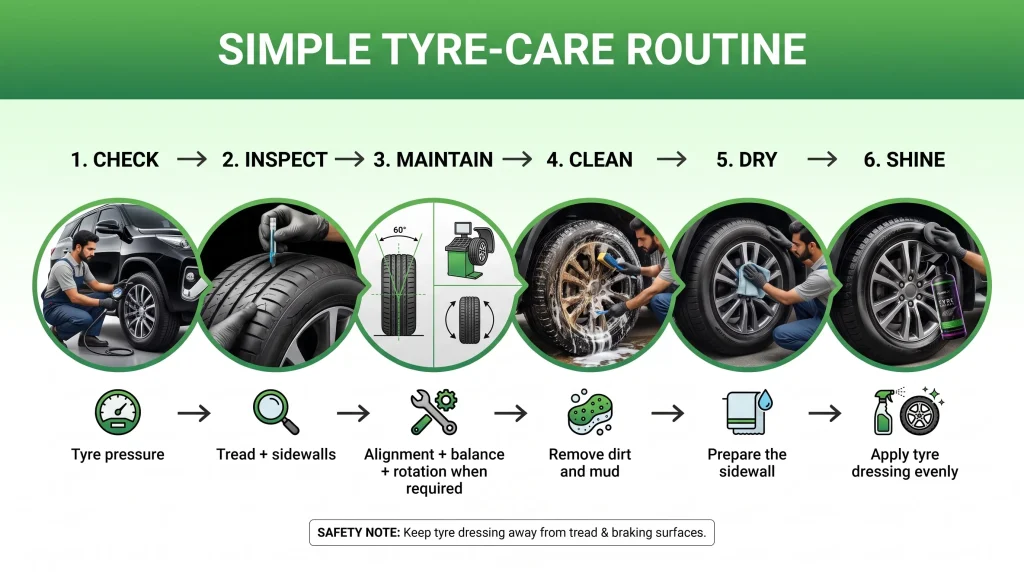
The complete process can be remembered in one simple line:
Check → Clean → Maintain → Dry → Shine
And remember: a shiny tyre can make your car look better, but a properly maintained tyre is what matters most on the road.
FAQ’s
How often should I check my tyre pressure?
At least once a month is a useful baseline, and the tyres should be cold when you take the reading. NHTSA also recommends checking before long journeys and whenever you suspect a pressure problem.
If you frequently drive long distances, carry heavy loads or encounter rough roads, more frequent checks can be sensible.
What tyre pressure should I use?
Use the pressure recommended by your vehicle manufacturer.
You can normally find it on the driver’s-door information label or in the owner’s manual.
Don’t simply use the maximum pressure printed on the tyre sidewall. That number is not necessarily the correct operating pressure for your vehicle.
Can I apply tyre shiner to the tread?
No.
Keep cosmetic tyre products on the appropriate sidewall and away from the tread and braking surfaces. FuelX specifically instructs users to avoid applying its Tyre Shiner to these areas.
Does tyre shine improve tyre safety?
Tyre shine is primarily a cosmetic/detailing product.
It can improve the appearance of the tyre sidewall, but it does not replace:
- Correct tyre pressure
- Adequate tread
- Damage inspection
- Alignment
- Balancing
- Rotation where recommended
These maintenance tasks should always come first.
Why do my tyres look grey or dull?
Road dust, mud, environmental exposure and normal ageing can make tyre sidewalls look dull or faded.
Washing removes accumulated contamination. After the tyre is clean and dry, a suitable tyre-finishing product can improve its appearance.
FuelX Tyre Shiner is specifically positioned for restoring a darker, glossy sidewall appearance.
How much tyre shiner should I use?
Use enough to cover the sidewall evenly rather than trying to create a very thick layer.
Applying excessive product can leave unwanted residue and increase the chance of sling. FuelX recommends an even application followed by a final inspection.
When should I replace a tyre?
There isn’t one single visual sign that applies to every situation.
A tyre may need replacement because of insufficient tread, significant cuts, cracks, bulges, irregular wear or other damage.
NHTSA identifies 2/32 inch (approximately 1.6 mm) as the minimum tread depth in its guidance and recommends addressing physical damage or irregular wear rather than continuing to use a compromised tyre.
If you’re unsure about a damaged tyre, have it inspected by a qualified tyre professional.
About FuelX Research & Detailing Lab
FuelX engineers high-performance automotive cooling solutions and specialized car detailing products engineered for Pakistan's demanding driving conditions. All guides and tips are validated by our technical team to ensure engine longevity and lasting vehicle protection.
Keep Your Engine Cool & Your Ride Shining
Shop FuelX certified Long Life Coolants, high-gloss tyre shine, safe car wash shampoo, and lint-free microfiber accessories.